
Egg Carton Labels and Animal Welfare
Learn which egg carton labels and certification stamps are most meaningful for the welfare of laying hens
I am proud to say that our little chicken farm is now certified by Animal Welfare Approved! We are tiny, but certification for us is a way to raise awareness of humane choices. AWA’s high standards make it an excellent choice at the grocery store, where many of the other egg carton labels are not very meaningful. Most of them imply something relevant to human health and/or poultry care, and in this article, I cover only those relevant to animal welfare and determine which are most meaningful. So excluded here are labels such as “vegetarian fed” or “omega-3 enriched”, because they have nothing to do with the conditions or care of laying hens. For ease of comparison, I pruned my findings down to the most important items and presented them in tables.
Why Care About the Welfare of Laying Hens? You can read more about laying hens and animal welfare under “Pros of Keeping Chickens” in Pros and Cons of Backyard Chickens. The typical conditions of hens in the egg industry are extremely depriving and absolutely nothing like the natural habitat of their wild relatives. Read more about natural chicken behaviors, how their wild relatives live, and how to simulate that for chickens in your own backyard in Creating a Chicken Habitat.
Egg Carton Labels and Animal Welfare
The following table is largely adapted from a portion of “How to Read Egg Carton Labels” on the Humane Society’s website (see sources below), with a few clarifications.
[table id=3 /]
Some important take home points from the above table:
- Only “Certified Organic” carries government regulated standards which must be verified by a 3rd party auditor.
- Cage Free, Free Range and Pastured labels can be used without any 3rd party auditing, and when they are, they may not be very meaningful.
- Only Pastured is defined as having access to green vegetation, BUT, as stated above, egg producers who put “Pastured” on their egg cartons were not necessarily audited. If they don’t display the stamp of an auditing organization, you can assume that they were not.
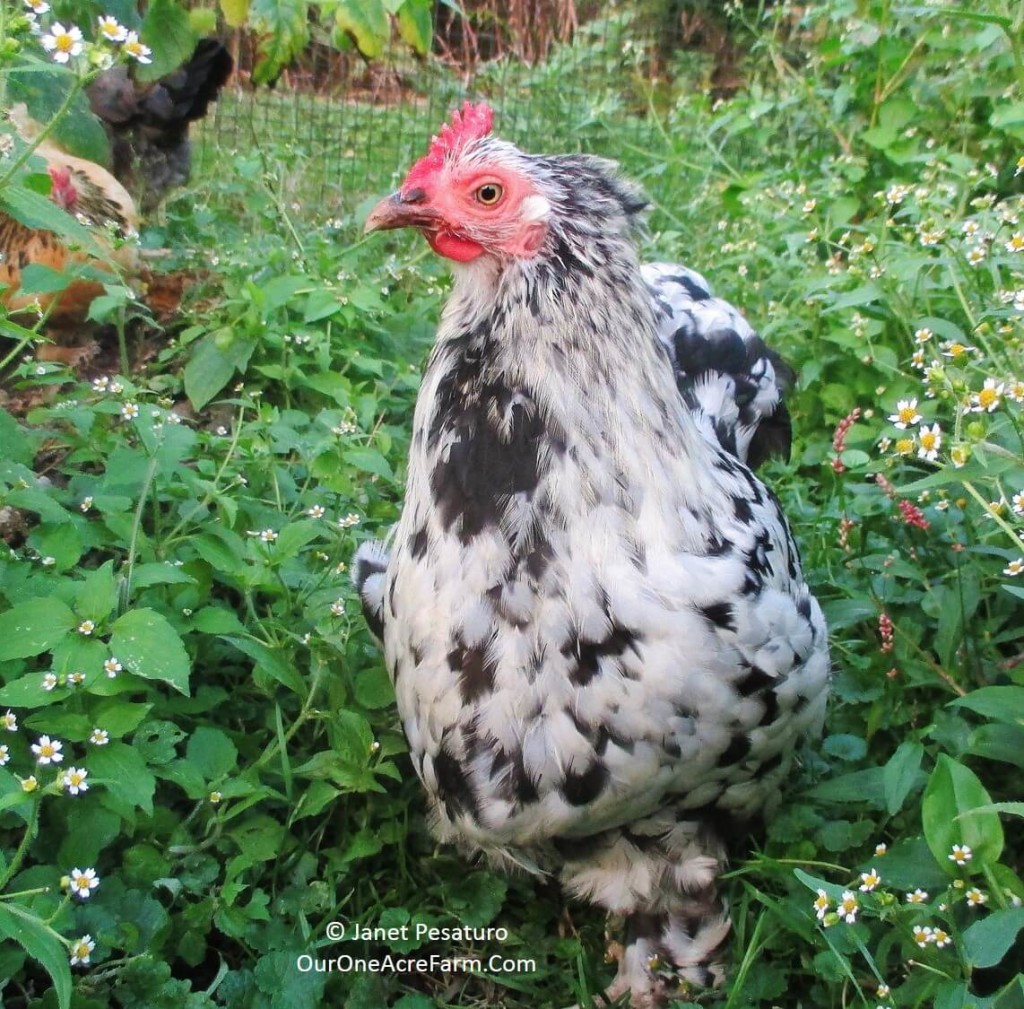
Like the chicken’s wild relatives, the domestic chicken is an active bird which prefers a diverse habitat with a variety of plant and animal foods.
Third Party Certifying Organizations
Words like “humane” and “pastured” mean a lot more when the egg carton also bears the stamp of a 3rd party certifying organization. The latter have standards which are available online, and they send auditors to farms to verify compliance. However, the standards vary from one organization to the other. One might expect “Certified Pasture Raised” to mean the same thing regardless of the certifying organization. It does not. Each auditing organization has different standards.
The table below summarizes the standards of the organizations, some of which have multiple levels of certification. For example, Certified Humane has Cage Free, Free Range, and Pastured programs. Please note that standards documents are lengthy and complex, and some organizations might amend them from time to time, or create additional levels of certification. Not surprisingly, I found errors in other articles on understanding egg labels, and I did my best to represent them as accurately as possible here. If you find something you think is in error, please leave a comment.
[table id=1 /]
A few things from the table above deserve emphasis or clarification:
- Regardless of the certifying organization, “Free Range” does not require access to pasture with green vegetation.
- Animal Welfare Approved has no minimum spatial requirement per bird on pasture. This might sound like a loop hole, but they do require that the pasture have growing green vegetation. Anyone who knows chickens knows that you won’t have growing green vegetation unless the density of chickens is very low.
- Animal Welfare Approved requires that chickens be pastured for only half the day, but when they are not on pasture, they must have access to green forage (e.g., fodder or hay).
- American Humane Certified leaves the reader with some lingering questions. Their document says that 85% of the standards must be met for a producer to earn certification. This may, in fact, be a loop hole. Which 85% would that be? Can a farm be certified “Pastured” with little or no green vegetation in the outdoor area, if all other requirements have been met?
- American Humane Certified has been criticized for lack of transparency. They do provide profiles of their Scientific Advisory Committee members, but do not reveal their board of directors, nor their sources of funding.
The winners? Certified Humane “Pastured” and Animal Welfare Approved both have clear, high standards without loop holes, and both are transparent organizations.
Finally, here’s a good infographic from Fix.com on eggs, egg production, and egg carton labels. It lacks information on the certifying organizations, but it does summarize the labels.
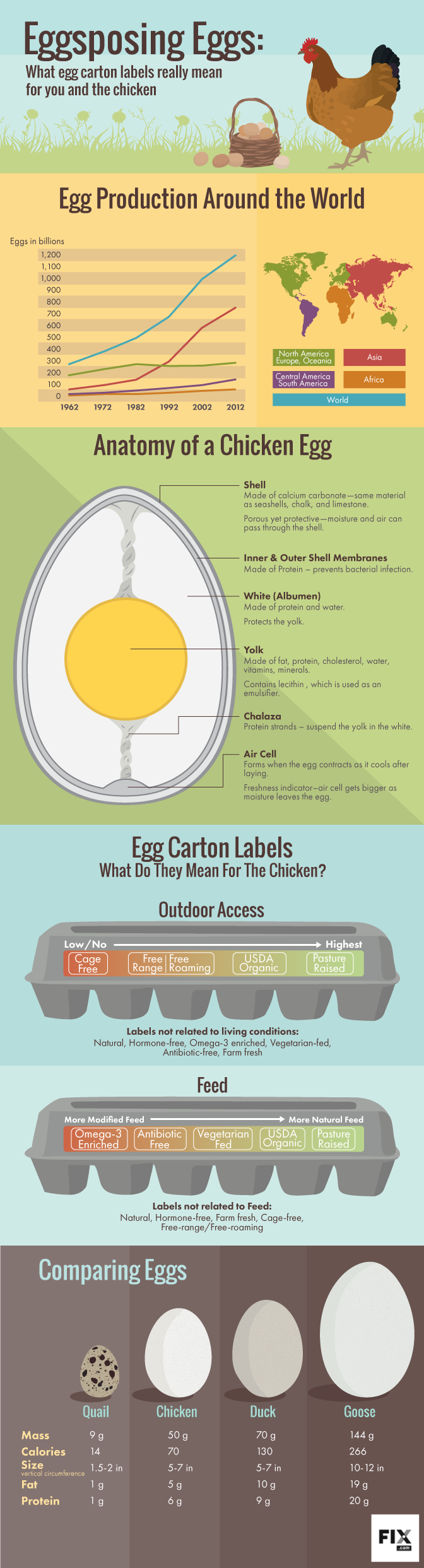
Source: Fix.com
Sources:
- American Humane Certified – Standards
- Animal Welfare Approved – Laying Hen Standards
- Certified Humane – Standards
- Food Alliance Certified Poultry FAQ’s
- How to Read Egg Carton Labels, by HSUS
- Humane Farm Animal Care Comprehensive Animal Welfare Standards Comparison By Program
- United Egg Producers – Animal Husbandry Guidelines