
Non-invasive Bumblefoot Treatment: Success Stories
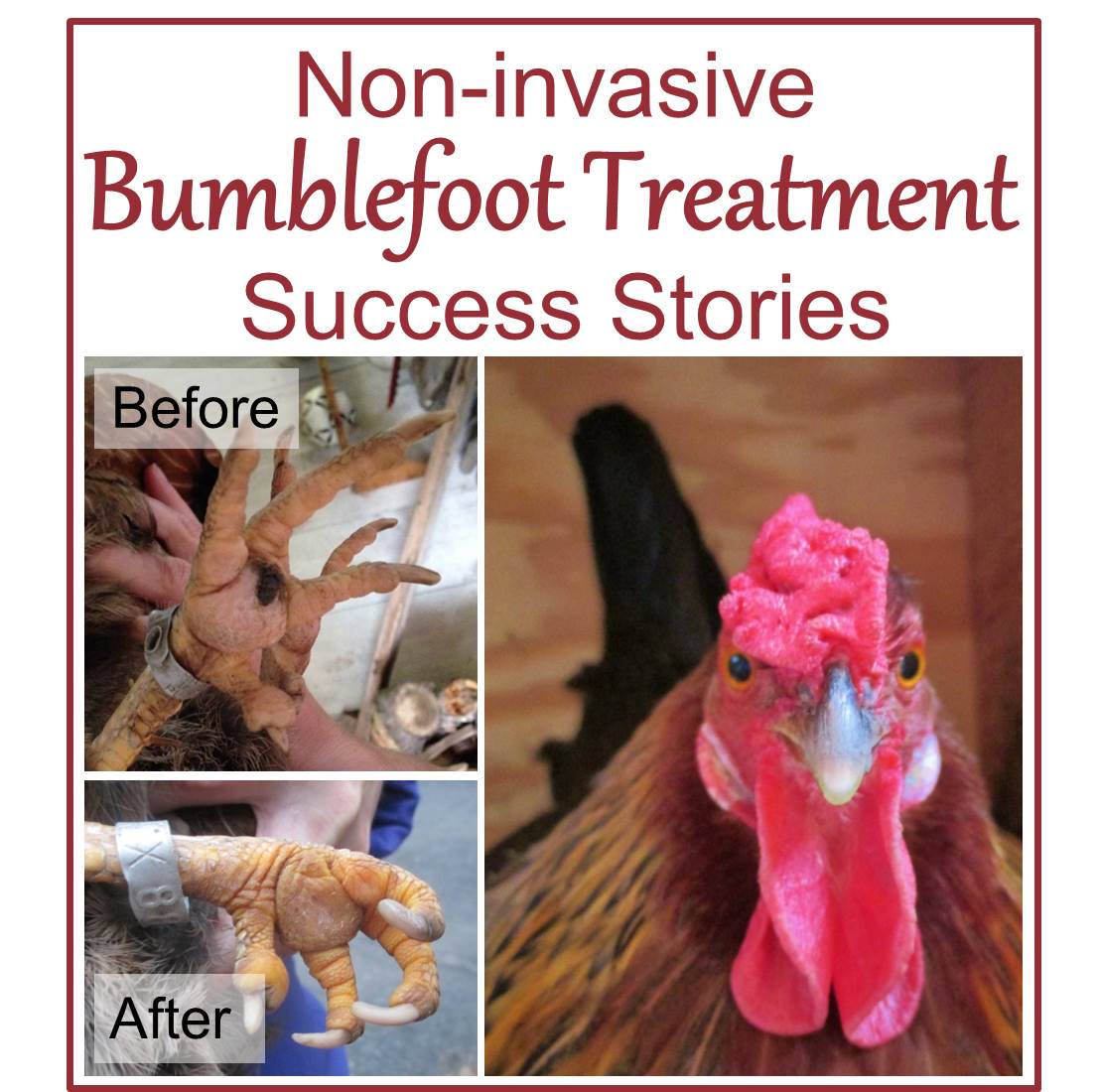
This is a follow-up to my first post on bumblefoot treatment with TricideNeo. Success stories with before and after photos are presented here.
It has been a year since I first wrote about bumblefoot treatment with TricideNeo, and since then, I’ve accumulated some success stories for which I have “before” and “after” photos. To my knowledge, there are no other online before and after photos of this treatment, so I thought I’d share these 4 cases here. One case is mine, and the other 3 come from readers. The importance of this approach is that it’s painless for the chicken and easy for the owner.
Non-invasive bumblefoot treatment: Success stories
The details of obtaining, using, and disposing of TricideNeo are covered in detail here. In brief, daily soaks of 5-10 minutes until complete healing have been recommended, based on experience with this medication in the treatment of skin ulcers on koi fish. However, the use of this medication for bumblefoot has not been systematically studied, so nobody really knows how often and for how long it should be used. Daily soaking is cumbersome for many people, and in all of the following 4 cases, soaks were done less frequently. Click here to learn more about what TricideNeo actually is.
This post contains links to online shopping, which is a way for you to support One Acre Farm at no additional cost to you. Click here for my full affiliate disclosure. Thanks for your support!
Case 1
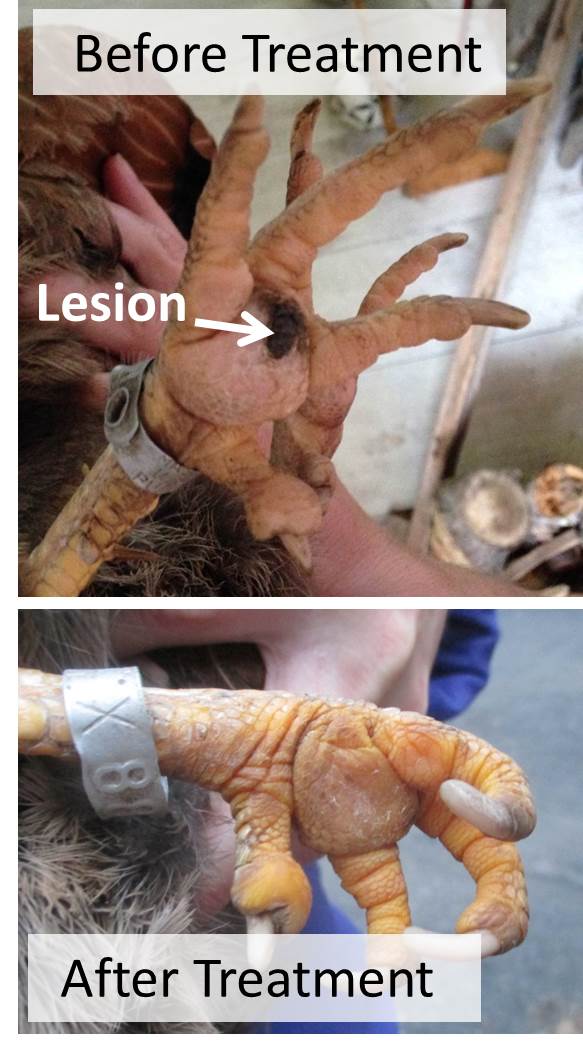
Case 1. Click for larger view.
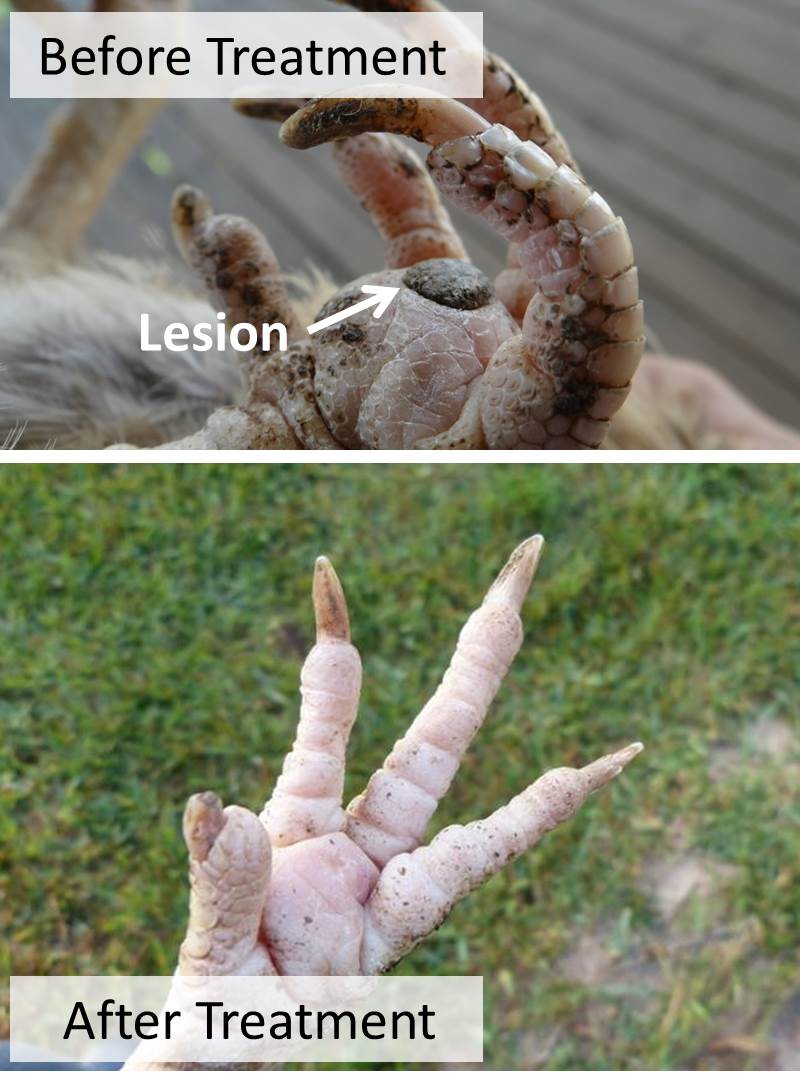
This is one of my hens. I first noticed her limping in early August, 2014, and began daily, 5-10 minute TricideNeo soaks in mid-August. The “before” photo in this case is actually after a 1-2 weeks of soaks, by which time the swelling had diminished and the limping was less pronounced. The appearance of the black scab, however, was unchanged. I needed an assistant to photograph the bottom of the foot, and did not have one until late August.
On average, I gave her 5-10 minute soaks about 4 days per week, through late October. By then, the black scab was beginning to shrink, and she was not limping at all, so I reduced soaking to 1 day per week. By late November, the scab was gone and the foot looked totally normal. The “after” photo was taken on November 24, 2014.
Case 2
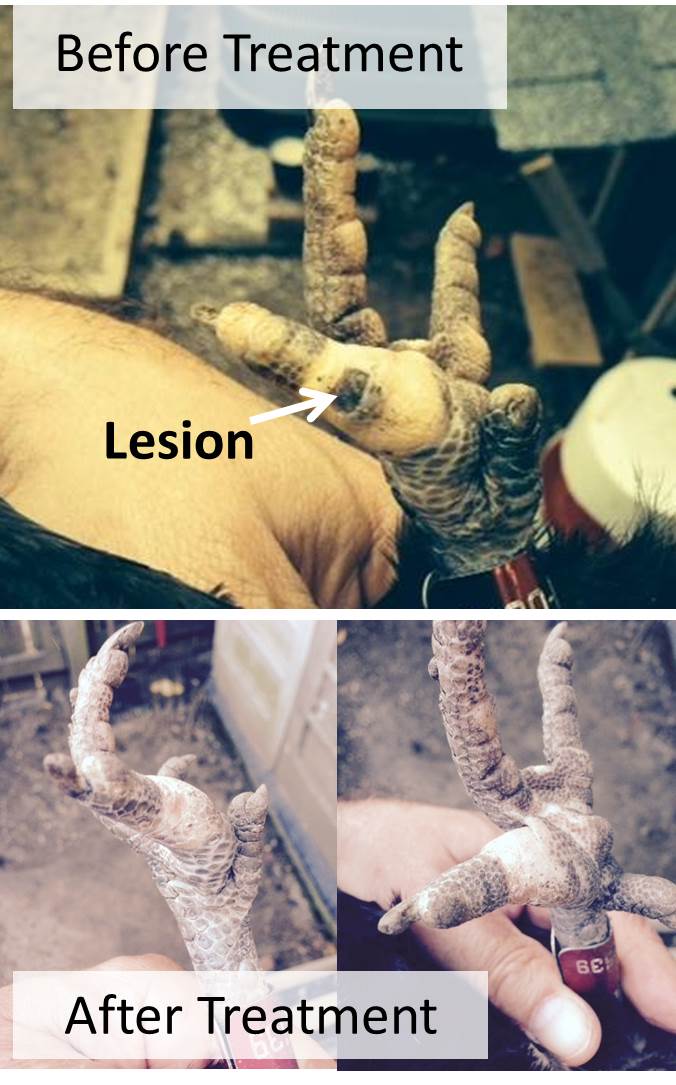
Case 2. Click for larger view.
This hen belonged to a reader who reported persistent bumblefoot despite “many months of numerous surgeries and squeezing”. He gave up on surgery and began daily soaks with TricideNeo on August 29, 2014. The “before” photo of this hen’s foot is before the TricideNeo soaks, but after numerous surgeries. After about 4 weeks of daily soaks and minimal improvement, the owner left for a 1 week long business trip, during which time the hen received no treatment. Upon his return on September 30, the lesion was completely healed.
Case 3
Case 3. Click for larger view.
This hen belongs to another reader. The owner never attempted surgery, but began TricideNeo soaks in November of 2013. Between then and late January of 2014, she gave the bird “3 rounds of soaks”, two 1-week periods, and another 3-4 day period. Swelling and redness were gone after the first 1-week stretch of soaking. The scabs gradually shrank and faded, and were substantially improved by late January. I do not know exactly when the scabs completely disappeared, but the owner provided “after” photos on July 9, 2014, to show that there had been no relapse or recurrence.
A confounding issue is that she also gave beta carotene orally (I’m not sure how often) and once applied Vetericyn VF gel spray. But since there is no consistent evidence of either beta carotene or Vetericyn curing bumblefoot, it’s not likely that they were important factors.
Case 4
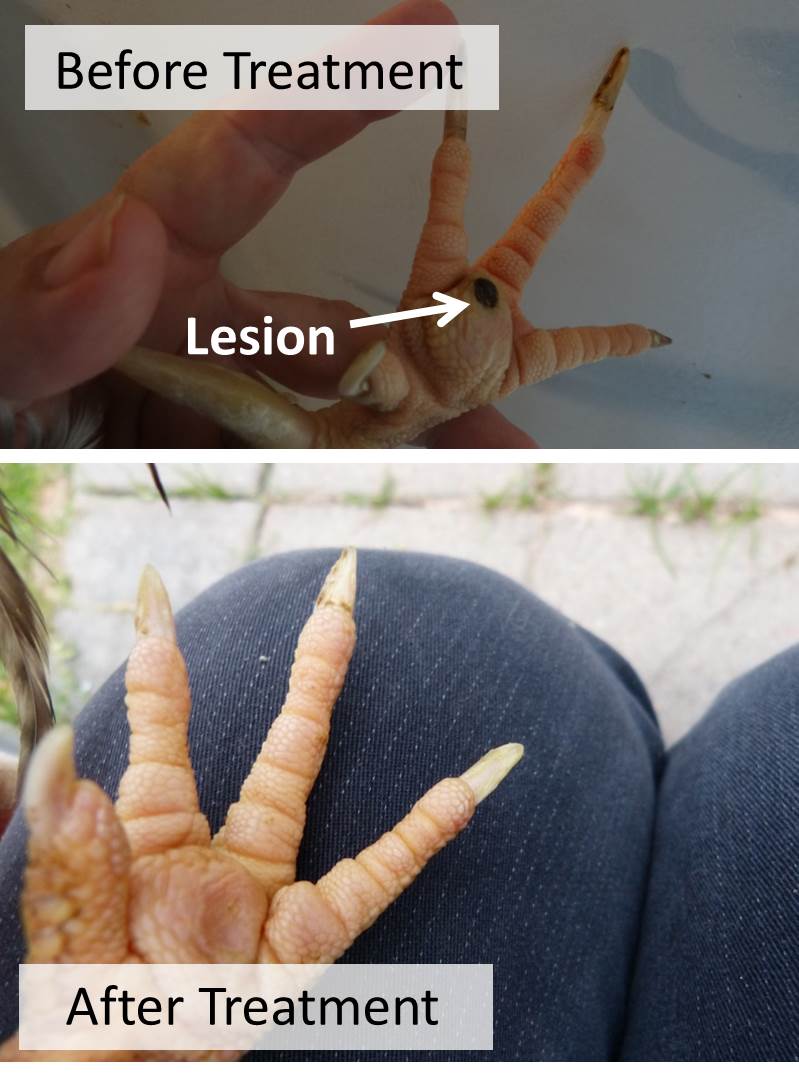
This rooster belongs to the same person as the hen in Case 3, and received exactly the same treatment during the same time period. See “before” and “after” photos below.
Final comments on bumblefoot treatment with TricideNeo
-
Case 4. Click for larger view.
These cases do not prove that TricideNeo is effective against bumblefoot, because they are merely anecdotal reports. They are suggestive, but they are not proof.
- At this point in time, there are no published placebo-controlled studies of the effectiveness of TricideNeo on bumblefoot (to my knowledge). Anecdotes are all we have.
- Anecdotal evidence suggests that daily soaking is unnecessary. And, if future controlled studies show that TricideNeo is an effective treatment for bumblefoot, additional studies to determine the optimal length and frequency of soaks should be done.
- None of these 4 cases were severe (extremely large). Whether this medication would work for severe bumblefoot remains to be seen.
What has been your experience with TricideNeo for bumblefoot? If you try it in the future, please take photos of the foot before and after treatment. Email them to janet (at) OurOneAcreFarm (d0t) com, along with a summary of the treatment, and I may add them to this post. I would also like to hear about failures with this treatment!
Shared on: Tuesdays with a Twist, Homestead Blog Hop