
Hunting Ethically with Mind, Body and Soul: An Interview
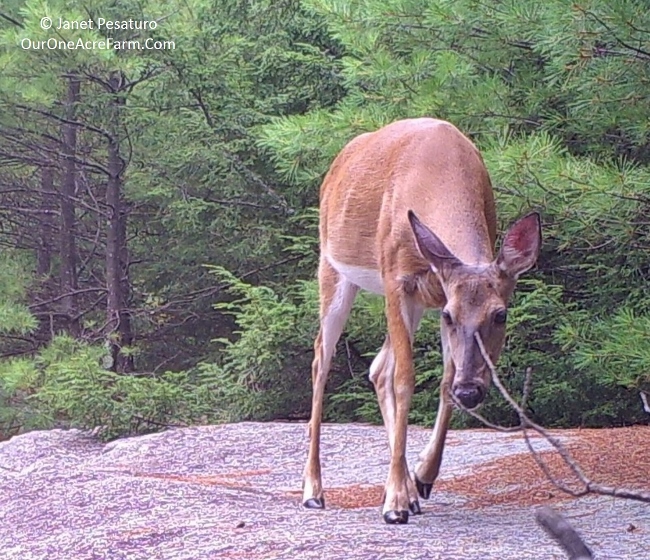
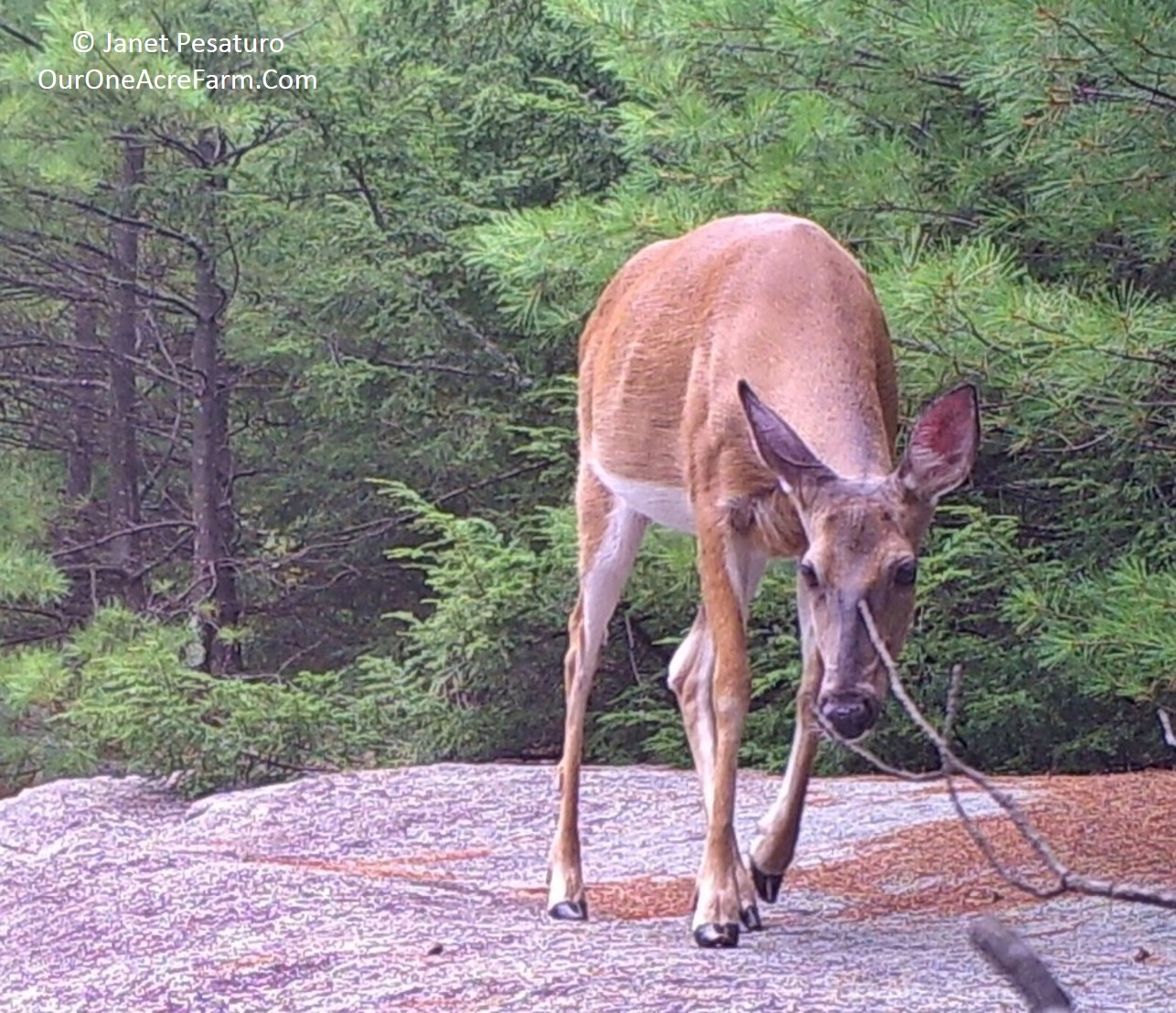
White-tailed deer caught on trail camera
What do the concepts of “sustainable”, “local”, and “humane” food choices bring to mind? Most people probably envision farmers markets, organic gardening, pastured beef, free range chickens, and ugly tomatoes. The hard core types might also fancy permaculture and aquaponics. And perhaps a few people imagine foraging for farm weeds, too. But most people don’t seem to think of hunting – or at least they rarely bring it into discussions about responsible food production. Yet meat from free and wild animals is more humane, more healthful, and less polluting than meat from livestock. That’s just my view. But because I don’t hunt, I interviewed a friend who has spent many hours on the tree stand pondering these issues. Meet Rick Brackett, Land Manager and GIS Specialist for the Monadnock Conservancy in New Hampshire, and fisherman/hunter since childhood.
This post contains links to online shopping, which is a way for you to support One Acre Farm at no additional cost to you. Click here for my full affiliate disclosure. Thanks for your support!
Hunting Ethically
Before I jump into Rick’s thoughts on the matter, I’d like to offer an explanation for hunting’s bad reputation amongst non-hunters who strive for ethical eating. Many of us have had little interaction with hunters, and those that do come to our attention are usually the bad eggs. Here’s what I knew of harvesting wildlife, before I made the effort to learn more:
- The lout who threw a trash bag containing a decapitated deer on the side of the road
- The trapper who picked my brain for tracking tips so she could consummate her home decor with a stuffed bobcat
- The deep sea fishing guide who stomped on the dog fish and then broke their necks before tossing them back into the ocean. (Dog fish are edible and are used for food on the other side of the Atlantic, by the way.)
None of those experiences left me feeling good about pursuing wild animal fare, but, I eventually learned, many hunters behave far more ethically. I think you’ll agree that Rick is one such person. For him, hunting is an activity for the whole self: mind, body, and soul. I hope you enjoy reading his views.
Food for thought
Rick’s thoughts about hunting have evolved over the years. His Dad’s hunting adventures made it seem fun and exciting, and he awaited his first hunt with great anticipation. He began hunting at age 10, for squirrels, and quickly learned “it’s not always fun and adventure but patience, work, commitment, and learning.
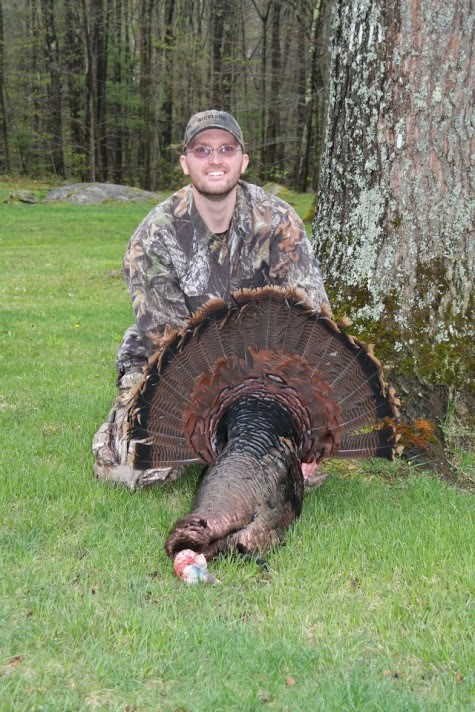
Rick with a turkey from his most memorable hunt.
And Rick grew to love the learning. “Hunting is an excuse to sit quietly in the woods for hours at a time… constantly learning about the prey and adjusting techniques based on what you learn.” One of his most memorable hunting experiences involved such learning and adjusting. It was a turkey hunt.
Rick explains, compared to deer hunting, turkey hunting involves a lot more action and thinking on your feet. After scouting and determining the right spot for an ambush, you get out there at dawn to imitate the call of the hen. Hopefully (and often immediately), the male turkey answers with his “thunderous gobble”. But sometimes the real hen continues to call, and you’re essentially competing with her for the male’s attention. “Sometimes you get into a calling battle with the hen and have to give her a piece of your mind in turkey talk….You’re actively learning, adapting, and implementing over the course of the discussion.”
Rick saved the tail feathers of the male turkey he shot in a Town Forest protected by a conservation easement held by the Monadnock Conservancy where he had just begun working. The feathers serve “as a reminder of the life taken, the experience, and the tangible benefits of the work I do at the Conservancy for wildlife and people.”
By “tangible benefits” Rick is referring to wildlife management issues, and these have become more important to him than the adventure and excitement of hunting. As humans convert habitat to subdivisions, wildlife must either adapt to the suburbs where they can become pests, or die of starvation. “I would rather capture some of the natural mortality…than letting wildlife starve through winter.” The deer population, in particular, has burgeoned in suburban-rural areas, adding to the spread of Lyme disease, and also to the spread of a parasite which is fatal to moose. Rick feels it’s his responsibility as a hunter to help with “mitigating any deleterious effects some wildlife may have on people, property, or other species as long as the hunted species is able to maintain a sustainable population.” He adds “If any game species were to be in decline I would not hunt that species.”
I suspect the idea of hunting to “manage” wildlife will stir up some discussion. There are times when it’s eminently reasonable to harvest wildlife for food, but I think we humans have a long way to go in learning tolerance for certain species. See my post on understanding and appreciating coyotes here.
Sustaining the body
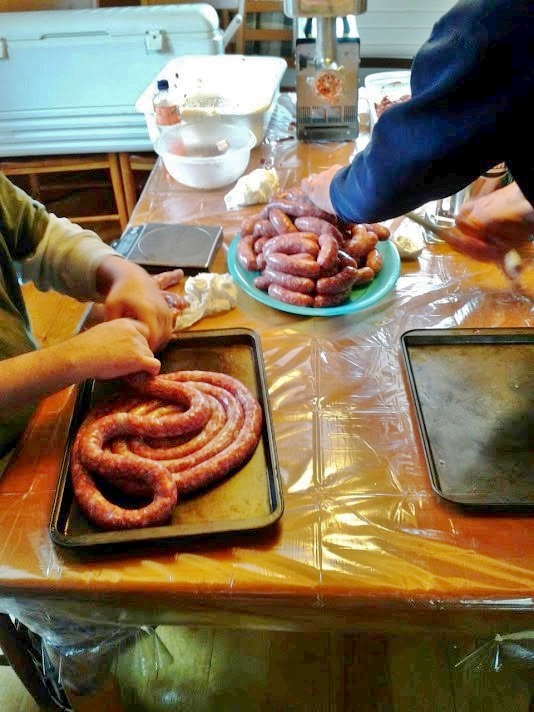
Making venison sausage
“I do not hunt for trophies; I hunt for food,” says Rick. I don’t know about you, but that wins me over immediately.
“I choose to eat meat. I see it as natural for humans to eat meat.” Rick’s thoughts on that have been challenged by his vegan and vegetarian friends, and he readily acknowledges that some people are able to thrive on a vegan diet. But he remains at peace with his choice. “We evolved as omnivores and our bodies and minds generally develop and function best when we have access to a balanced diet with all things in moderation….In terms of personal nutrition, wild game is the best source of meat, because “you don’t get the antibiotics, vaccines, growth hormones, and other potential threats to human health.” (Click here for more on the health benefits of wild game.)
And, wild game is more flavorful: “Today beef and pork and even turkey and chicken flavor is dependent on the fat content. Game is rich in flavor because it eats a varied diet, uses its muscles, and takes a long time to grow.”
Rick aptly points out that supplementing his diet with wild game reduces reliance on food from factory farms, which is arguably the worst in terms of animal welfare, personal health, and environmental impact. “To me it is kinder to hunt and fish for as much of my meat as possible to reduce my personal demand on industrial/factory farming and subsidize my overall meat consumption with game so that I can afford local meat options for the rest of my family.”
And kindness to animals is as much a priority for Rick as it is for many non-hunters.
Soothing the soul
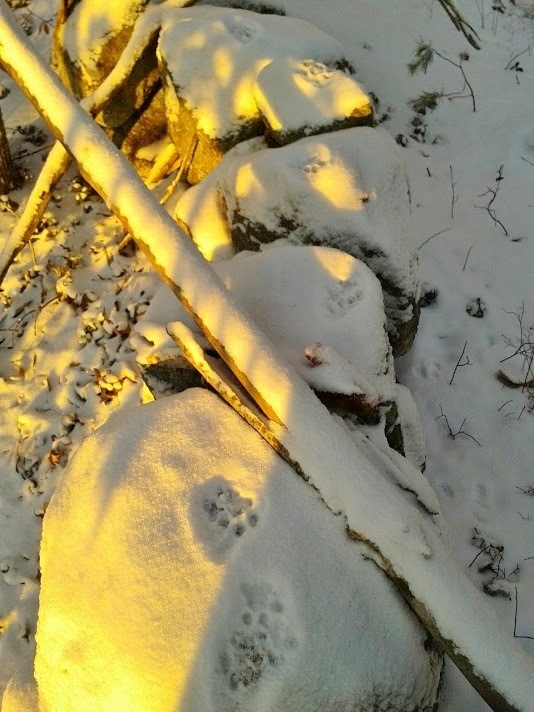
Hunting makes Rick feel connected to nature, and many of his favorite hunting experiences, like finding these bobcat tracks, have nothing to do with getting his quary.
If meat is “murder”, then I’d have to say eating anything is murder, for consumption of anything leaves less of it for wildlife. Regardless of diet, humans compete with animals for food, as well as space to live and grow food. Animals might also be dashed under the plow or poisoned by pesticides, in the name of vegetable food production. The difference is that hunters actually see the animals who die to fill their plates. Perhaps it is for this reason that ethical hunters like Rick see the reality of their impact in full color. They don’t need to reduce it to a black and white alarmist chant.
Rick acknowledges that “hunting is wonderful from the stand or blind and at the dinner table but there is a lot of not so great aspects between pulling the trigger and putting the fork in your mouth.” He recalls his first deer. He was 16, and proud of the accomplish, but “struggling with having killed something”. In fact, each time he a makes that life or death decision for another animal, “it is a chance to reassess whether I feel like what I am doing is right or wrong.”
Once he came close to retiring his gun for good. His second deer “ran 15 yards, fell and passed away in my sight. I watched as it struggled for what seemed like forever but was less than a minute….That experience shook my resolve and made me question whether I wanted to continue to hunt…The last thing I want to do is watch something die. The glassy eyes and cold body still get to me.”
You might expect hunters to deny the emotional capacity of animals, as a way of distancing themselves from whatever suffering they cause. Not all hunters. “I’ve had cats and dogs…since I was young. I loved all of them….They each had/have their own personality and way of relating to me. I strongly believe that animals have a consciousness and emotive quality beyond what most people grant them.” No denial there! In fact, Rick acknowledges that he might be unable to kill an animal with whom he has a relationship: “I firmly believe that I would make a bad farmer because I would be hard pressed to kill a lamb after caring for it and getting to know it for months. If faced with that choice I might even go vegetarian.”
As hard as it is to kill for food, animals have to die for us to live, one way or another, and there is something positive about doing it and observing it directly. It forces one to realize that Homo sapiens is part of Nature, an animal within the complex food web “as opposed to separate and above as I feel a lot of folks feel now….At one point in time our species was wildlife, we were predators and prey. Somewhere down the societal and philosophical train tracks humans became separate and above. I dislike that system. I like the reconnection to the environment I get from hunting and being an active participant in the natural cycles.”
As a hunter out there among wild and sometimes dangerous animals, Rick recognizes that “someday a bear, boar, or mountain lion might hand me a Darwin award.” Now that’s accepting one’s place within the food web! Perhaps if we could all see the animals who die so we can live, more of us would understand our linkage of interdependence with all the other species. Maybe then we’d take better care of them.
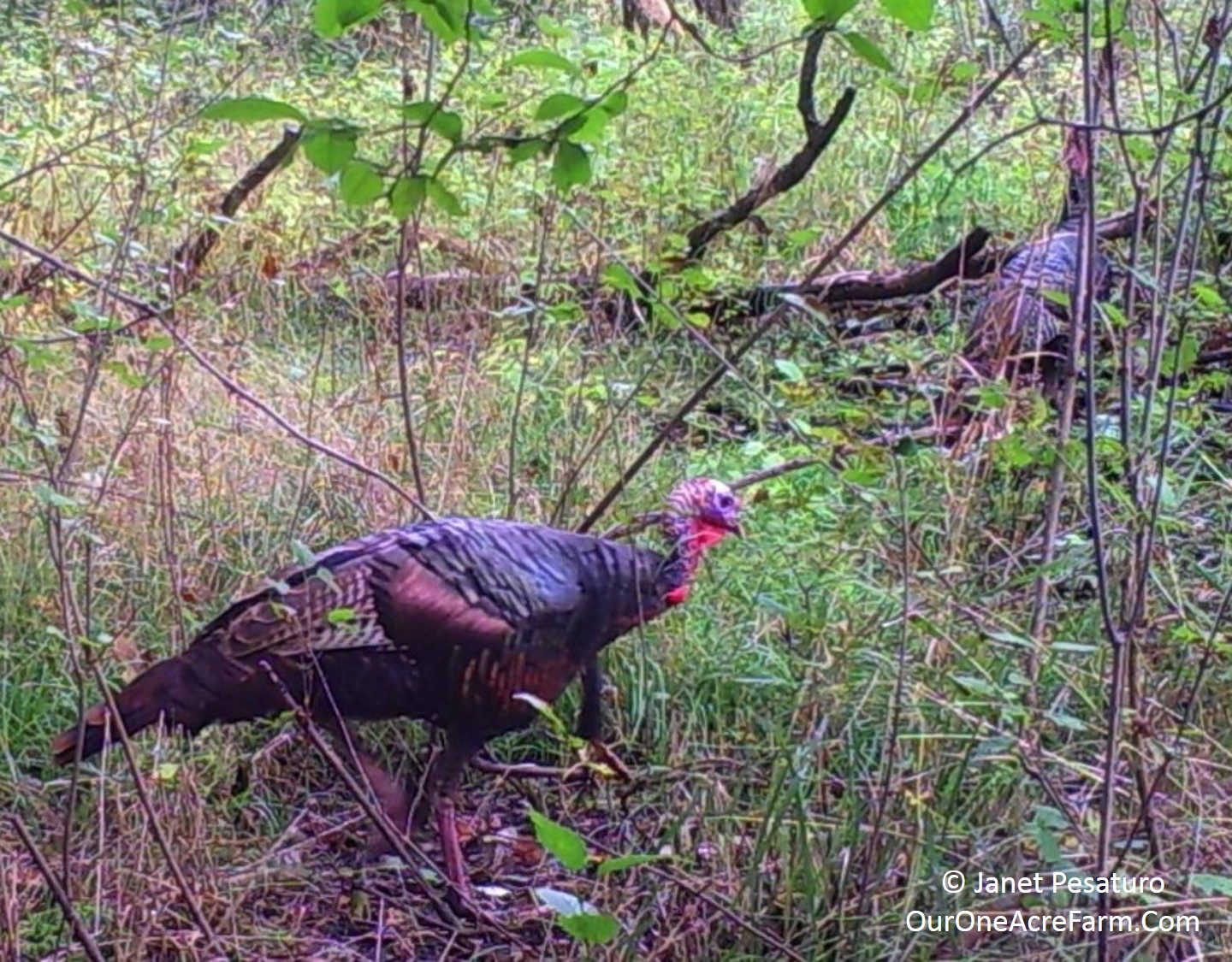
Wild turkeys caught on a camera trap
Share your thoughts! Is hunting humane? Is it more or less humane than farming? How does its environmental impact compare to that of farming livestock and crops? Are humans a part of, or above, nature?