
Poultry Predator Identification: A Guide to Tracks and Sign
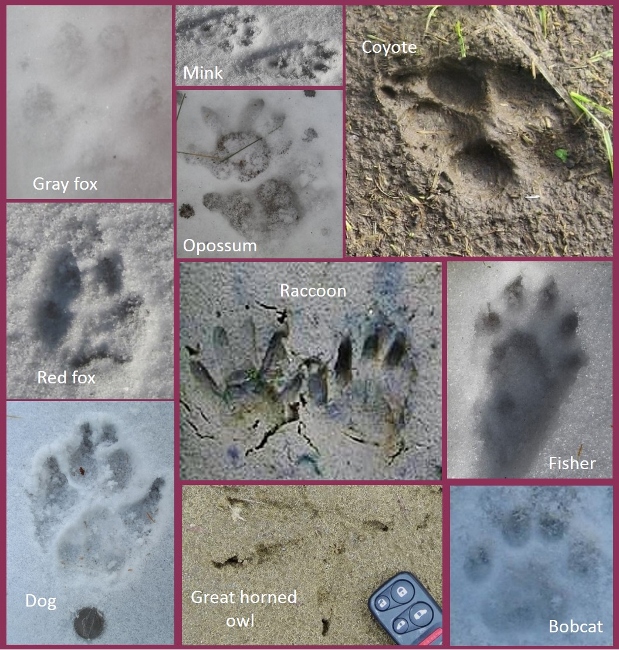
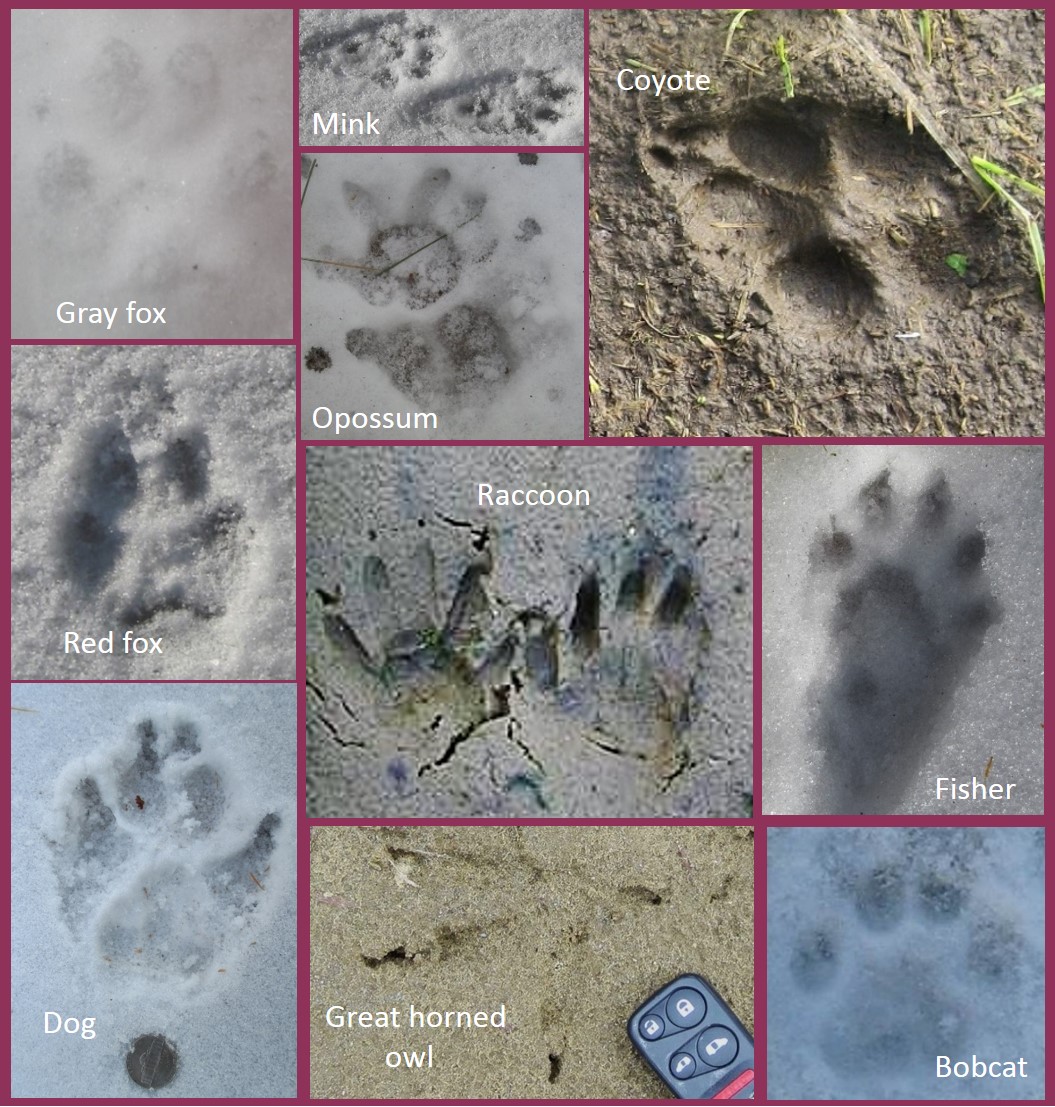
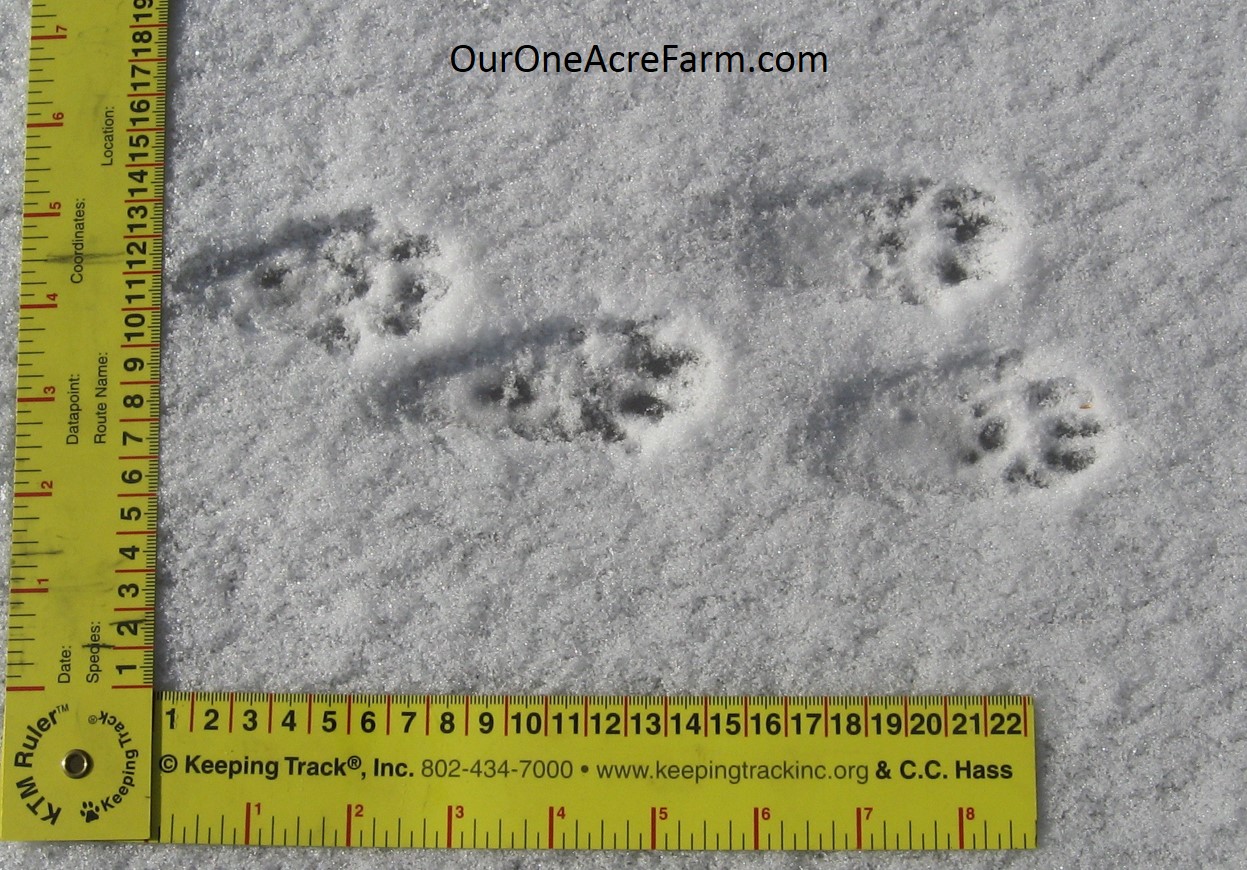
The photo shows tracks of some of the most common chicken predators, but this post also covers scat, feeding sign, and behavior.
This is a fairly thorough guide to common poultry predators of the US, with emphasis on tracks, scat, and behavior. Instead of simplified drawings, I use photos of a actual tracks I have found, to give a better sense of what they really look like. This is more detailed than many other guides for poultry farmers, because reliance on overly simplistic information leads to misdiagnosis, misunderstanding, frustration, and higher impact intervention (shooting, trapping, and poisoning). My intention is to educate and inspire a respect for wildlife. Hopefully, this will encourage responsible livestock protection, which allow you to coexist with predators. And if you’re interested in wildlife, check out my blog dedicated to tracking and photographing wildlife with motion sensitive cameras, at Winterberry Wildlife.
Things to keep in mind when determining which predator:
- Animals are not machines, so don’t expect them to always leave the “classic” sign. Behavior is influenced by many factors. A hungry animal will eat more than a not so hungry animal. An animal weakened by exhaustion, starvation, or illness will be less able to carry prey away. A migrating individual will not be familiar with your habits, and might take risks that resident animals would not. A predator startled during an attack might flee before leaving classic sign.
- Track appearance varies enormously depending on substrate, weather, and time elapsed since the track was left. Perfect, textbook tracks are rarely seen. The examples in my photos are among the clearest and best I’ve found in 10 years of photographing tracks. Tracks you find near your coop may be far less distinct.
- There is much more to tracking than what I’ve presented here. For example, knowledge of trail patterns is often necessary, but that is beyond the scope of this. I encourage you to read more about tracking.
This post contains links to online shopping, which is a way for you to support One Acre Farm at no additional cost to you. Click here for my full affiliate disclosure. Thanks for your support!
Poultry Predator Identification
Humans
Suspect this clever predator when birds disappear from a secure area, leaving no trace. These are sneaky beasts with dextrous front paws and large brains, capable of tremendous damage despite fencing, gates, locks, and guardian animals. Seriously, I include ourselves here to drive home the point that predators are not the bad guys and we the good. We, too, are predators. We have much more in common with wild animals than we care to admit.
Dog Family
This includes dogs and wild canids, such as wolves, coyotes, and foxes. Tracks show 4 toes, usually with claw marks. Scats vary, depending on the animal’s diet.
Dog
Domestic dogs are usually well fed and don’t eat their prey. Tracks of all members of the dog family are similar, but those of dogs vary more than those of wild species, because there are so many different breeds.
-
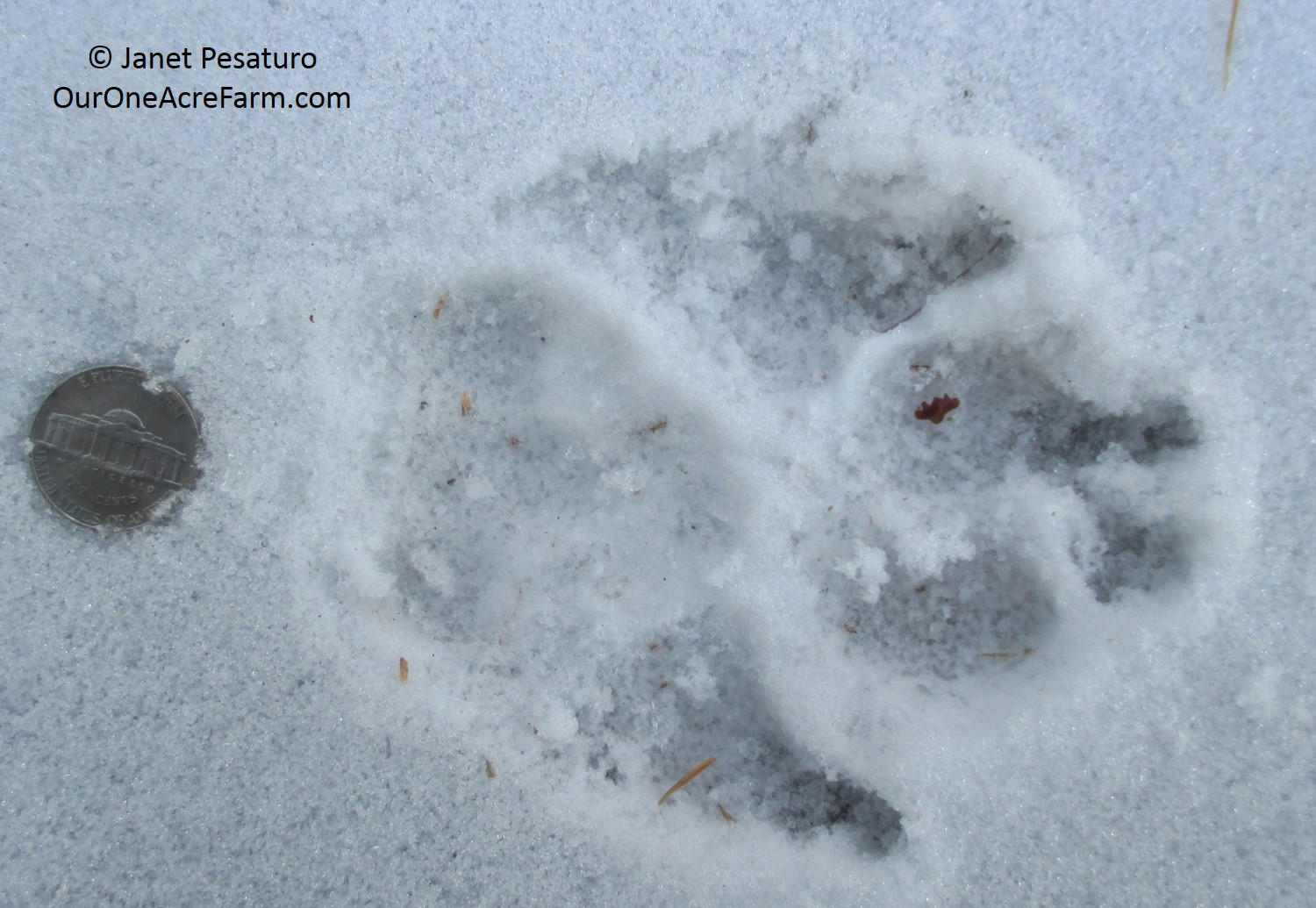
Dog tracks often show prominent heel pad, blunt nails, and outer toes that can point outwards.
Tracks usually show a very prominent triangular heel pad and prominent claw marks. Outer toes might stick out to the side somewhat.
- Scat bears the sign of a diet high in grains: smooth and grainy, without any twist.
- Suspect them when many birds have been killed but none eaten, and they don’t bear the typical signs of other wild predators.
Coyote
Eastern and western coyotes are considered the same species, but there are important differences. Western coyotes are much smaller (and therefore tracks and scats are smaller), more solitary, and focus on smaller prey, such as rodents and rabbits. Eastern coyotes are intermediate between western coyotes and wolves, and in fact carry a small percentage of wolf DNA. They are more social than western coyotes, may hunt in small packs, occasionally take larger prey, and may go after livestock much larger than chickens. Read more about eastern coyotes here.
- Tracks are very streamlined, with all 4 toes pointing forward, the 2 leading toes close together, pinpoint claw marks, and heel pad impression fainter than toe pad impressions.
- Scat depends on the diet of this omnivore. It may contain fruit or berries, or fur or bone fragments. If it contains fur, it appears twisted. Scats tend to measure 1/2 inch to 1 and 1/4 inches in diameter. Larger bone fragments in scat help distinguish coyote from foxes, which are much smaller and cannot crunch larger bones in their jaws.
- Scat is often left at prominent locations, and sometimes on elevated surfaces (stone or log).
- One or many birds may be killed, all might be carried away. Piles of feathers and even some dead birds might be left behind. You might notice evidence of biting on the back of the neck (broken neck, neck feathers missing).
- Usually active at dawn, dusk, and during the night, around human habitations, but bold enough to venture out in broad daylight when hunger calls and livestock appear easy to take.
- Will dig under fences and chew through chicken wire.

Coyote tracks are streamlined, and scat may show bone fragments that are somewhat large, as seen here.
Fox
There are several species of fox in North America. Two common, wide ranging species are the red fox and the gray fox. Both hunt singly (except when teaching young) and focus on small prey. The largest individuals weigh only about 12-15 lbs, and many are half that weight. Carrying an adult standard sized chicken is a challenge for this small predator, which may drop its prey to make a quick escape when frightened.
- Tracks tend to be streamlined, but smaller than those of coyote. Heel pads appear much smaller than those of coyote tracks, due to an abundance of fur on the bottom of the foot, which obscures the heel pad print. Here’s a post on tracking red fox and distinguishing their tracks from those of coyote and dog.
- Scats vary by diet, and look like coyote scats but smaller – no more than 3/4 inch in diameter. It appears twisted when it contains fur.
- Foxes are notorious for leaving scat where it’s very noticeable, especially on elevated surfaces (on a stone or log, for example).
- Red fox urine smells like skunk spray, but much fainter. You can get a whiff of it in the air, but it doesn’t knock you over. Gray fox urine smells similar, but even fainter. You can’t smell it unless you put your nose close to it.
- Usually active at dawn, dusk, and during darkness where human activity is high, but will hunt during daylight if prey appears easy to get.
- Will dig under fencing and chew through chicken wire.
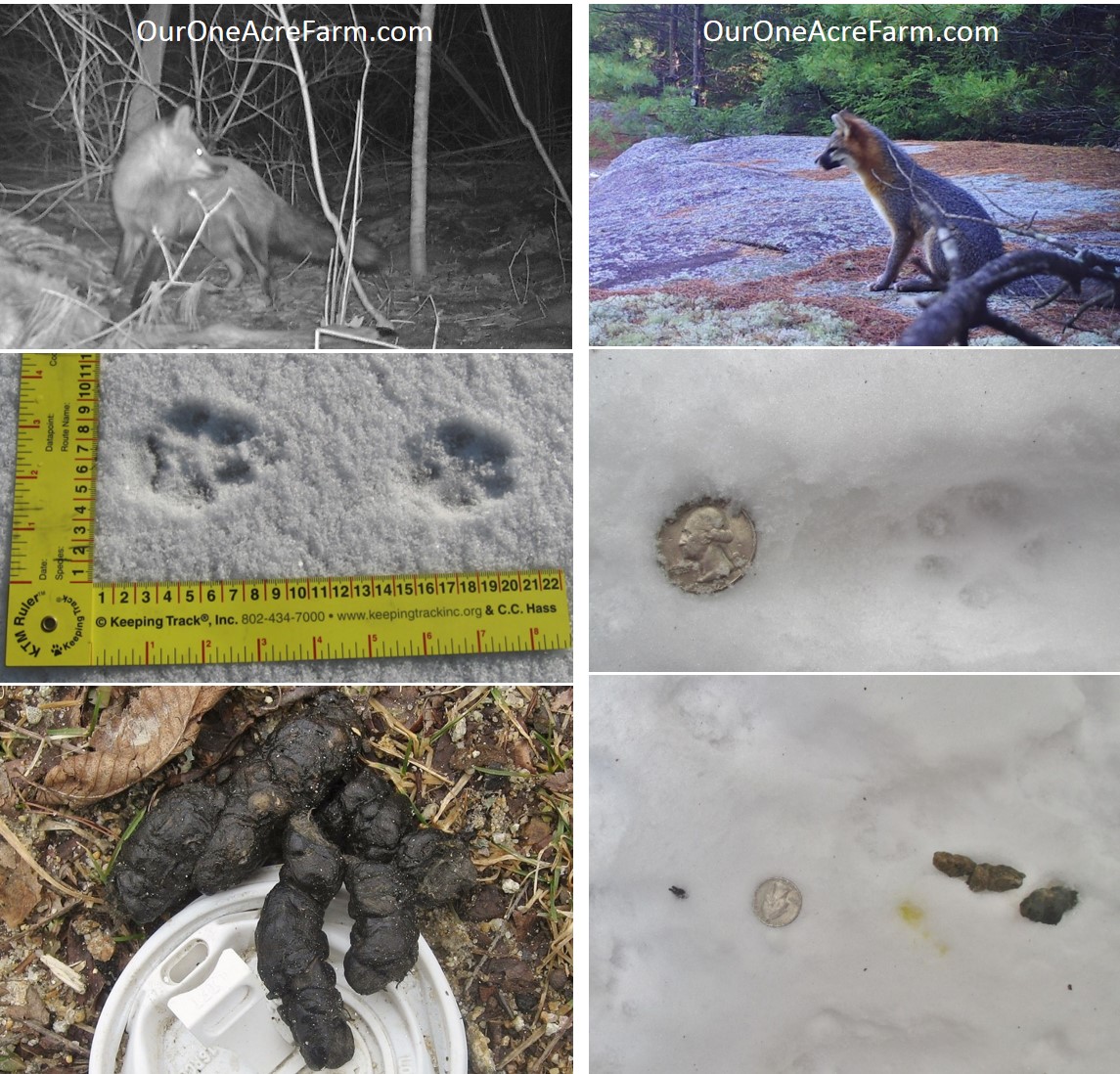
Left column: red fox and its tracks and scat. Note that scat is prominently located on a piece of trash. Right column: gray fox and its tracks and scat. Note that both species have small heel pads, and that of red fox is often nothing more than a bar. The red fox is bolder around people, and is the more common chicken predator.
Cat family
This includes domestic cats and wild felines, such as bobcats and cougars (also called puma, panther, and mountain lion). The lynx, a large footed, northern relative of the bobcat, will probably also take small livestock when easily available, but they don’t live in the suburbs like bobcats. Feline tracks show 4 toes, usually without claw marks, and a large heel pad shaped somewhat like a trapezoid.
House cat
Many house cats will kill young chicks, given the opportunity. Hatchlings may be entirely consumed. Wings, feathers, head, and/or feet of growing birds may be left behind. The largest, boldest or hungriest will attempt to kill adult, standard sized chickens. Growing birds are in a gray area. My cats generally ignore pullets over about 6 weeks of age. All of my cats, however, study baby chicks with great interest, so I keep the chicks inaccessible.
- Tracks are small and round, measuring about 1 to 1.5 inches in diameter.
- House cats usually cover their scat. When you see one, it usually appears segmented but not twisted. It may contain fur, if the cat has been feeding on small mammals. It might contain a small amount of grass, but will never contain a lot plant matter. It will not contain large bone fragments, because domestic cats cannot crush large bones.
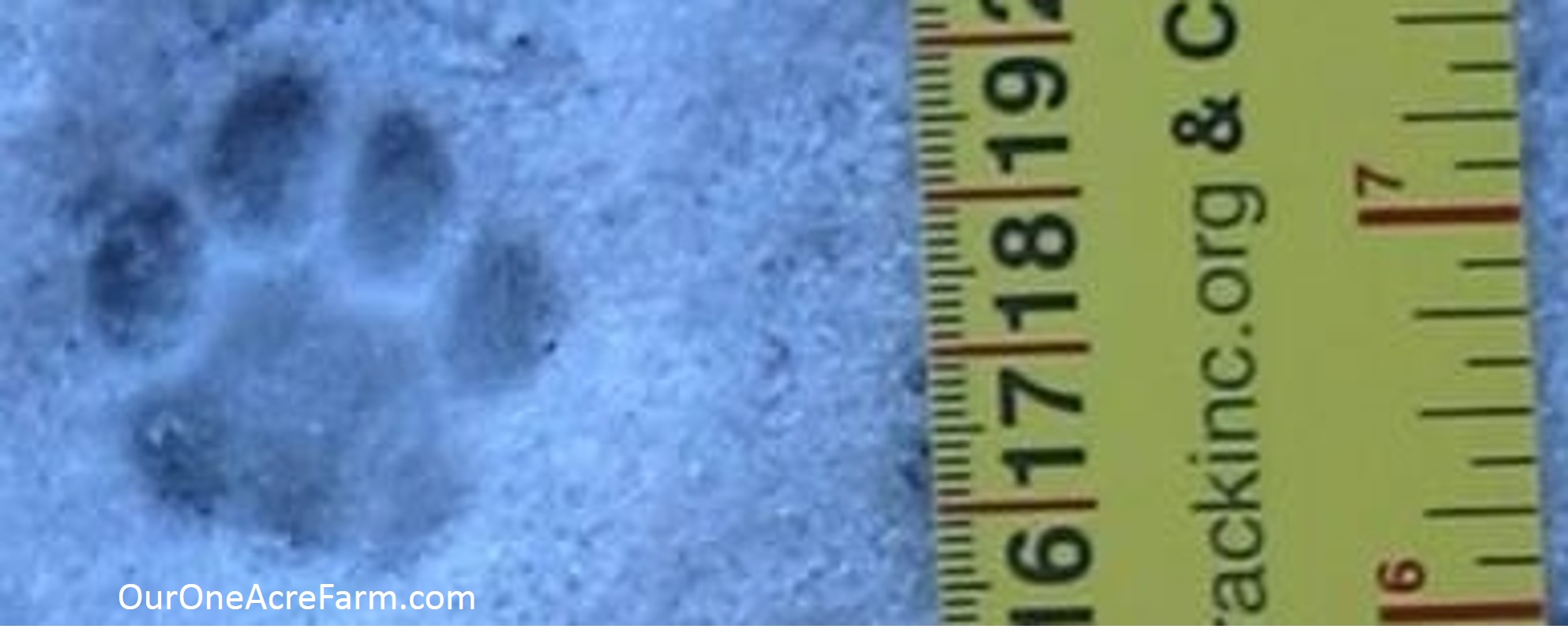
House cat track
Bobcat
This wild feline is about twice the size of a house cat, and frequents rural, suburban, and occasionally urban areas. In some parts of the US, bobcats have become bold around humans, and might pose a significant threat to small livestock at any hour. Bobcats are common here in Massachusetts, but are typically reclusive. That may change as they adapt to the suburbs.
- Tracks are virtually identical to house cat track, though larger, measuring about 1.5 to 2.5 inches in diameter. More details about tracking bobcats here.
- Bobcats usually do not cover their scat, and frequently place them in obvious locations. Like house cat scat, bobcat scat usually appears segmented but not twisted, and never contains a lot of vegetation, nor large bone fragments.
- Bobcats frequently spray urine onto vertical surfaces, much like intact house cats. It smells just like house cat urine.
- Bobcats tend to bite the back of the neck and shoulders of adult chickens.
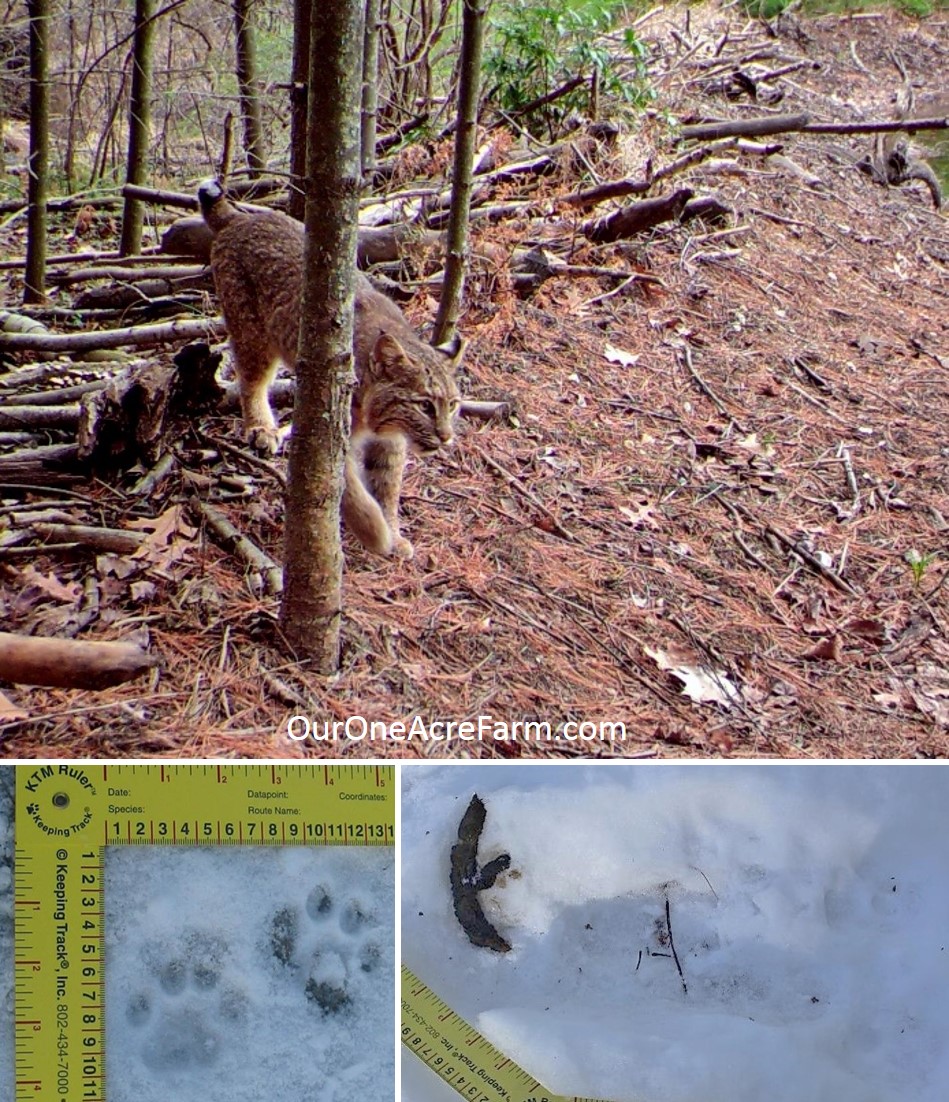
Trail camera photo of bobcat, and bobcat tracks and scat.
Cougar
These large cats are not common chicken predators because they prefer much larger prey. However, any poorly protected livestock, including chickens, can appear on the cougar’s menu.
- Track measures 2 and 3/4 to 4 and 3/4 inches in width, and has the same general appearance as tracks of the smaller cats.
- Scats are about 3/4 to 1.5 inches in diameter, placed in the open, in a scrape (cat scrapes ground with front paws), or covered.
- Large animals are killed by a bite to the back of the neck.
Weasel family
This group of capable hunters includes, in North America, fisher, marten, mink, river otter, badger, wolverine, and 3 species of small weasel. Otters eat mostly fish and crayfish and are not likely to take chickens. We don’t have marten, badger or wolverine in Massachusetts, so I have not included them.
Fisher
Often called a “fisher cat”, this member of the weasel family is not a cat at all. It usually weighs 5-15 lbs, but the long tail and rich pelt make it look larger. Fishers eat mostly small rodents, rabbits, and carrion, and will take small livestock if the opportunity arises.
- Tracks show 4 or 5 toes (the smallest one does not always register), and a C-shaped metacarpal pad. There is also a heel pad which may or may not show in the track.
- Scats look a lot like fox scats, and like the fox, the fisher often places scat on elevated surfaces.
- Fishers are excellent climbers and diggers.
- More active at night, when living close to humans, but occasionally seen during daylight, especially in the northeast, where they’re adapting well to suburbs.
- May kill many chickens in one visit, in effort to cache for future consumption.

Photo of fisher (“fisher cat”) from game camera, and fisher track, scats, and urine.
Mink and smaller weasels
Mink are semi-aquatic, and hunt both on land and in water, and will take chickens when available. They weigh only 2-4 lbs, and their long skinny bodies can fit through small openings. Weasels are even smaller, and the smallest ones can slip through a 1 inch diameter hole. Weasels are probably more interested in rodents dwelling in livestock housing, but will kill chickens as well.
-
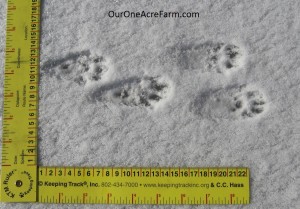
Mink tracks. Weasel tracks are very similar, but smaller.
Tracks and trails look like miniature versions of fisher tracks and trails. The track width is usually about 1 to 1.5 inches for mink. The smallest weasels may have tracks no wider than 1/2 inch.
- Scat reflects the diet. For the mink, scat can be up to 7/16 inches in diameter. For weasels, scat may be up to 3/8 inch in diameter. If it contains fur, it may appear twisted.
- These small predators may need to bite full sized chickens repeatedly on the head and neck to kill them. Sometimes they eat only the heads, and often they kill multiple birds. This surplus killing is probably done with the intention of returning to dine later, when hungry. Because humans also store great quantities of food for future meals, it is ironic that they often condemn the weasel’s behavior as “senseless killing”.
- Mink and weasels climb well.
Raccoon family
This includes the ubiquitous and omnivorous raccoon, as well as the ringtail, but I have no experience with ring-tails, and their distribution is mostly limited to the southwest.
Raccoon
These clever and adaptable creatures climb well, dig well, tear through chicken wire, and can even open simple latches with their dextrous hands and long fingers. If they cannot tear fencing, they may try to pull chickens through holes in the fencing. They will even pull the heads through the 1-inch diameter holes in chicken wire, so be sure to use heavy, fine mesh fencing. They may hunt singly or in family groups.
- Tracks look like tiny human hands, and are usually about 2 to 3.5 inches long and 2-3 inches wide. Claw marks often show.
- Scat is 1/2 to 1.25 inches in diameter. Appearance depends on diet, but it’s often very smooth and not twisted. It looks like it’s been squeezed out of a giant tooth paste tube. Like many other predators, they may leave scat at the scene of the attack. If you have a lot of raccoons in your area, you might find a “latrine” of many scats at the base of a large tree, or on a large stone or log.
- Intelligent animal with complex behavior, and leave a variety of sign, depending on the situation. They may eat the heads and leave the rest. They may leave heads behind and carry off the bodies. They may take chunks out of the breasts and leave the rest.
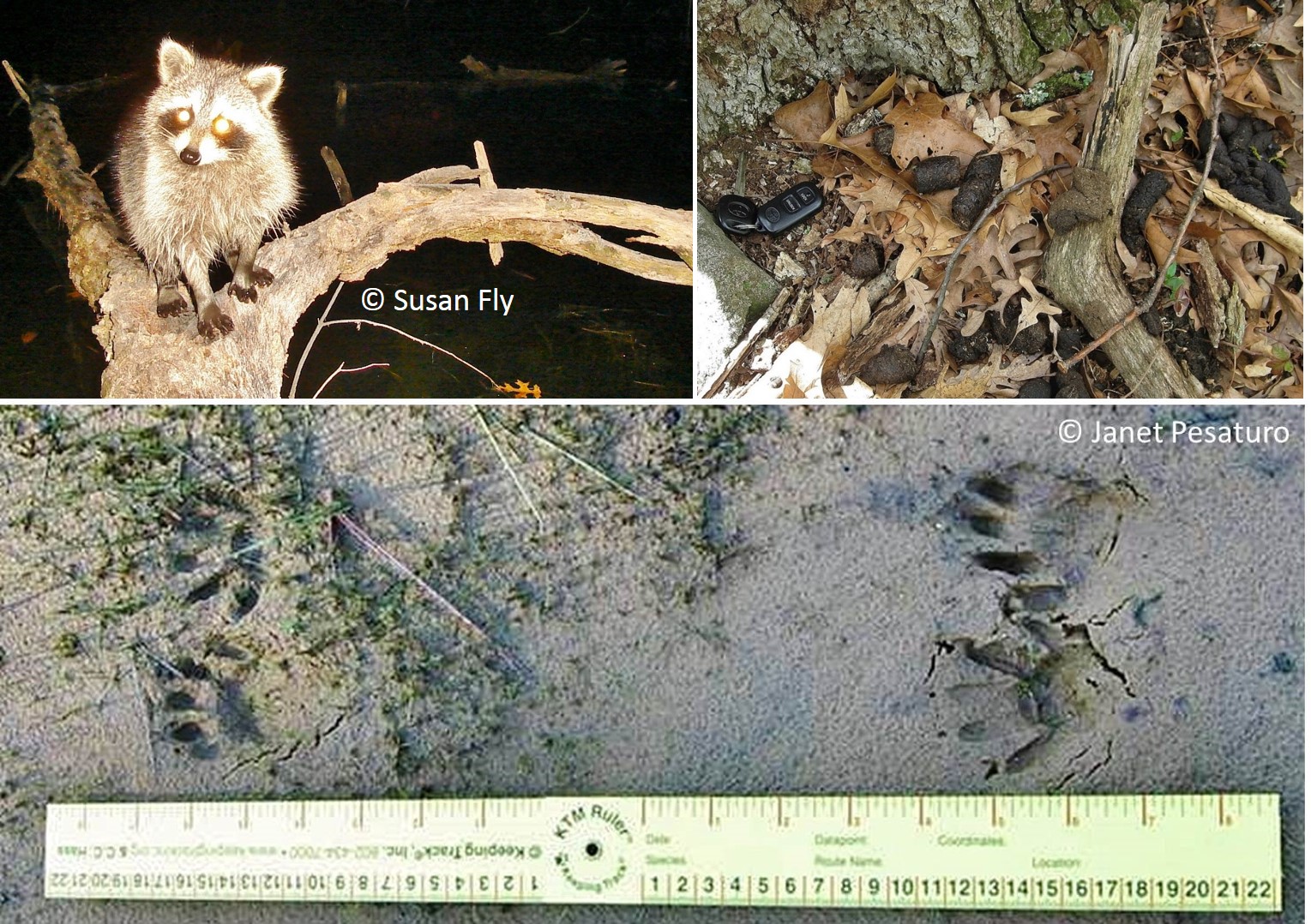
Raccoons are common chicken predators, so it’s important to understand them. Tracks look like tiny human hands, and you can see why, by looking at its paws in the trail camera photo. They might leave scat at scene of attack, and also leave scats in latrines, here at the base of a large tree.
Bear family
Bears are enormous omnivores which eat mostly plants, insects, and carrion, but will take livestock when possible. They can easily destroy most chicken coops. If you live in bear country, you’ll need electric fencing. We use it. Read here for detailed information about using electric fencing to exclude bears. I have no experience with grizzlies, but think of them as a larger and more aggressive version of the black bear.
Black bear
- Most likely to attack livestock in spring when they’ve come out of hibernation and little other food is available.
- Adults have very large tracks can be up to 6 inches wide. They have 5 toes on each foot but sometimes only 4 show. Claw marks usually show.
- Scat appearance depends on diet, but often looks like over-sized raccoon scat (untwisted, and as if it was squeezed from a tooth paste tube).
- Livestock death may be accompanied by other destruction that could be accomplished only by a large, strong animal.
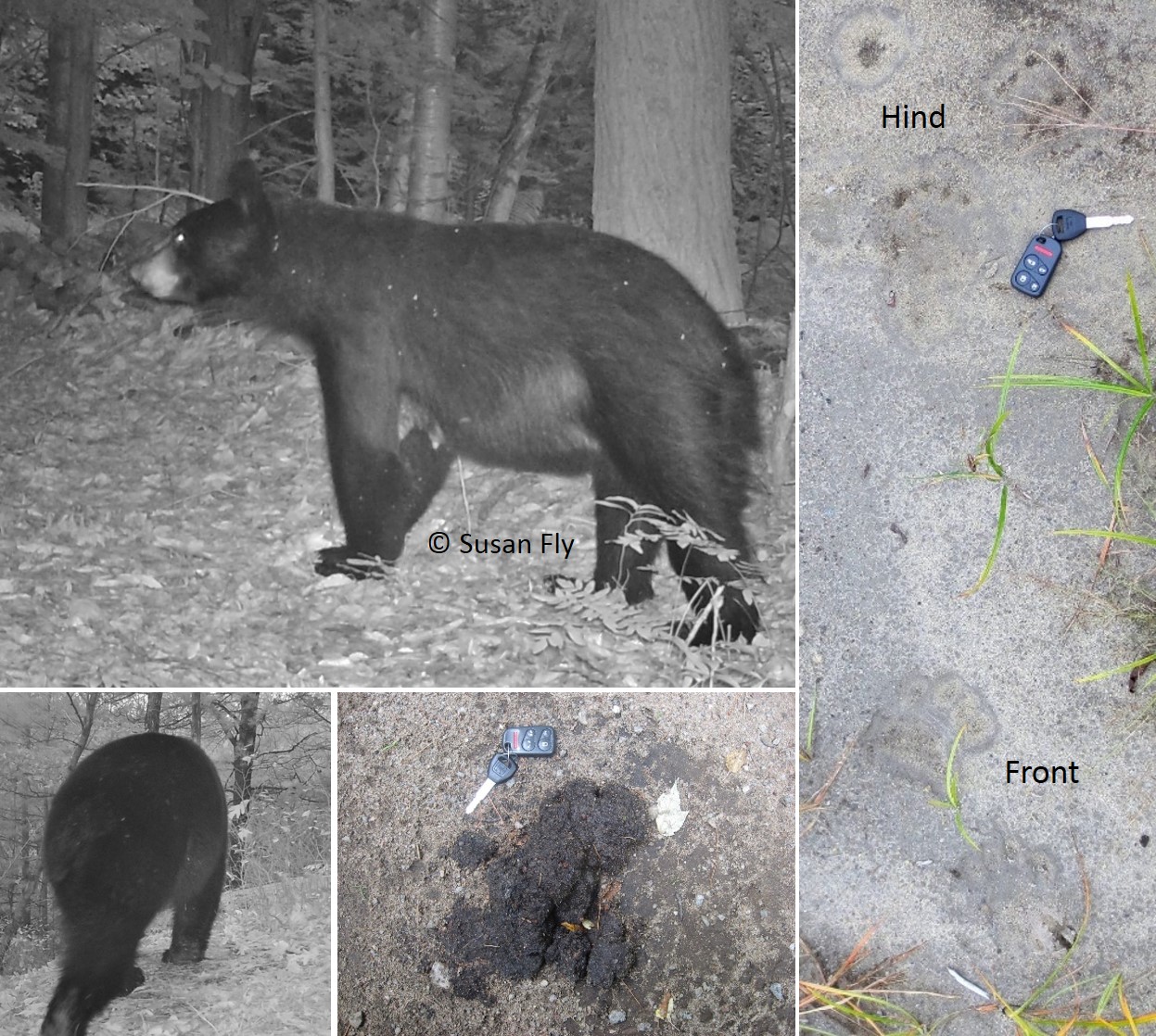
Game camera photos of black bear, giving you a sense of what its feet look like and how it walks. Look closely for the tracks in the photo at right. Scat, below, is very large.
Skunks
There are several species of skunk in North America, the most common and widespread being the striped skunk. The omnivorous skunk’s diet varies with the seasons. They eat plants, insects, grubs, worms, salamanders, small birds, bird eggs, and small mammals.
-
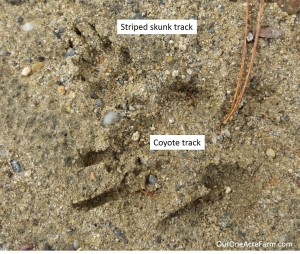
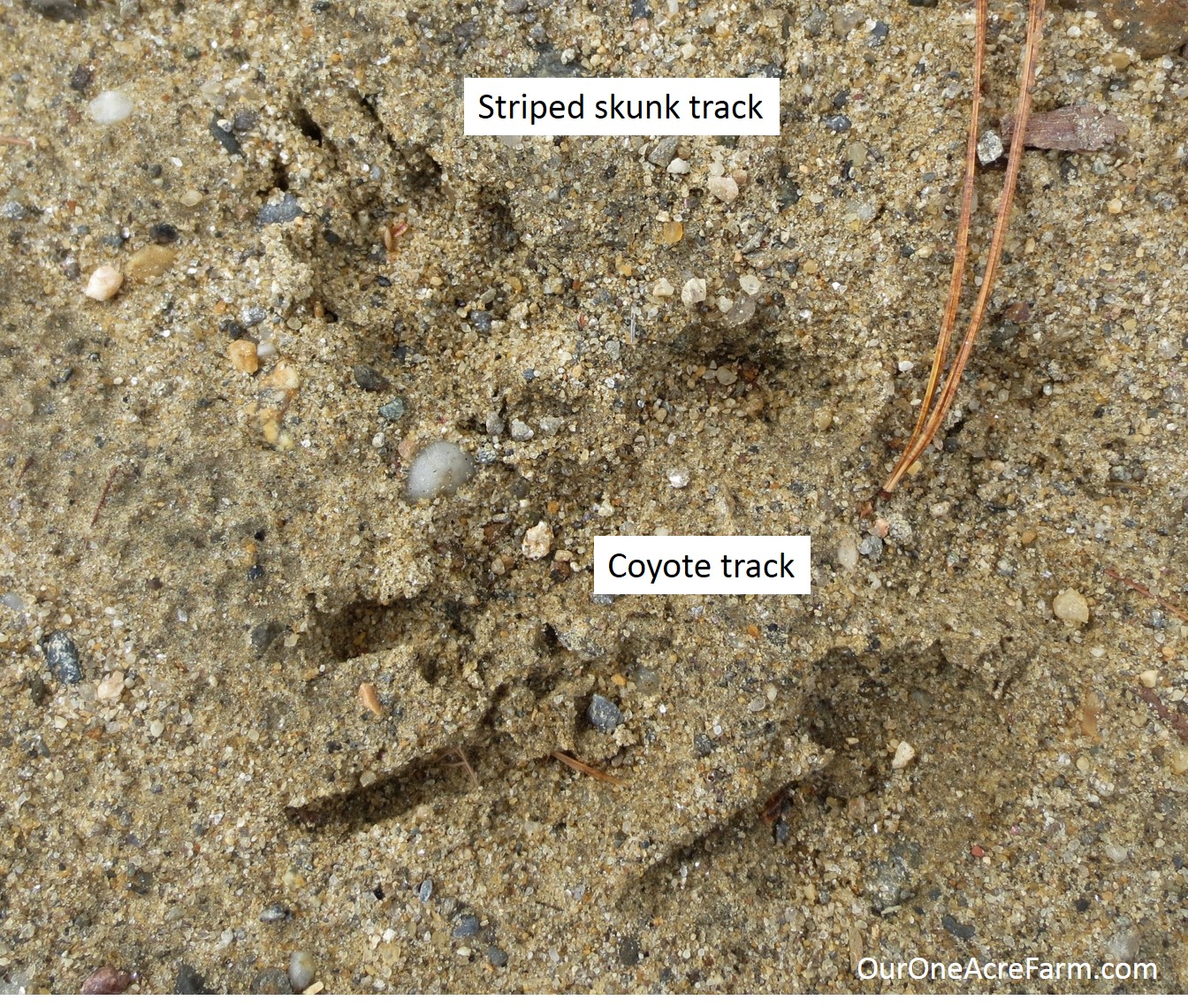
The track of a striped skunk at top left overlaps a coyote track.
Tracks of striped skunk typically show all 5 toes and claw marks, and about 1 to 1.25 inches wide. Hognose skunk tracks are a little larger, and hooded, pygmy, and spotted skunk tracks are a little smaller.
- Most species are good diggers but not good climbers.
- More likely to eat eggs than adult poultry. May eat eggs right in the coop, and typically they bite into the egg at one end, and lick out the contents. You will find a large portion of the shell mostly intact, and the bitten off end will be crushed.
- Attracted to rodents in poultry housing, and may help reduce the rodent population. However, they do love eggs.
- Might predate on adult chickens, but because they did not evolve to kill large birds, they may maul them with multiple bites.
- Likely to kill only one or a few chickens.
- Usually nocturnal.
Virginia opossum
This omnivore eats a wide range of plant and animal foods, including birds and eggs.
- Tracks measure 1.25 to 3 inches wide. All feet have 5 toes, front track looks like a star, and hind track looks like a tiny human hand with an outstretched thumb. That thumb has no claw, but the other toes do, and may or may not leave pinpoint marks in tracks.
- Scat appearance varies with diet, and is rarely found.
- Excellent climbers
- Chews eggs into small pieces
- Did not evolve to kill large birds, but will take them if easily accessible, and kill by mauling, usually beginning at the cloaca.
- Usually kills only 1 at a time, and might consume most of the bird.
- Usually nocturnal
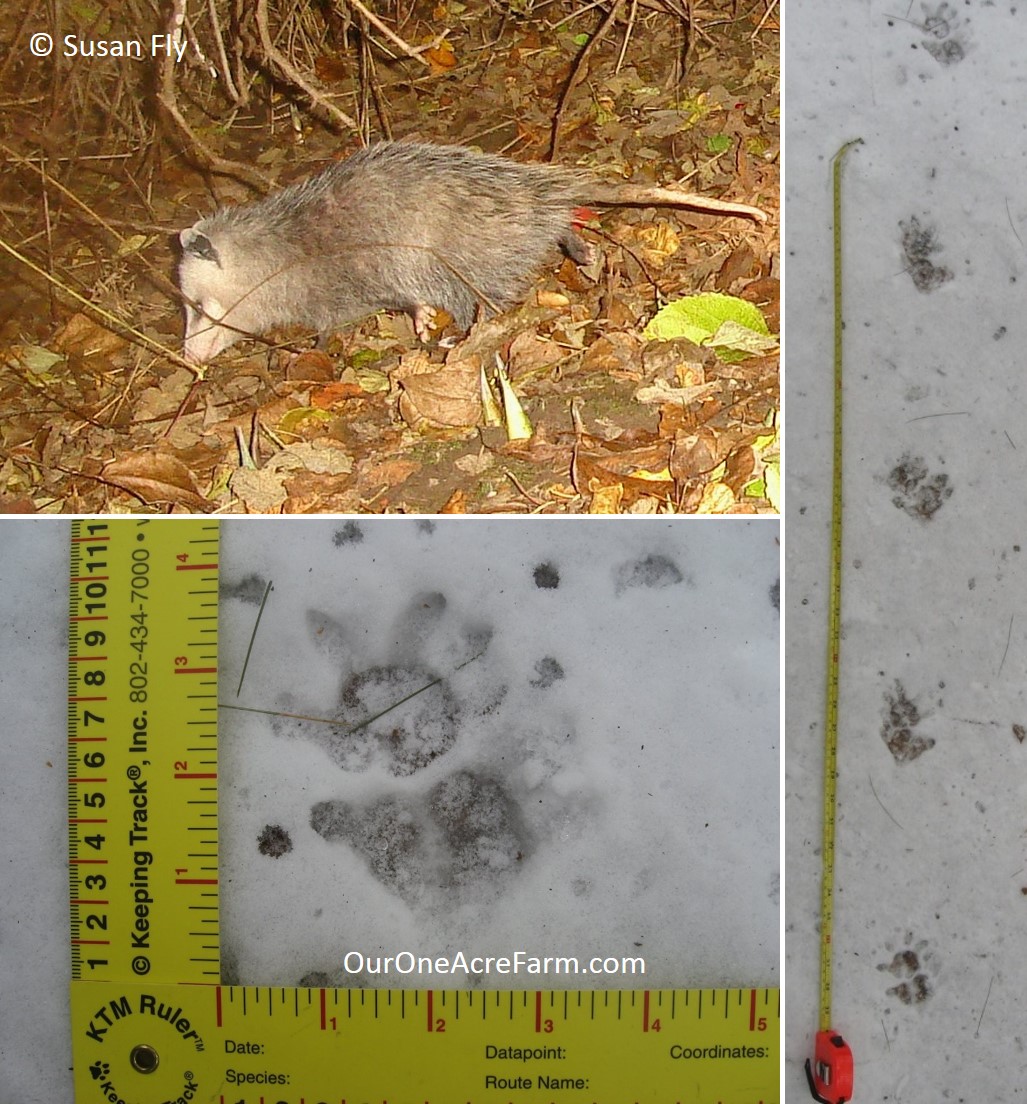
Game camera photo of an opossum, small hand-like tracks, and a typical trail pattern.
Rats
Rats chew up eggs in the coop or carry them away, and they chew up young chicks. I have read that they occasionally attack adult chickens on the roost, chewing the toes or breast. They probably enter the coop to dine on chicken feed, and to find shelter. Look for small pellet droppings around feeders. They are about 1/8 to 1/4 inch in diameter, and 1/4 to almost 1 inch long.
Snakes
- Rat snakes are the most likely to eat eggs.
- May be active day or night, depending on temperature. During extreme heat, they may be more likely to hunt at night, and during cool weather they feed during the day. They are mostly inactive in winter in colder climates, but they may come out on warm days.
- They eat entire eggs and young chicks, leaving no remains.
- You might find shed skins if a snake is living in your coop.
- The smaller the snake, the less damage it can do. Our runs are covered with 1/2 inch hardware cloth which will exclude snakes that can eat large eggs or chicks of standard breeds. Protect housing for bantam chicks with 1/4 inch hardware cloth.
Birds of prey
Birds of prey will attempt to take chickens. The larger the raptor species, the larger the chicken it can carry off, but smaller species will attempt to kill even large birds and eat them in place. Find out which species live in your region, learn to identify them, and read about their habits and hunting style. I will cover only the 3 species which commonly attack chickens in my area (east-central Massachusetts). Beware that raptors are protected by the Migratory Birds Treaty Act, and cannot be killed without a permit.
Cooper’s hawk
- Small hawk which cannot carry away a full size chicken, but will attempt to kill and eat in place.
- Those that stick around for the growing season learn that well protected chickens are not worth pursuing and generally don’t attack.
- New individuals passing through during fall migration may be very hungry and bold around people and come down for a chicken before your very eyes (I once literally pulled one off a hen).
- Fly within the tree canopy so it’s hard to see them as they plan an attack.
Red-tailed hawk
- Large hawk can carry off full sized hen, though awkwardly if it’s a heavy breed. You might find a few feathers or no remains at all.
- Juveniles are bolder around humans.
- Easy to see, as they perch on snags or dead branches, and fly over head.
Great horned owl
-
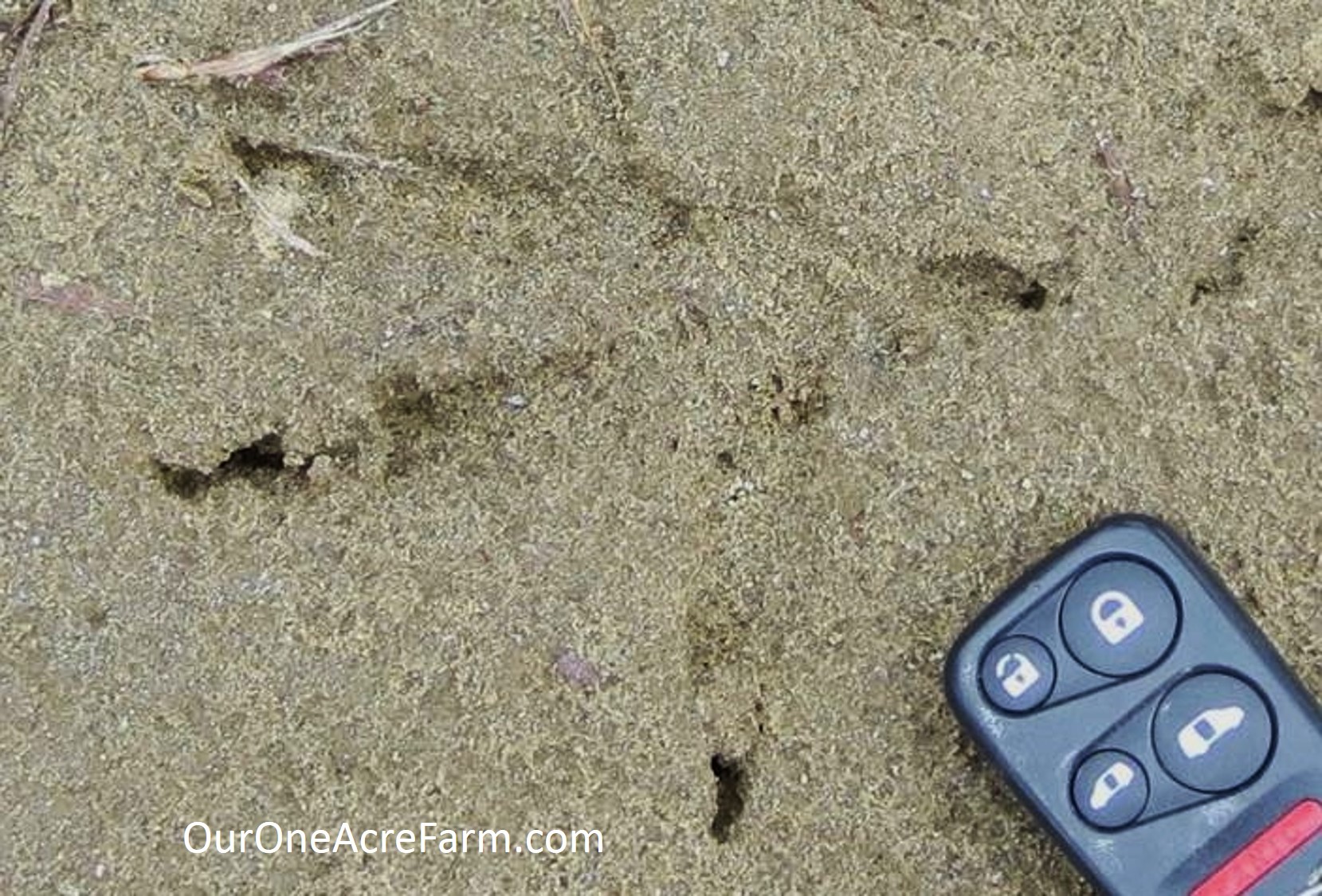
A great horned owl track. Note the prominent claw marks, consistent with a bird of prey with large talons.
Very large; can carry off adult chickens.
- Hunt mostly at night and at dawn and dusk, though occasionally take poultry during daylight.
- Typically decapitate victim, so if owl is frightened away before feeding, you might find a headless chicken.
- Informative video of great horned owl predating on chicken found here.
- May kill in excess, if the opportunity arises, and, like humans, cache the excess for later consumption.
- Learn to recognize their night time hoot which you can listen to here.
Opportunistic birds
Crows, ravens, magpies and jays will take eggs and young birds, and will also partake in chicken feed, if you make it easy for them.
- They might poke eggs open, consume the contents, and leave the shell, or carry the shell away and drop it elsewhere. Large birds can carry small eggs away in their beaks.
- Might enter the coop if you leave it open all day, and noise and activity are minimal.
- May learn your habits, work around them, and recognize sounds that indicate your imminent return.
- Crows are highly intelligent and work together. One might stand watch while another slips into the coop to eat an egg or carry it off.
Sources and further reading:
- Winterberry Wildlife
- Damerow, Gail. 1995. A Guide to Raising Chickens. Storey Communications, Inc. Pownal, VT.
- Elbroch, Mark. 2003. Mammal Tracks & Sign: A Guide to North American Species. Stackpole Books. Mechanicsburg, PA.
- Reid, Fiona A. 2006. Mammals of North America. Houghton Mifflin Company. Boston, MA.