
Guide to Growing Sunflowers
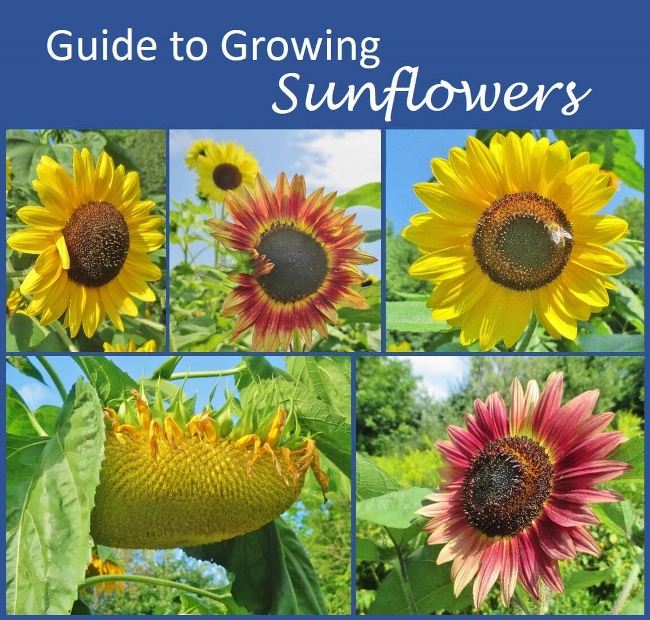
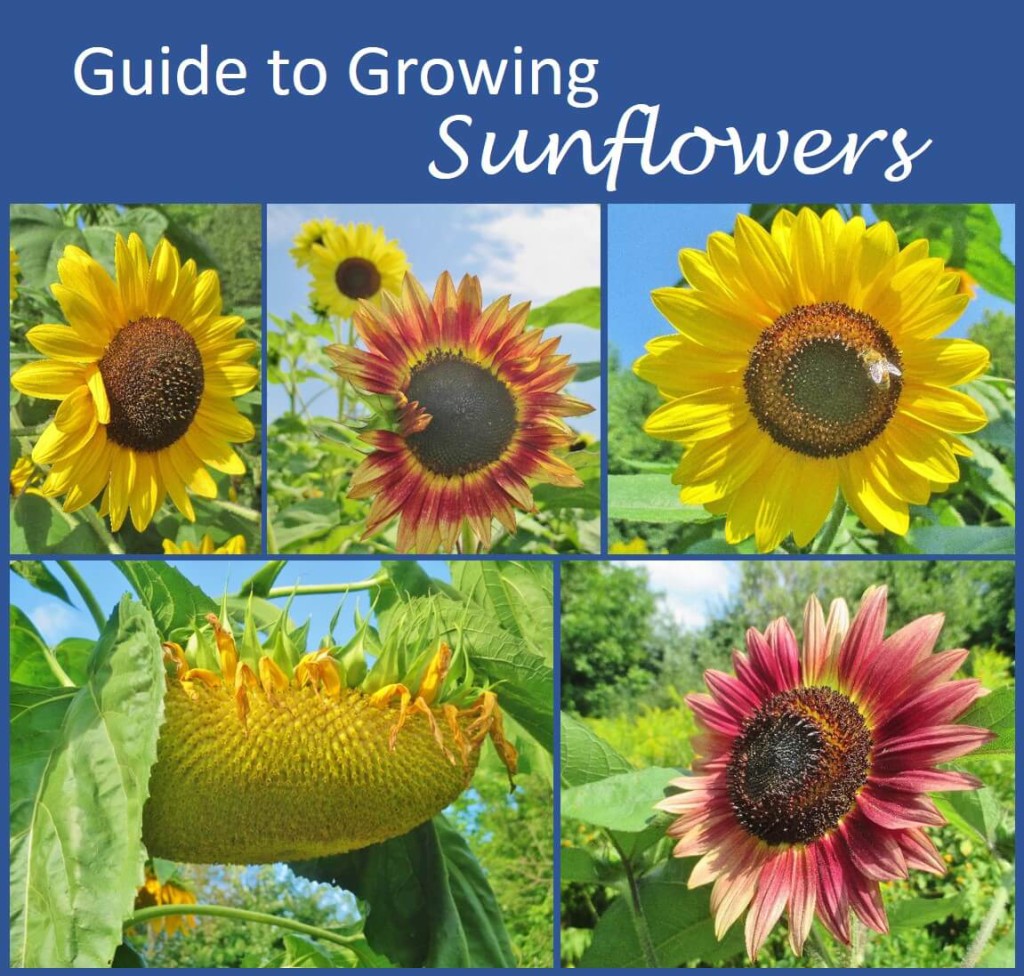
Learn to grow spectacular sunflowers for their beauty, wildlife value, and/or delicious snacks.
It wouldn’t be summer without big, bright beautiful sunflowers. Every year I await the sunny blooms with great anticipation, and when the flowers whither and seeds ripen, I enjoy watching chickadees and goldfinches flit around seed heads, and my chickens feasting on the toppled ones. Here you’ll learn how to grow sunflowers, how they are pollinated, how to choose a variety, and how to deal with common problems. You, too, can succeed with this American native, whether you’re interested in ornamental qualities, wildlife value, or a tasty snack.
Guide To Growing Sunflowers
Just a bit of history, first. The sunflower (Helianthus annus) is the only seed crop which was domesticated from an American native, and for me, that is reason enough to grow it. Native plants support native pollinators. Learn more about supporting native pollinators in Gardening for Pollinators. The wild annual sunflower is usually highly branched, producing many small seed heads, and reaching 10 feet in height. Domestication of this plant began about 3,000 years ago. The Spaniards brought it to Europe in 1510, but there was little interest in it until the late 1800’s, when the Russians began a selective breeding program to increase the oil content of sunflower seeds. Sunflower breeding is an ongoing endeavor, and modern hybrids yield more seeds and resist some of the pests and diseases, as you will see below.
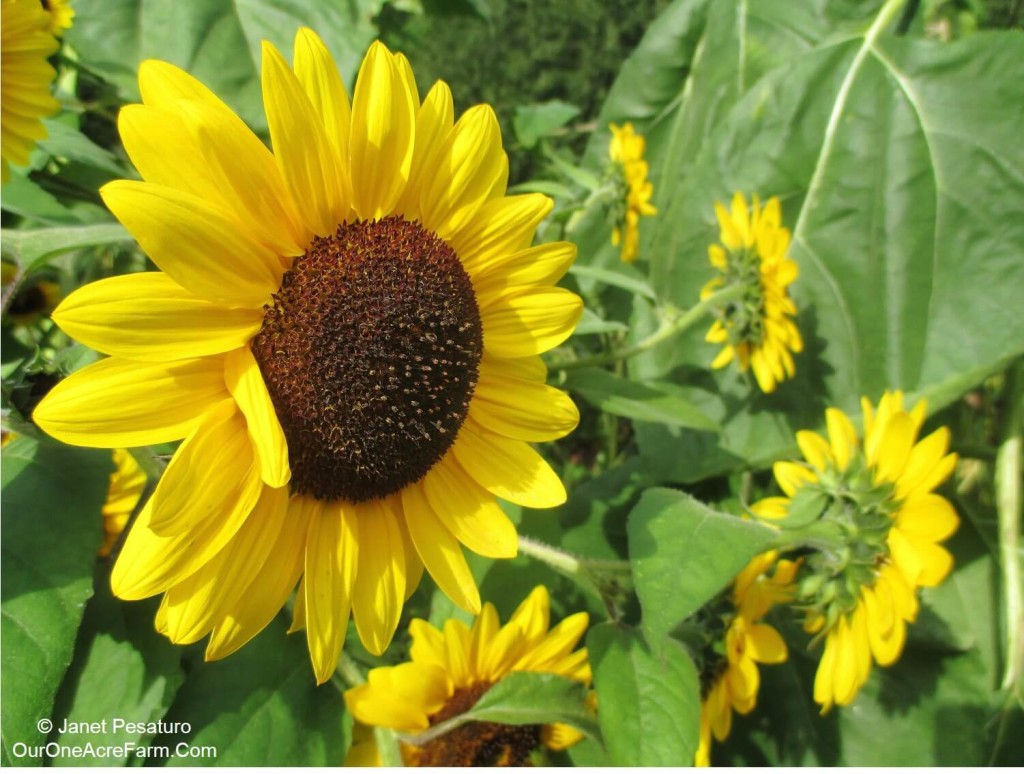
The multi-branched habit and smallish yellow flowers of this hybrid sunflower, make it similar in appearance to the native wild sunflower.
Common problems growing sunflowers
While sunflowers are easy to grow, many people complain “I can’t grow them”, and typically describe one or more of the following problems:
- Seedlings are cut or chewed off shortly after germination
- Mature plants are small and poor
- The season is too short for seed production
- Many of the seeds are empty hulls (poor pollination)
- Seed production in the center of the head is poor
- Wild birds and mammals steal the seeds
- A variety of insect pests and diseases
Read on, and you will learn more about these problems and their solutions.
This post contains links to online shopping, which is a way for you to support One Acre Farm at no additional cost to you. Click here for my full affiliate disclosure. Thanks for your support!
Growing conditions
It’s often said that sunflowers are drought tolerant plants that can adapt to a range of soil types. This is true: A long tap root allows the sunflower to harness water and nutrients several feet below the surface of the ground. But this is misleading for the gardener hoping for big beautiful plants with seed packed heads. Sunflowers grown in poor, dry soil will be scrawny plants with small seed heads. To reach its potential in size and seed production, a sunflower needs fertile soil, regular watering, and a pH of 6.0-7.5. Before planting, we enrich the soil with compost made from, among other organic material, poop from our chickens. Sometimes I side dress with a little more compost in mid-summer, or fertilize with manure tea or compost tea periodically throughout the season. I’m not scientific about the timing or quantity, and our sunflowers always do well.
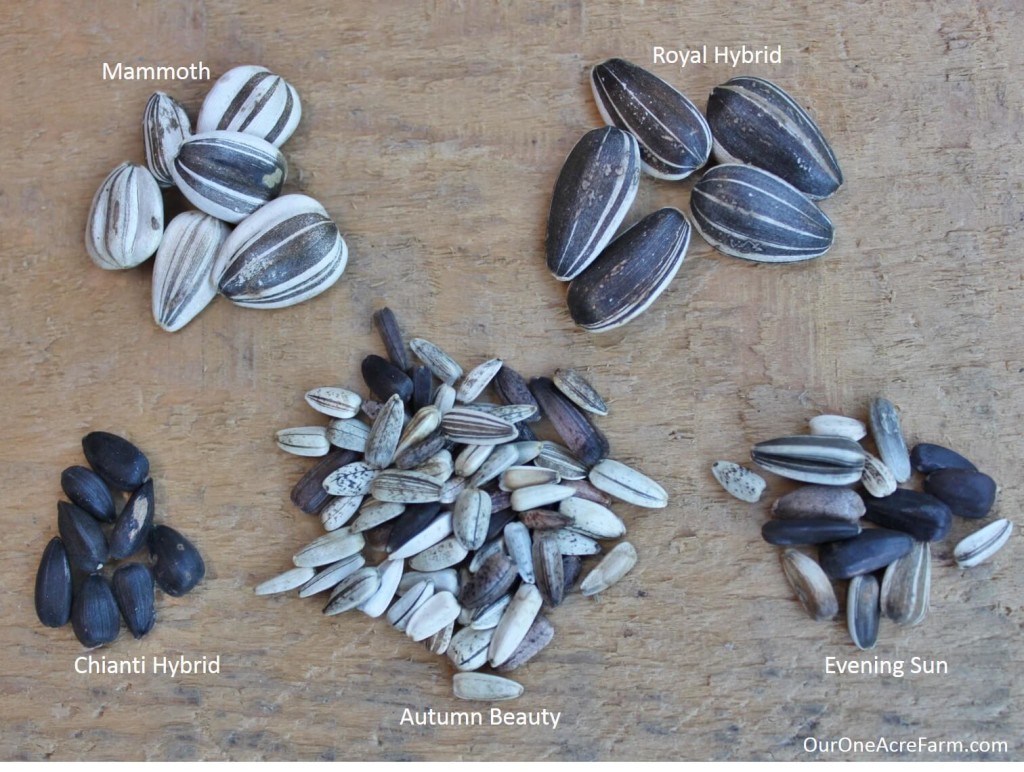
Seeds of several varieties of sunflower
Planting sunflower seeds
Most sunflower varieties need 95-110 frost-free days to produce mature seeds, which means they can grow in zone 5 and warmer. Conventional wisdom says that the seeds should be either direct seeded after danger of frost, or, in short season regions, started in pots a few weeks earlier, for later transplanting. But experience tells me that neither of those strategies is ideal for slowly maturing varieties (such as giant sunflowers) in short season regions. Here’s why:
- Direct seeding after danger of frost leaves a short growing season, sometimes too short.
- Transplanted seedlings sometimes grow up into stunted plants. This is probably a result of confining or damaging the long tap root.
So, I direct seed my sunflowers up to 4 weeks before the last frost date. Yes, sunflower seedlings are actually frost hardy. I learned this from watching so many early volunteer sunflower seedlings survive frost. For giant sunflowers, I usually plant groups of 5 seeds spaced 18-36 inches apart. For smaller, branched sunflowers, I plant one seed every 1-3 inches, in rows spaced 12 inches apart.
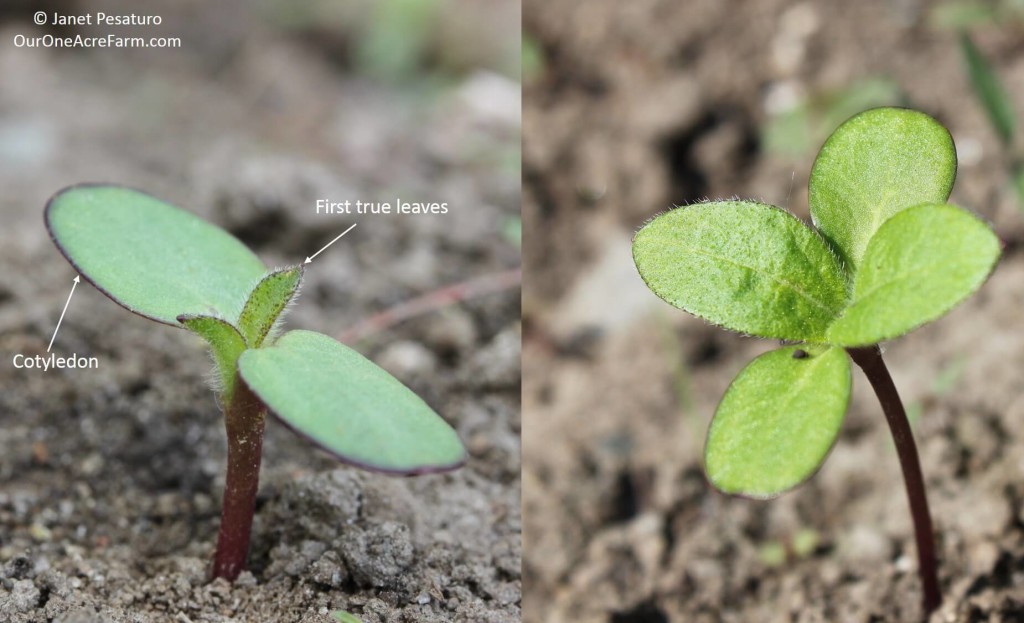
With its first true leaves just emerging, the seedling on the left still needs protection from birds, which love the embryonic cotyledons. The seedling on the right has well developed true leaves, and no longer needs protection from birds.
Protecting sunflower seedlings
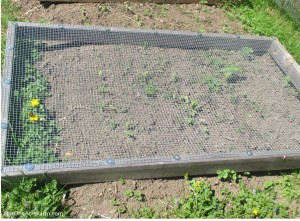
This hardware cloth sifter protects young seedlings from birds
Once you plant the seeds, you need to worry about critters eating those first leaves that emerge from the seed – the cotyledons, or embryonic leaves. Slugs, rodents, rabbits, deer, and birds are all thought to relish newly sprouted sunflower seeds, so you will need to protect them accordingly. You might need:
- Snail bait
- Cutworm cuffs
- Netting or other barrier
Our problem was birds eating the cotyledons, so we exclude birds by placing our hardware cloth sifters over the sunflower beds (see photo). Do not remove these barriers until the first true leaves are well developed.
Thinning the seedlings and supporting growth
- Thin by cutting/pinching, not pulling. Thin gradually, over the course of weeks, to select the most vigorous seedlings each time.
- Thin giant varieties ultimately to one plant per group, and smaller varieties to one plant per foot. Dwarf varieties can be grown more closely together.
- Water during dry spells, and fertilize with compost tea about once a week, or a side application of compost once or twice, for robust plants with large seed heads.
- Mulch them to keep down weeds and retain moisture. (I often mulch with the poop laden hay from my chicken runs. That’s an effective mulch AND fertilizer.)
- You might want to stake tall varieties, especially single flowered varieties expected to develop very large seed heads. My experience has been that about half of them topple if I don’t stake them.
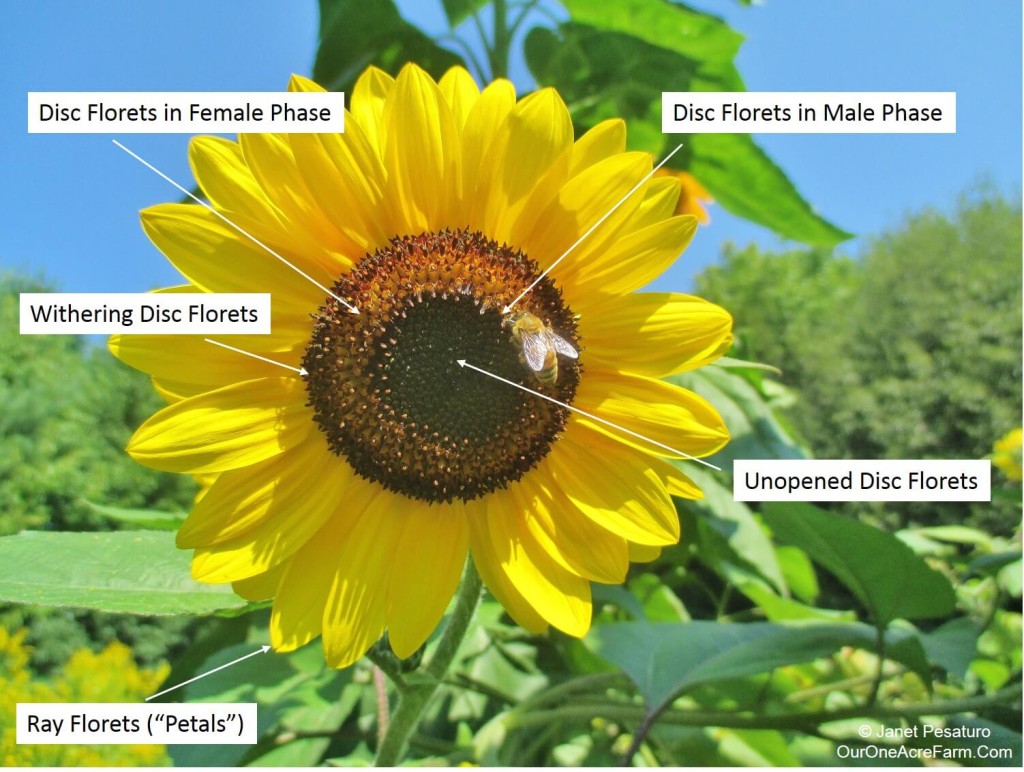
Sunflowers are called composite flowers because they are composed of many smaller florets. The florets open in spiral fashion from the periphery inwards. Notice that the bee is feeding from florets in the male phase. That’s a common observation, and it’s because nectar production is highest and pollen is released during the male phase.
Understanding sunflower pollination
As members of the aster family, sunflowers are composite flowers, meaning that the “head” (what most people know as the flower) is composed of many smaller flowers called florets. Sunflowers have 2 types of florets:
- Ray florets, which most people know as the petals. These are sterile, meaning that they contain neither pollen nor an ovary, and cannot set seed. The purpose of ray florets is to attract pollinating insects.
- Disc florets which usually have fertile female and male parts.
To set seed, old fashioned sunflowers need insects to carry pollen from one plant to another. Many hybrids are more self-fertile, and the most modern commercial hybrids are fully self-fertile and self-pollinating. Each floret is open for at least 2 days. On day 1, only the male part is fertile (meaning that pollen is released). Nectar production is highest when the male part is fertile. On day 2, only the female part is fertile (meaning that the pistil is receptive to pollen). The result is that individual florets are not likely to self-pollinate.
If you’ve grown sunflowers, you might have noticed that the disc florets open from the periphery inwards. So, for most of the flowering period, a head has closed florets in the center of the disc, surrounded by a ring of florets in the male stage, then a ring of florets in the female stage. Watch the bees visiting a sunflower, and you will notice that they prefer the florets just beginning to open around the center of closed florets. That’s because they are in the male phase, when nectar production is highest and pollen is being released.
An interesting consequence of this pattern of opening from the periphery inwards, is that there is less and less pollen available to fertilize the remaining florets. This is why seed production is poorest in the central part of the disc.
Honeybees are the most important sunflower pollinators in terms of sheer number, but many species visit sunflowers, and bumblebees are the most effective sunflower pollinators. Temperature, humidity, and precipitation can all affect insect activity, so poor weather can mean poor seed production.
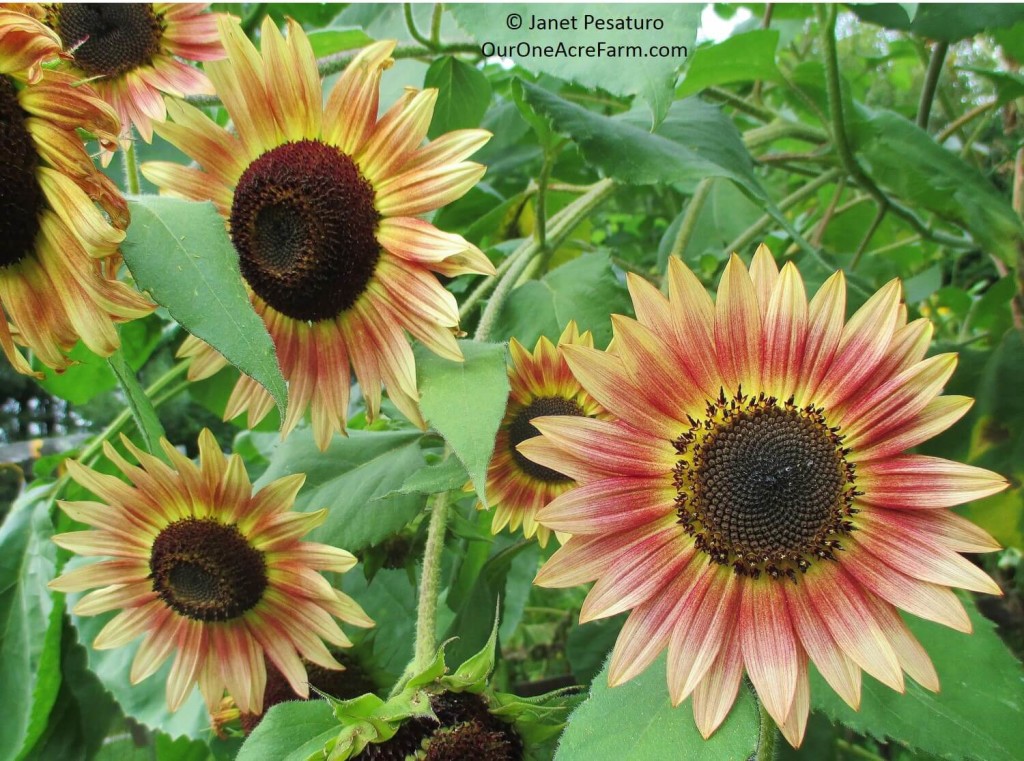
The gorgeous bi-color sunflower was from the mix, Autumn Beauty
Sunflower varieties
Hybrid sunflowers have replaced the wild sunflower for several reasons:
- Less dependence upon insect pollinators
- Better pest resistance
- Better seed yield
- Stronger stalks
- Uniformity in growth habit
- Desirable ornamental characteristics, including pollenless, double, colored, bi-colored, and dwarf.
Some hybrids are somewhat self-fertile, but produce seeds in greater number and of greater size and better quality in the presence of insect pollinators. Though I have read conflicting reports, I believe Mammoth Russian is one such variety. I have grown it many times. Sometimes seed production is poor and sometimes moderate. Because seed production is never excellent, I don’t think it is fully self-fertile nor fully self-pollinating.
Some modern commercial hybrids are fully self-fertile and self-pollinating. This means that the quantity and quality of seed production are excellent even in the absence of insect pollinators. One example is Royal Hybrid, available from Johnny’s Selected Seeds, which I am growing this year. I have grown this in the past and it produces much better than Mammoth Russian. Grow a modern hybrid if you don’t want to chance poor seed production.
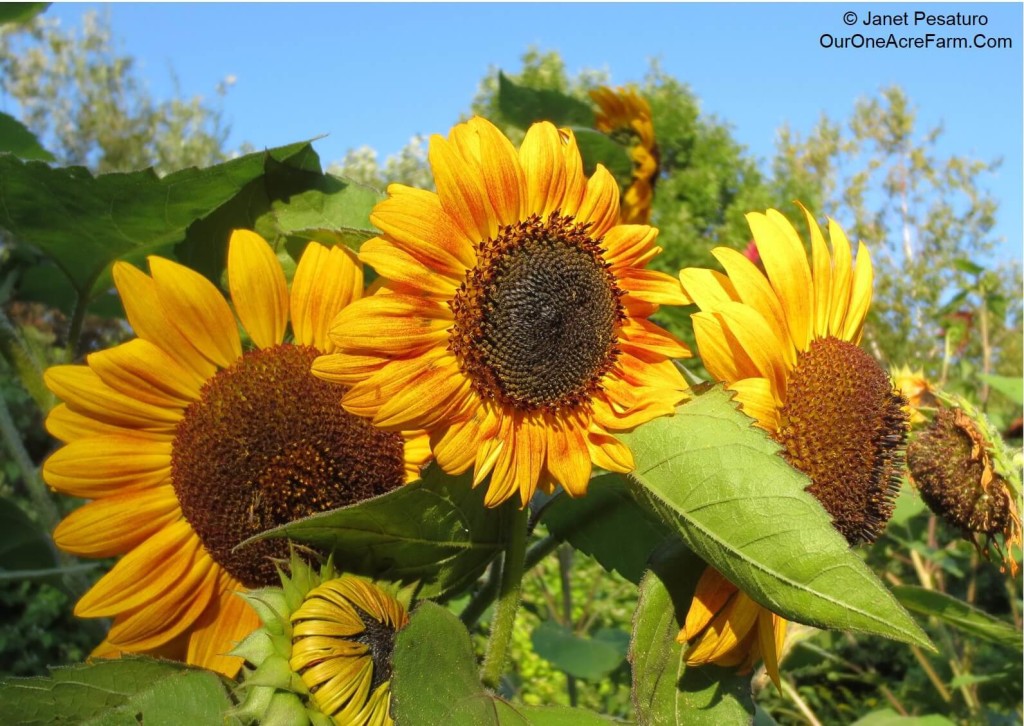
This stunning bi-color sunflower was from the mix Evening Sun.
Male-sterile varieties are pollenless, but the female parts can be pollinated by insects if pollen producing sunflowers are growing nearby. These hybrids do offer nectar for bees, but no pollen, so they are less valuable to insects overall. People like them for cut flowers, because they don’t drop pollen all over the furniture. Sunrich and Pro Cut are popular pollenless sunflower varieties.
Double-flowering sunflowers have disc florets with fluffy yellow petal-like material, but fertile disc florets they are, not sterile ray florets. Seed production may be poor (it’s always poor when I grow them) because it’s difficult for pollinating insects to reach the nectar and pollen. Of course that also means that double flowering sunflowers are a less valuable food source for pollinators. Teddy Bear and Giant Sun Gold are double varieties.
Fancy colored varieties sunflower come in shades of bronze, red, orange, pale yellow, near-white, and bi-color. Chianti is a beautiful deep wine red variety, and Lemon Queen is a lovely pale yellow. Autumn Beauty and Evening Sun are spectacular mixes of various colors and bi-colors. I grow one of those mixes almost every year, always with great success. Most of the plants in these mixes are branched, producing several small seed head. Goldfinches and chickadees love the small seeds.
Dwarf sunflowers grow less than 3 and 1/2 feet tall. Teddy Bear is a dwarf double flowering variety, Firecracker is a colorful mix of dwarf sunflowers, and Big Smile is a 1-2 feet tall variety with classic single yellow flowers.
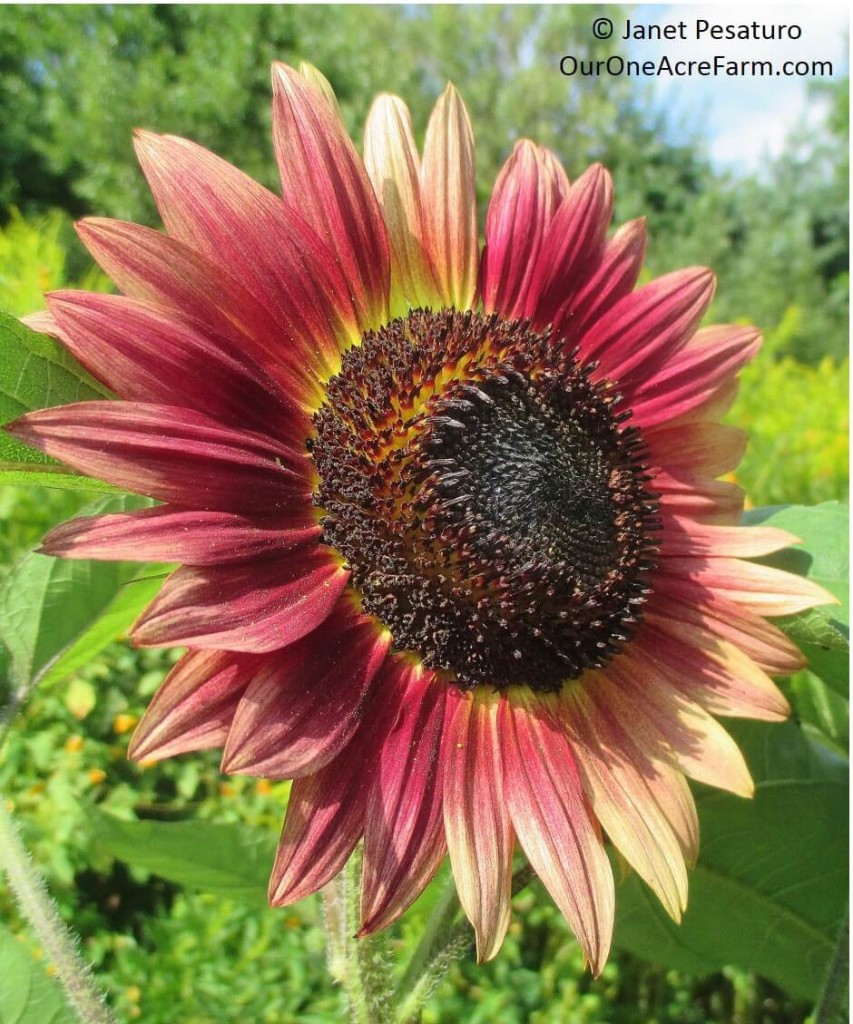
A spectacular deep red sunflower from the mix Autumn Beauty
Sunflower pests and diseases
The fact that the sunflower is native to North America explains why pests are rarely a serious problem. It co-evolved with over 150 species of insects which feed on some part of the sunflower plant, and over 100 species of predatory and parasitic insects which prevent outbreaks of the pests. So unless an exotic pest with an appetite for sunflowers makes its way to North America, you’re not likely to have overwhelming problems in the backyard. At the same time, there are occasional serious problems, and frequent minor problems. Here are some tips for thwarting them:
- Rotate the crops to minimize problems with soil borne fungal diseases such as Sclerotia, which causes sudden death or wilting.
- Grow sunflowers among other flowers, herbs, and vegetables, which helps maintain a balance of insects and other disease organisms. To understand how plant diversity prevents pest outbreaks, read the sections on “Species Diversity” and “Balance” in my article on Permaculture Principles.
- If you have problems with wind borne fungi, such as Ascospore, the best strategy is to grow disease resistant hybrids.
- Bt (Bacillus thuringiensis) might help fight caterpillars like sunflower moths and borers.
- Various leaf spot diseases might cause unsightly patches, but aren’t usually an overwhelming problem. My sunflowers almost always show sign of leaf spot, but overall the plants remain attractive, in a rustic sort of way, and productive.
- Aphids feed on sunflower plants by draining liquids from the undersides of leaves. They usually aren’t a serious problem…unless ants find them. Ants like the sticky, sweet “honeydew” that aphids produce. Like humans, ants farm their livestock: they protect the aphids from predators and spread them around, helping them multiply. A combination of aphids and ants on sunflowers could thus become a serious problem, causing leaves to discolor and dry up. Deter ants with a sticky trap collar below the first set of leaves, and blast aphids with a garden hose.
Good companions and bad companions: Allelopathy
Notice that I just recommended growing sunflowers among other flowers, herbs and vegetables. This might conflict with what you’ve read about sunflowers. They produce allelopathic compounds, which can inhibit the growth of other plants. But a plant’s ability to produce allelopathic compounds depends on its genetics and the environment. Different sunflower cultivars produce these compounds in different quantities, and the amount produced by a given cultivar varies depending on environmental conditions. What are the chances that the variety you choose will produce a significant quantity under the conditions in your garden? Hard to say….
So I don’t pay a whole lot of attention to allelopathy, or to the “rules” of companion planting in general. The reason is that living systems are complicated, with so very many factors influencing how well any given plant grows. Unless you’re doing a lot of testing, documenting, and controlling a plant’s environment, many of the specific rules of thumb probably don’t apply. I simply aim for diversity, for lots of different species growing together, because that tends to prevent any one factor from having an overwhelming influence. So, our sunflowers get rotated near any and all other crops we grow.
Here are a few of many exceptions to the rules that I’ve observed. Pole beans and potatoes are said to suffer when grown near sunflowers, but I haven’t found these rules of thumb to be true. Last year my sunflowers rubbed elbows with my pole beans, and we enjoyed a fantastic pole bean yield. Peppers are sometimes said to benefit from nearby sunflowers, but last year our peppers were also next to the sunflowers and did horribly.
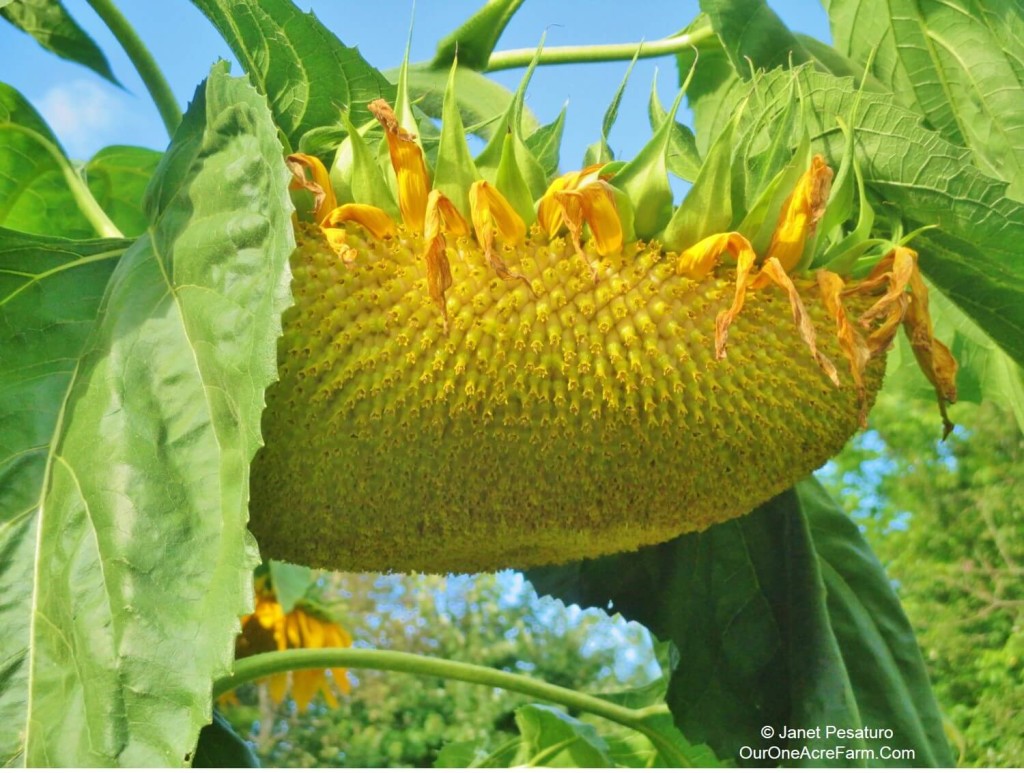
A Mammoth Russian sunflower packed with developing gray striped seeds.
Harvesting seeds
We are usually content to share our sunflower seeds with our chickens and with wild birds, but if you want to harvest them for yourself, cover the seed heads with a paper bag or mesh onion bag. The time to do this is when the petals are dry and falling off, the center florets are drying up, and the seeds begin to swell. Once the seeds develop a hard shell, all the petals have fallen off, and the backside of the flower head has turned yellow or brown, cut the stalk, leaving at least a foot of stalk on the head. Remove the seeds by rubbing them over a wire mesh, or scraping with a spoon. If you are very patient, you can put a paper bag over the flower head and wait for the seeds to fall out on their own. Air dry them, and store in a rodent proof container.
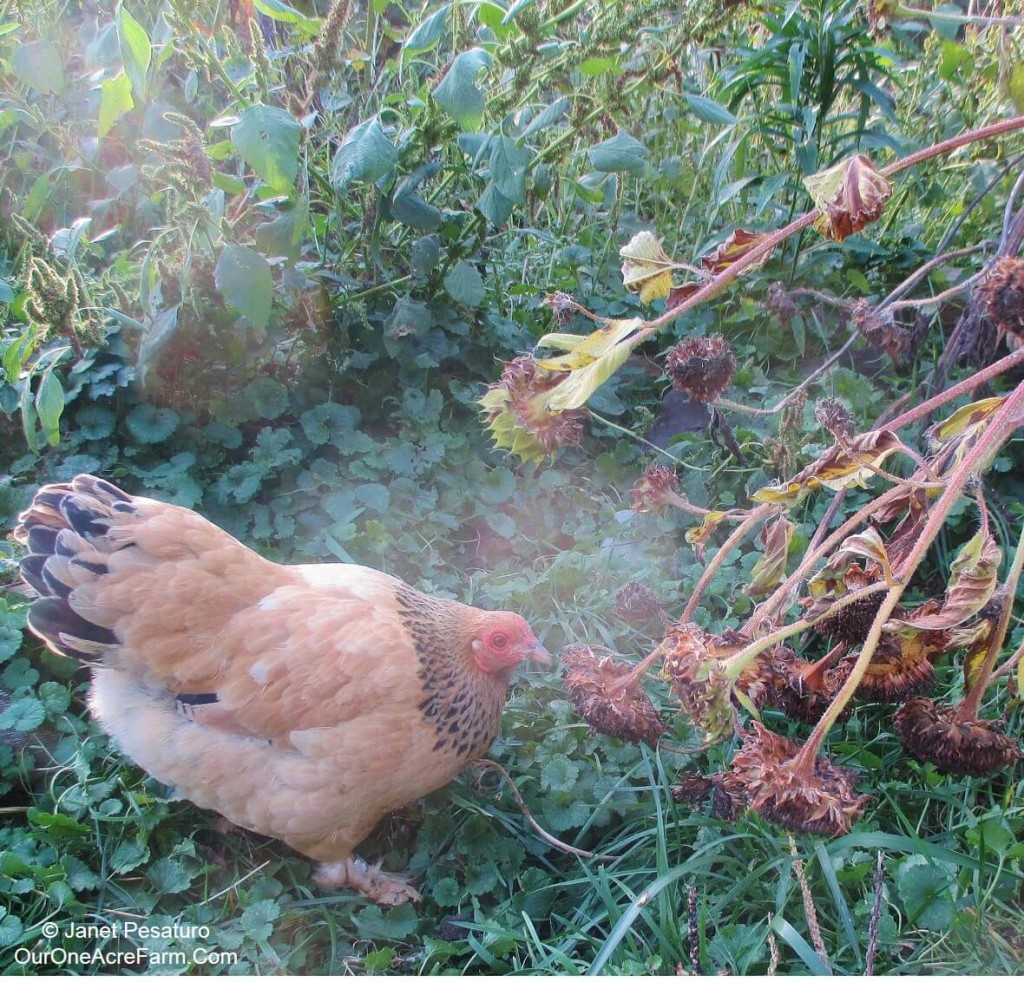
One of our bantam hens enjoying the seeds from a toppled Autumn Beauty sunflower
Sources:
- Ants Raising Aphids on Sunflowers (from Home Guides)
- How to Grow Giant Sunflowers
- How to Harvest Sunflower Seeds
- Michalak and Peterson. 1993. Rodale’s Successful Organic Gardening: Vegetables. Rodale Press, Emmaus, PA.
- Nikneshan, P. et al. 2011. Allelopathic potential of sunflower on weed management in safflower and wheat. Australian Journal of Crop Science. 5(11): 1434-1440
- Sunflower: An American Native, from University of Missouri Extension (history)
- Sunflowers, from the University of Minnesota Extension (doubles)
- Sunflower Pests and Problems
- Sunflower Revolution: New Sizes, Colors, and Varieties for Every Garden