
Elderberries
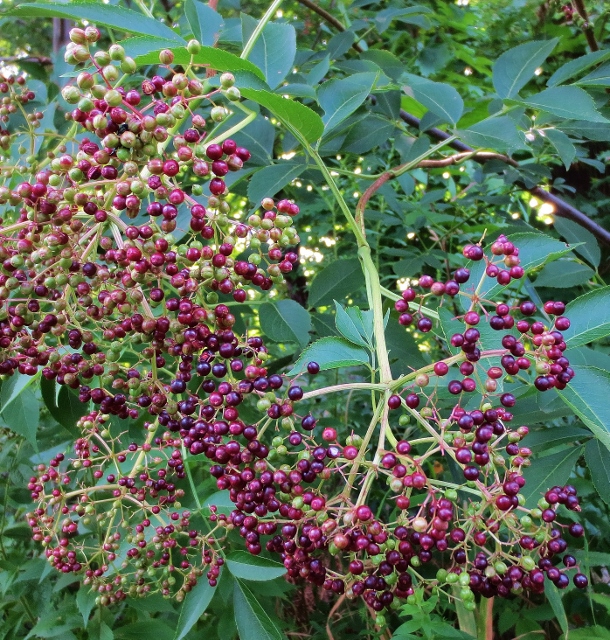
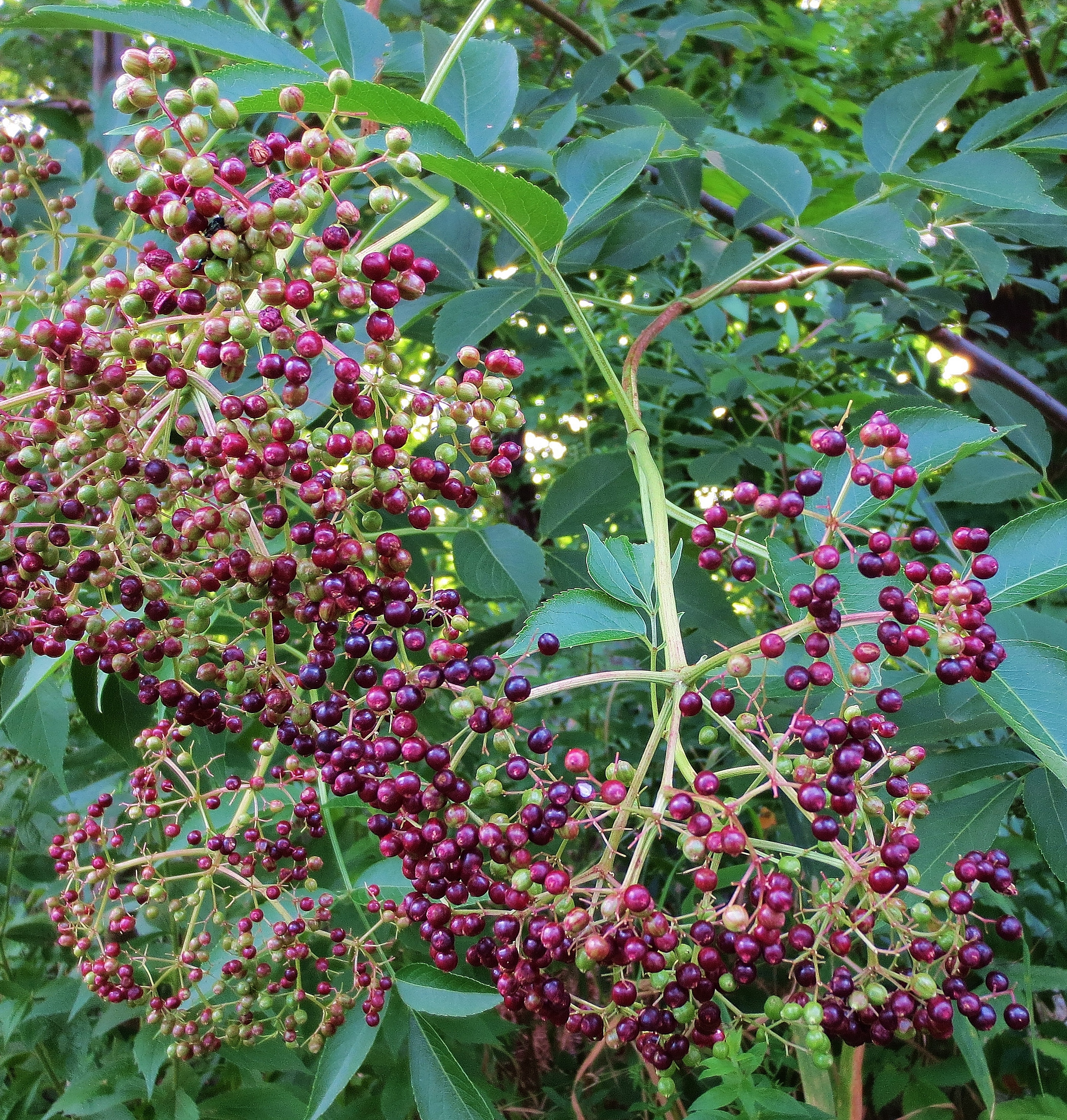
Foraging for Elderberries: How to identify, where to find it, and how to harvest the berries. Detailed photos for ID.
The American elderberry, Sambucus canadensis, also called common elderberry or wild elder, is native to eastern North America. It is sometimes considered to be the same species as Sambucus nigra, the European elderberry or black elderberry. The two are at least very closely related. Because this common roadside shrub is relatively easy to find and the berries and flowers are easy to harvest and prepare, foraging for elderberries is popular among wild food enthusiasts.
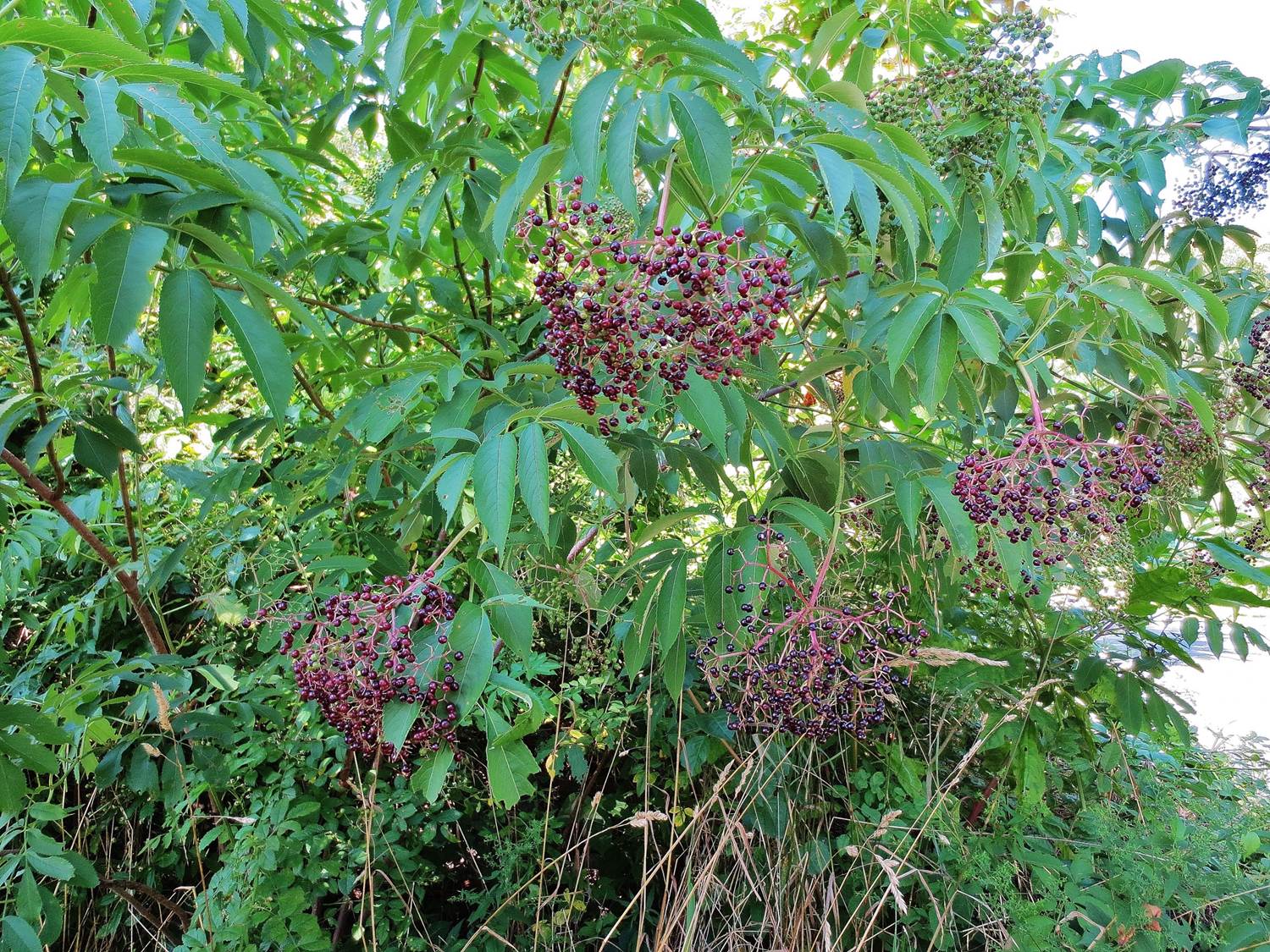
Roadside American elderberry shrub with ripening berries
Common elderberry bears a profusion of edible flowers and berries. The berries are high in vitamin C and cancer fighting antioxidants (Thole, et al., 2006, Journal of Medicinal Food). There is little Sambucus canadensis in cultivation in the US, but this is changing as interest in its health benefits grows, and cultivation of Sambucus nigra is already common in Europe.
Although both flowers and ripe berries are edible and nutritious, all other plant parts are toxic, so be sure to pick over your harvest and remove all leaves, twigs, and stalks. Now this doesn’t mean that every speck of leaf or twig visible to the naked eye will make you sick. Pick out as much as you can and use common sense.
I pick elderberries almost every August, because there is a huge roadside clump of it right across from my house, and many smaller clumps along my daily walking route. Harvesting them couldn’t be easier or more convenient, and foraging is cheaper than shopping.
General description of Sambucus canadensis
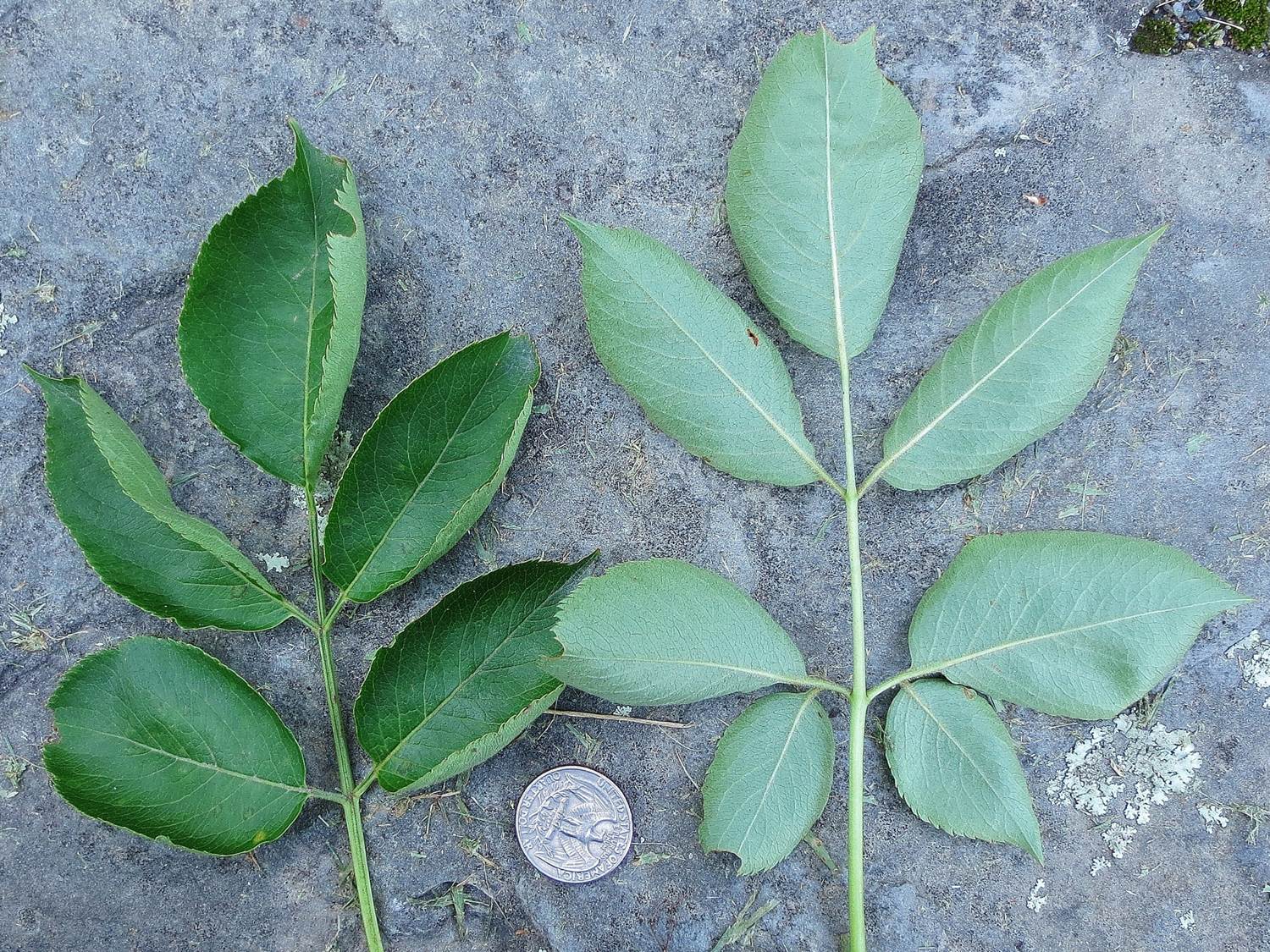
American elderberry leaves with coin placed for scale
American elderberry is usually a spreading shrub that reaches about 10 feet in height, here in Massachusetts. It can grow to 12 or 13 feet in the southern portions of its range. I have read that it can grow as a small, single trunked tree, but all specimens I’ve encountered are shrubs
The leaves are oppositely arranged on the twigs. Each leaf is composed of an odd number of toothed, oval leaflets. There are typically 5-9 leaflets, but occasionally as many as 11.
American elderberry flowers
The lacy clusters, composed of many tiny white flowers, bloom in mid-late June here in central New England. Once you have developed a search image in your mind for the shrub in bloom, look around for the flower clusters as you travel about in spring. This is an excellent way to map out foraging opportunities, whether you are after flowers or berries. If you pick the flowers, though, less fruit will be produced. I leave the flowers and wait for the berries.
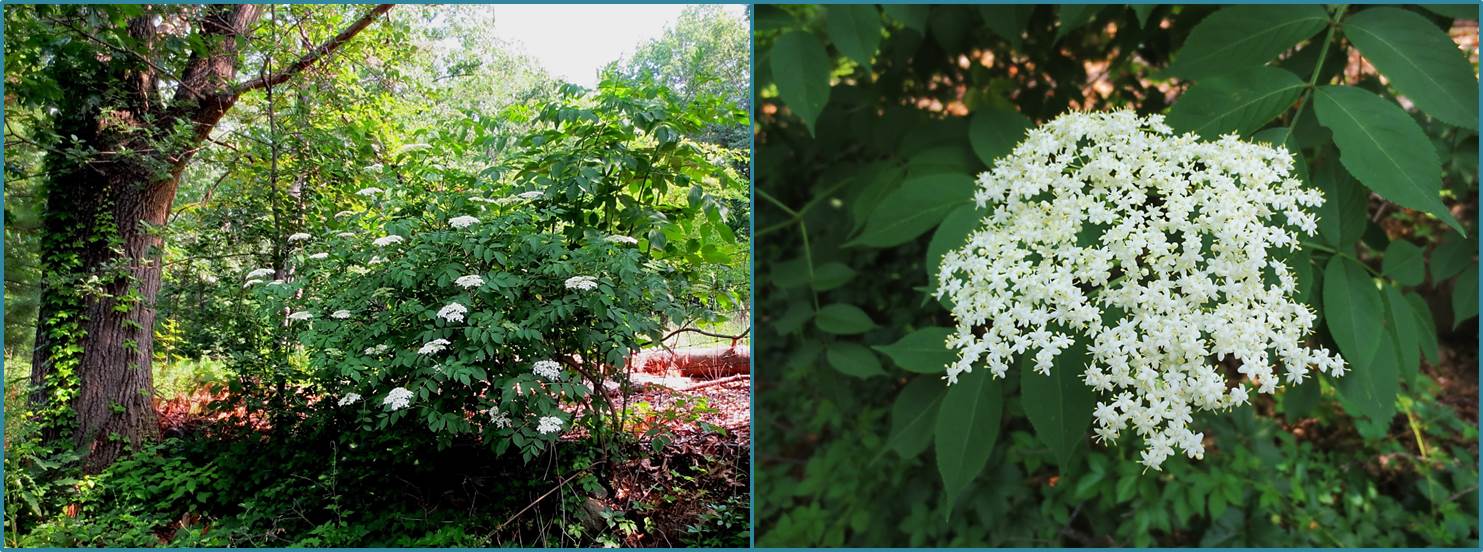
Blooming common elderberry shrub, and closeup of flower cluster.
Berries of Sambucus canadensis
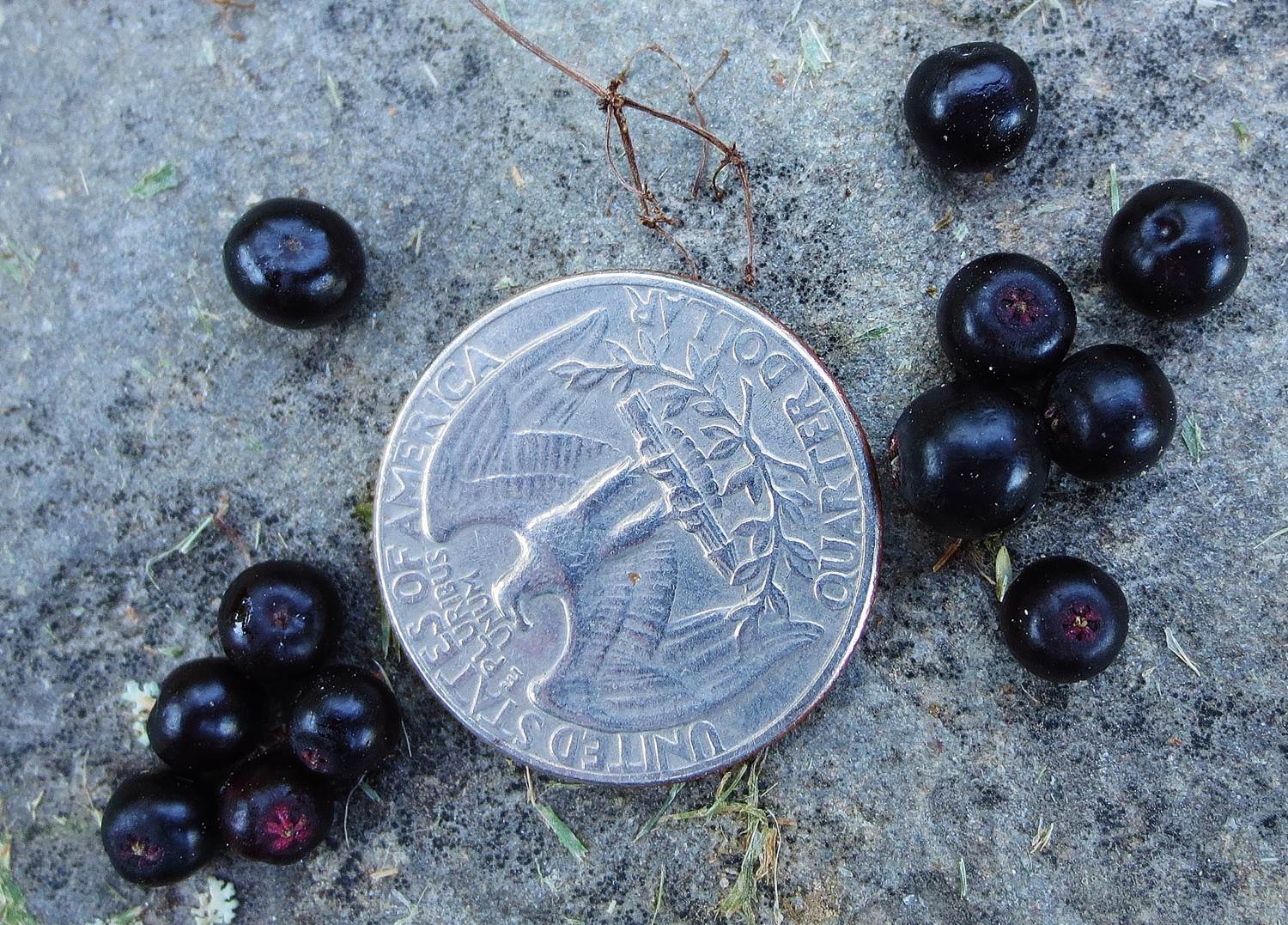
Closeup of American elderberries with coin placed for scale
Here in central New England, the tiny berries (about 3/16 inch in diameter) ripen in mid-late August, to a deep purple-black color. They’re borne in clusters at the ends of twigs. Often, some of the berries in a cluster will be ripe when others are still greenish.
I usually harvest them by gently rubbing the clusters between my fingers, allowing the berries to fall into a basket. But entire clusters break easily from the twig, so if the weather is unpleasant, I fill a basket with whole clusters and retire to a more comfortable spot for removing berries from stalks.
However you do it, be sure to pick them over and remove any plant matter other than ripe berries. You’ll have less picking over to do, if you wait until the whole cluster is ripe, but I find that if I wait that long, the birds get most of the berries.
Where to forage for elderberries
Common elderberry is native to eastern North America, but it has naturalized in some of the western states. So, its range map now includes much of the continent. It prefers fertile soil which is moist but well drained. It likes good sun exposure, so look for it in open areas. You’ll find it in ditches along the side of the road, and at field and wetland edges. If you live in a densely populated area or manicured suburb, you’ll probably have to seek out a more unruly landscape to find this plant. I live in a semi-rural town with few sidewalks, and American elderberry is quite common along the narrow roads and hayfield edges.
Preparing and eating elderberries or elderberry flowers
The flavor of the raw, ripe berries is somewhat reminiscent of blackberries, but not as juicy or flavorful. Cooking them greatly improves and intensifies the flavor. Raw berries can be dried and later cooked, or fresh berries can be boiled to make delicious juice, syrup, jelly, and jam. My favorite in the jelly/jam category is Seedless Elderberry Apple Jam. I also have a recipe for scrumptious elderberry ice cream using a syrup made with the berries. And, of course, berries can be used to make elderberry wine.
I’ve never used the flowers, but many, especially Europeans, enjoy elderflower cordial, elderflower pancakes, and elderflower fritters.
Wild elderberries have been harvested and enjoyed for many generations. Although you might not see elderberry jams and jellies at your local supermarket, you’re likely to find them for sale at farmers’ markets, farm stands, and agricultural fairs.
Be sure of identification when foraging for elderberries
As with any wild plant that you want to consume, be sure to double and triple check with other sources, until you know the plant well. Take advantage of the many wild edibles books and workshops available around the country. But I don’t mean to scare you off. Accurate identification is really not difficult once you learn to recognize the plant’s distinguishing characteristics.
For further reading, check out the USDA Plant Guide entry on Sambucus canadensis. It lacks good photos, but has a detailed technical description of the plant, as well as an interesting summary of its ethnobotany.
Shared on: Simple Life Sunday #20, Backyard Farming Connection #83, From the Farm Blog Hop