
Foraging Garlic Mustard, an Edible Invasive Plant
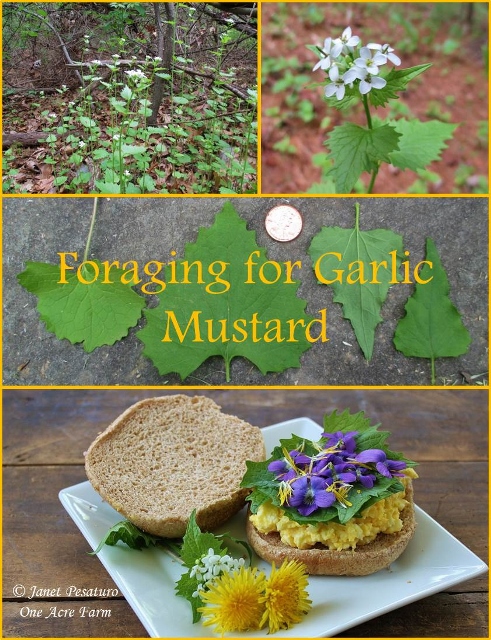
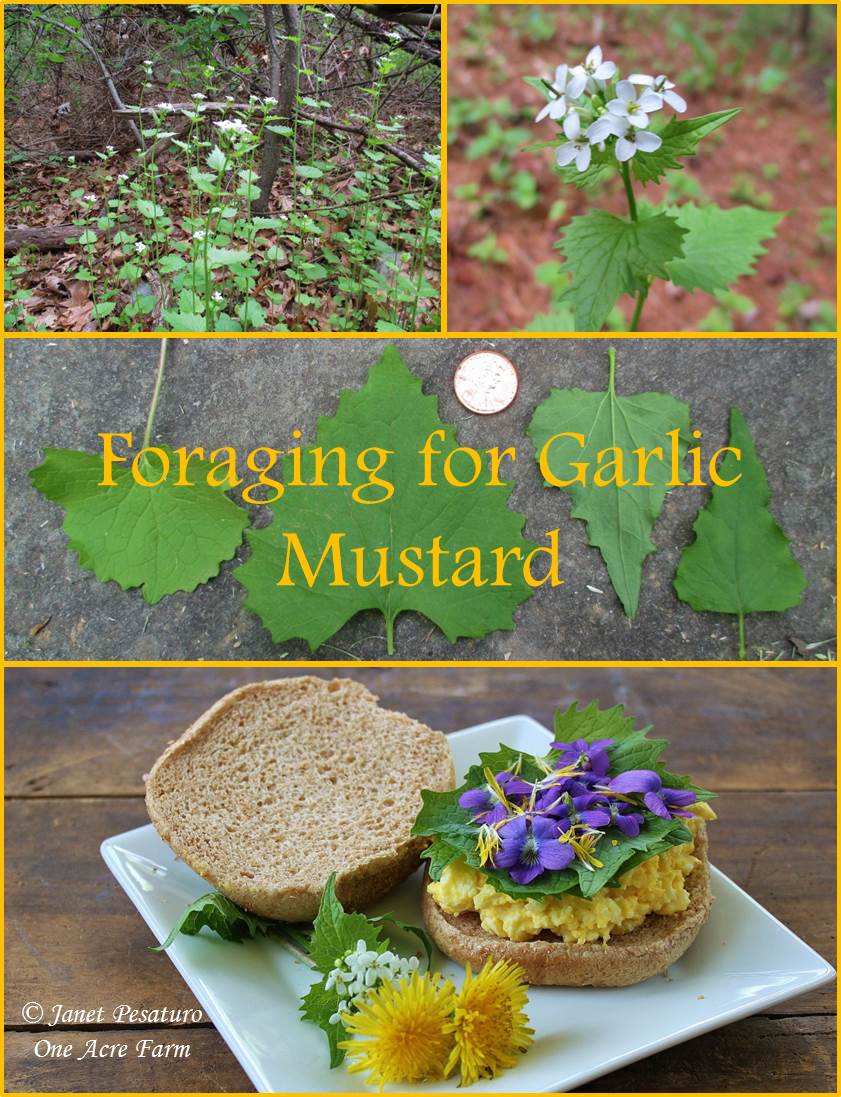
Foraging Garlic Mustard. How to identify it, where to find it, and how to harvest this abundant wild edible plant.
This European native is one of the most maligned plants in the US. In many areas, garlic mustard (Alliaria petiolata) is controlled by pulling, poisoning, and/or burning, due to its invasive nature. Controlling it by eating it is rarely mentioned, but it is a cruciferous vegetable, in the same family as broccoli, cauliflower, and cabbage. And it may be more nutritious. If you’re already familiar with this plant and want a recipe, try my garlic mustard pesto.
For a nutritional analysis of garlic mustard, I give you the esteemed Journal of Food Biochemistry. In a 1999 study, Guil-Guerrero et al. studied the nutritional composition of 5 wild edible crucifer species, with A. petiolata among them. The vitamin C contents were high, and especially high (261 mg / 100 gm) in garlic mustard. Compare this to 93 mg of vitamin C per 100 gm of raw broccoli. Garlic mustard was also high in mineral elements, carotenoids, and fiber. The authors’ conclusion? “We believe these species of crucifers could be used for dietary purposes, due to the amount and diversity of nutrients they contain.”
Yet people destroy garlic mustard and dispose of it as a noxious, invasive weed.
How invasive is it? Earlier studies describe its ability to out compete native plants and inhibit their growth. But some of the more recent studies show little affect on other plant species (Davis et al., 2012) and declining ability to inhibit the growth of other plants, over time (Lankau et al., 2009). Maybe we jumped the gun on engaging in chemical warfare with this plant? I am no purist, but the fact that we pollute with herbicides, in an effort to reduce a nutritious vegetable of questionable environmental impact, boggles my mind.
So please join me in adapting to our changing environment. Transform garlic mustard into a useful resource. Its abundance may or may not be damaging, but in either case, we can reduce it and benefit from its nutrition at the same time. Help stop the chemical warfare and start cooking with garlic mustard. I can’t wait till some clever chef discovers its great culinary potential, and gets top dollar from unsuspecting patrons who don’t realize they’re eating a weed from the edge of the parking lot.
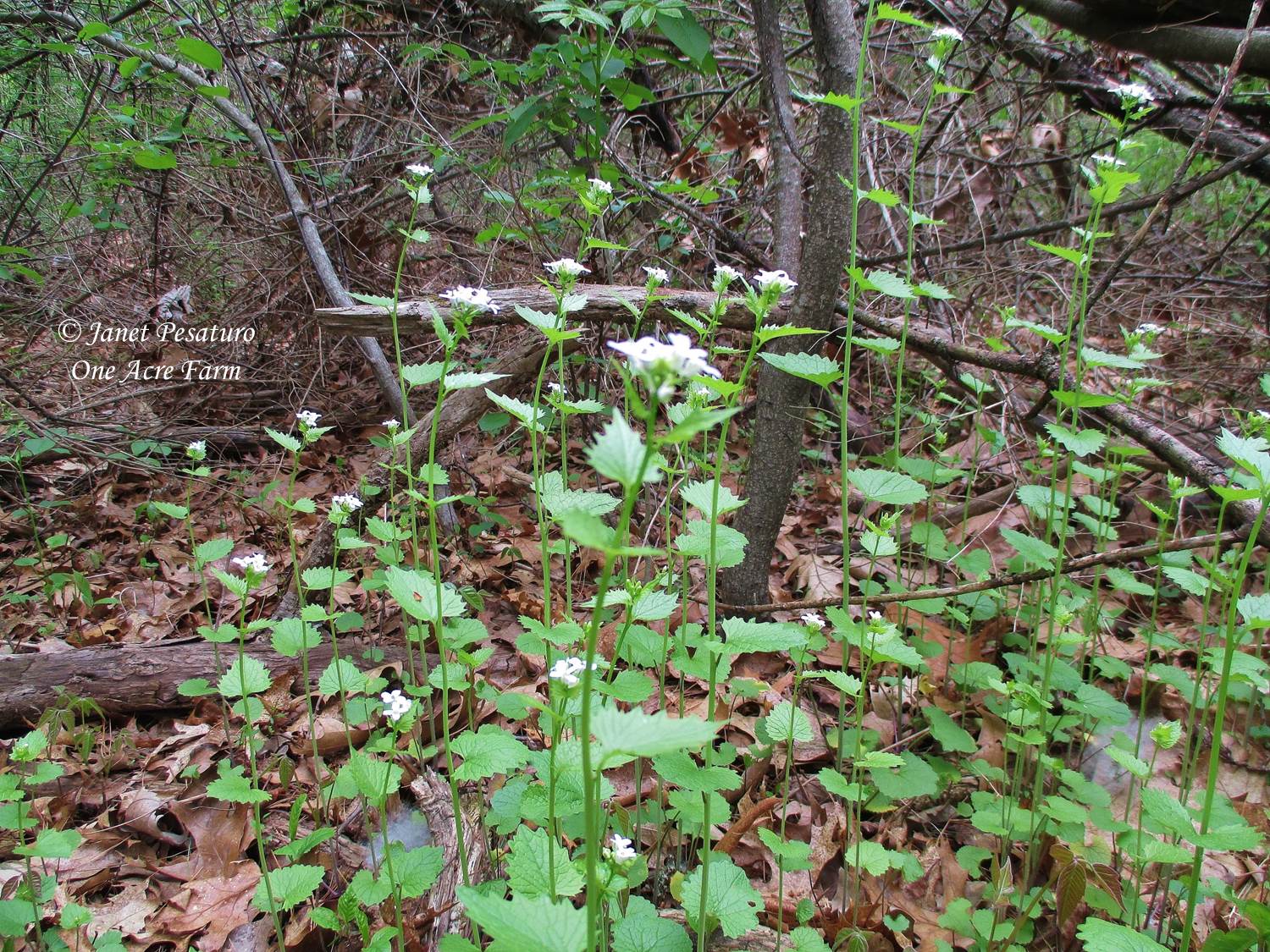
Foraging for Garlic Mustard. Photo shows a typical patch of this delicate looking plant topped with tiny white flowers.
Before I describe how to identify and harvest this plant, I want to emphasize how important it is to be 100% certain of identity before eating any wild plant. Be sure to consult several resources. Here are some of my favorites, which I use regularly:
Foraging garlic mustard: where to find it
This Eurasian native is now found in most of the eastern and mid-western US, and in Alaska, British Columbia, Ontario and Quebec, according to this range map. Within its range, look for it on roadsides, trail sides, other disturbed areas, and even in the forest understory.
If you are new to garlic mustard, the easiest way to learn to identify it is to find it in spring while it’s blooming. Here in MA, blooming begins in early-mid May. Look for a patch of a 2-3 foot tall, somewhat delicate appearing, herbaceous plant with a haze of small white flowers at the top, as in the photo above. Then examine the flowers and leaves to see if they match garlic mustard.

Foraging Garlic Mustard. Photo shows the 4-petaled, tiny white flowers atop this wild edible plant.
Identify garlic mustard flowers
The small white flowers are clustered at the top of the plant. Each bloom is about 1/2 inch in diameter and has 4 petals.
Identify garlic mustard leaves
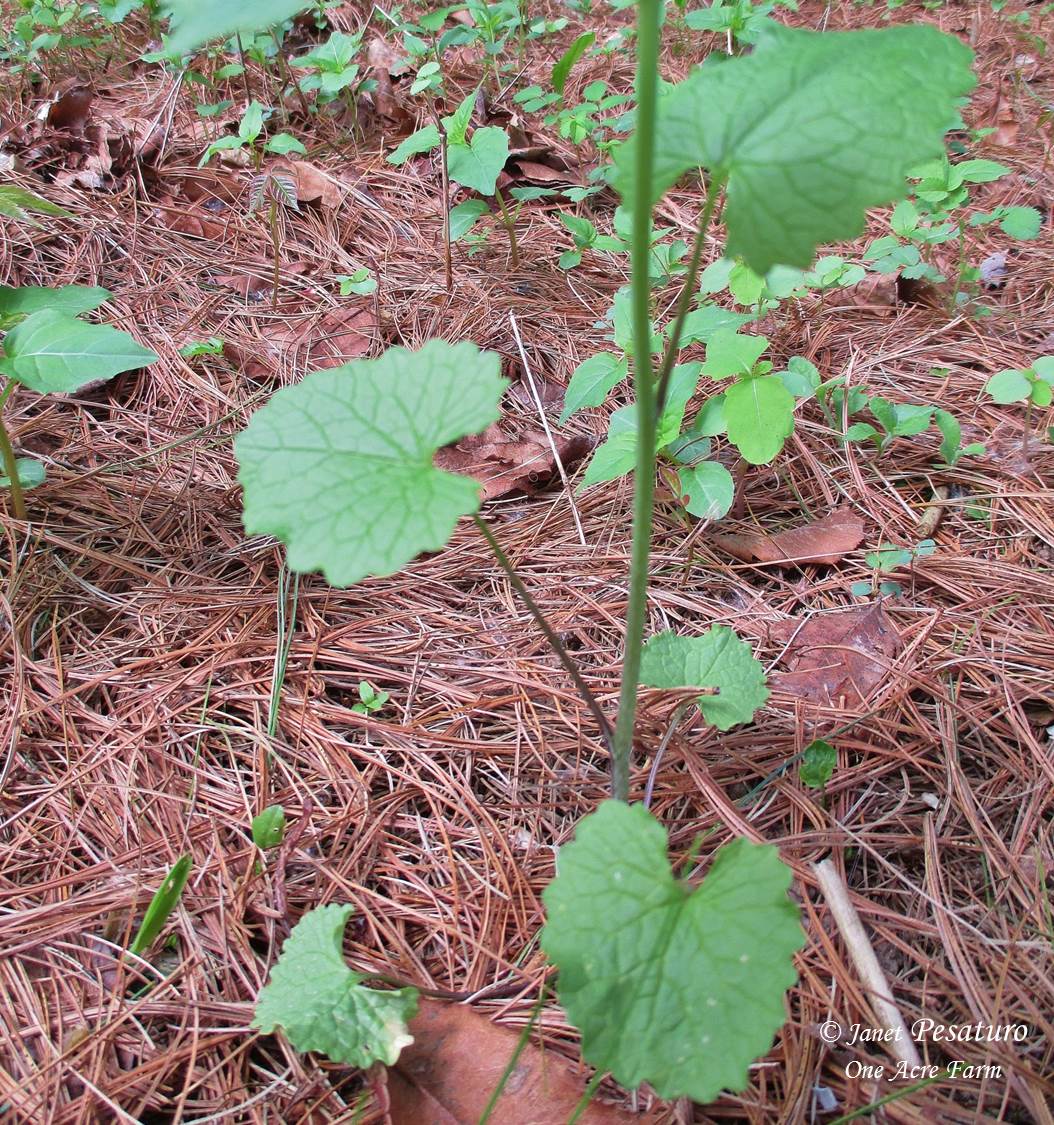
Foraging Garlic Mustard. This photo shows the typical lower leaves.
Leaves are arranged alternately on the stem. They are approximately heart shaped, but vary according to where they grow on the plant. They are about 1.5 to 4 inches long. Lower leaves are like a heart with a blunt point, and scalloped edges. Moving up the stem, leaves become longer, narrower, and pointier, almost triangular, with toothed edges. The photo at right shows lower leaves. The photo below shows a basal leaf on the far left, and leaves taken from further up the stem as you move right.
Garlic mustard is actually a biennial plant, and in its first year appears as a rosette of the roundish, scalloped leaves that grow at the base of 2nd year plants. But you don’t really need to know this to forage for it, and it’s easier to find 2nd year plants.
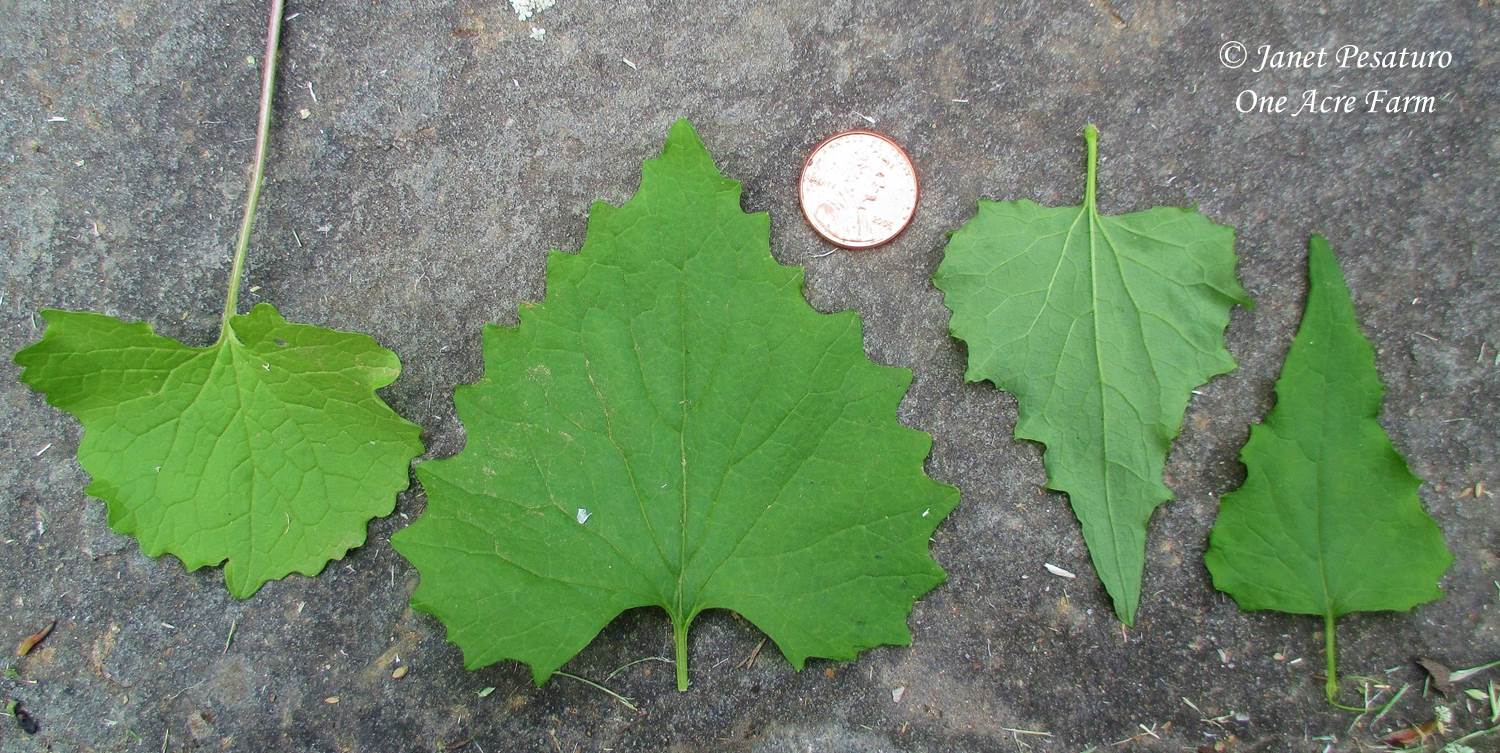
Foraging Garlic Mustard. Photo shows lower most to upper most leaves, from left to right. Coin placed for scale.
Identify garlic mustard seed pods
By mid-late May, long, skinny 1-3 inch long seed pods appear at the top where flowers once were. Ripe seeds are dark and elongated.
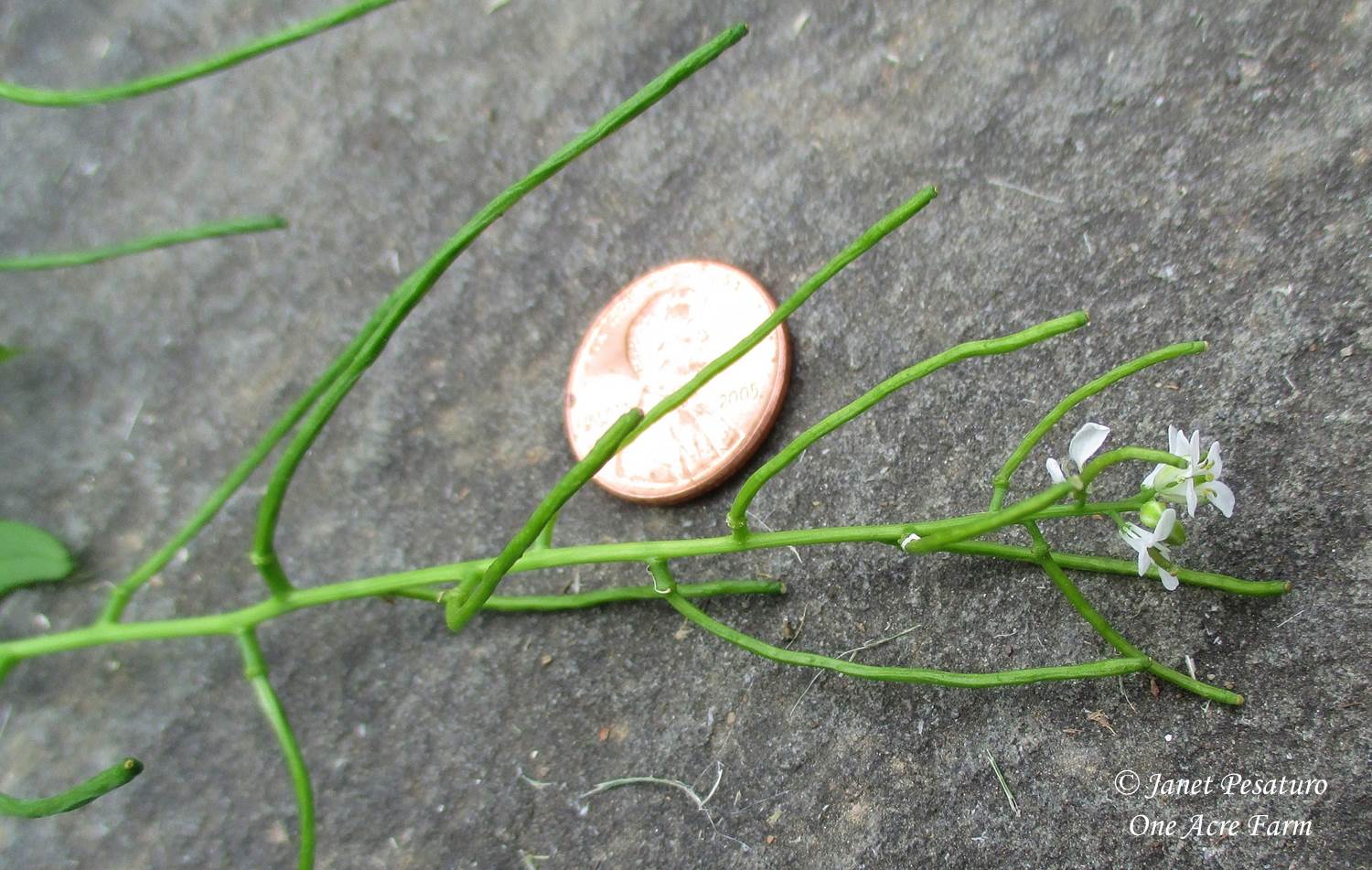
Foraging Garlic Mustard. Photo shows long, skinny seed pods. Coin placed for scale.
Harvesting and eating garlic mustard
Stalks
Young stalks are said to be best if harvested just prior to flowering. I have not tried these, and descriptions of their flavor vary from author to author. Some say they are bitter when raw but sweeten after boiling. Others say they are the best part of the plant: sweet and broccoli-like in flavor, even when raw. Perhaps the flavor varies with site conditions, plant genetics, or taste buds.
Leaves
Here in MA, I have found that leaves are somewhat pungent (sharp and peppery, I would say), but not bitter, if harvested before any of the flowers have gone to pods (at which point they do become bitter). I have found this to be true of leaves I harvest in my area, whether the soil is poor and sandy, or deep and rich. I was pleasantly surprised at the flavor – shocked, even – based on what I’d read or heard from several others. Some people describe the flavor as quite bitter, even when young.
I’m sure it’s partly a matter of taste, but not entirely, as I am not very tolerant of bitter flavors. I wonder if the wide variation in flavor description has more to do with plant genetics, especially in light of the findings of Lankau et al. (2009). They found that phytotoxin declines with time, as the plant evolves, after invasion. Perhaps the bitter compounds decline as well.
I don’t think the leaves taste much like garlic, by the way. To me, they are similar to cultivated young mustard greens that are added to gourmet mixes of baby salad greens. Except garlic mustard grows in abundance all on its own, and is free for the taking.
One friend who does like it, suggested topping egg salad with garlic mustard leaves, and I found that delicious. It also works well on tuna salad, and in mixed green salads. It’s also makes a nice pesto – click here for my garlic mustard pesto recipe.
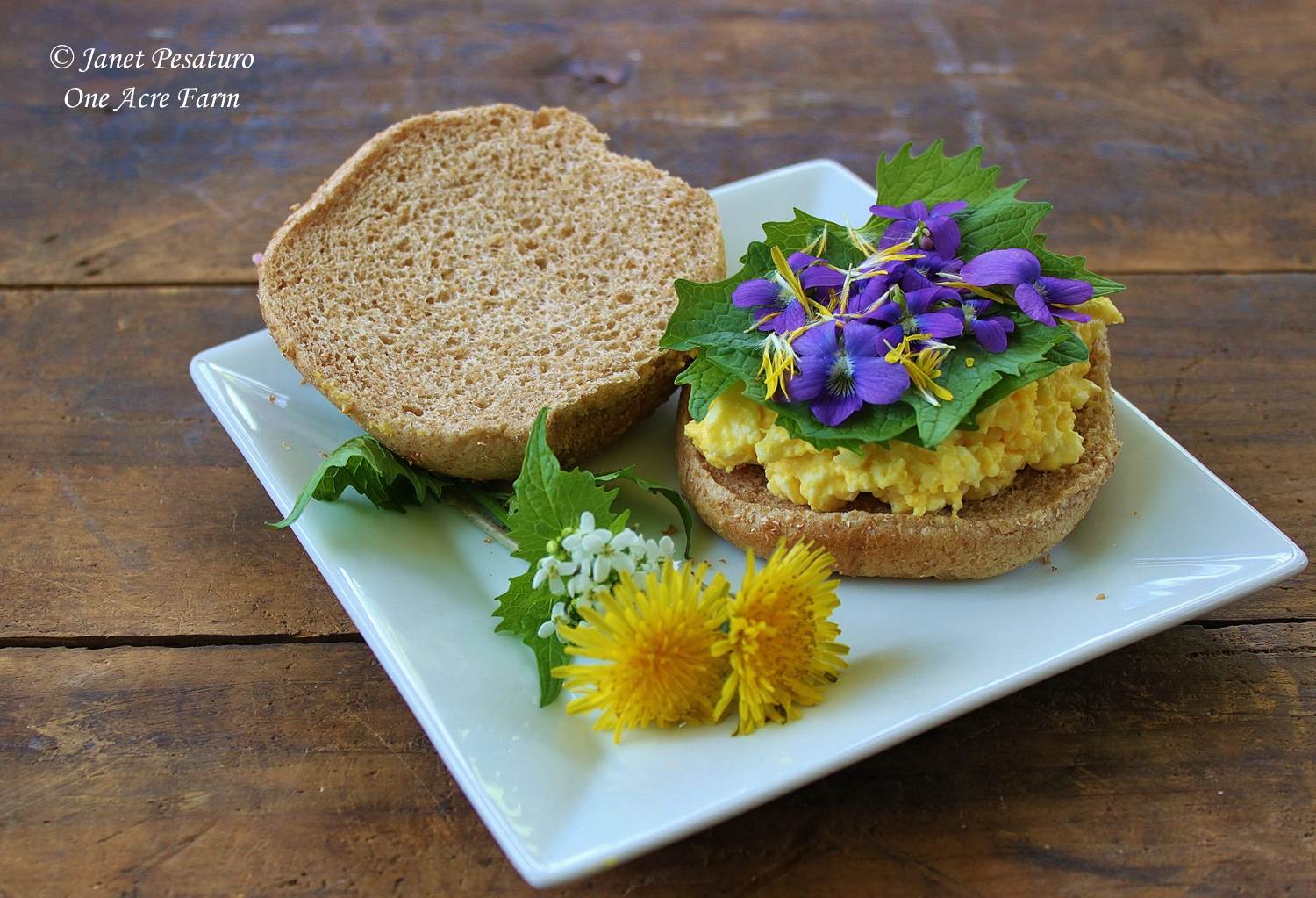
Foraging Garlic Mustard. How to identify, find, and harvest this wild edible plant. Young, raw leaves are excellent in sandwiches and salads. Here, I add violets and dandelion petals for a bit of sweetness.
Seeds
A friend of mine is working on a recipe for spreadable mustard using garlic mustard seeds. This is not something I have attempted, but look forward to her results.
Have you tried garlic mustard? Which part of the plant? How do you prepare it?
Sources:
- Davis, M.A. et al. 2012. The Population Dynamics and Ecological Effects of Garlic Mustard, Alliaria petiolata, in a Minnesotao Oak Woodland. A. Midl. Nat. 168: 364-374.
- Guil-Guerrero, J.L. et al. 1999. Nutritional Composition of Wild Edible Crucifer Species. Journal of Food Biochemistry. 23(3) 283-294.
- Kallas, J. Edible Wild Plants. Gibbs Smith publishing company, 2010.
- Lankau, R.A. et al. 2009. Evolutionary Limits Ameliorate the Negative Impact of an Invasive Plant. PNAS. vol. 106, no. 36.
- Thayer, S. Nature’s Garden. Forager’s Harvest Press. 2010.
Shared on: HomeAcre Hop #7, From the Farm, Natural Living Monday, Homestead Barn Hop #166, Mostly Homemade Mondays #87, Wildcrafting Wednesday #139