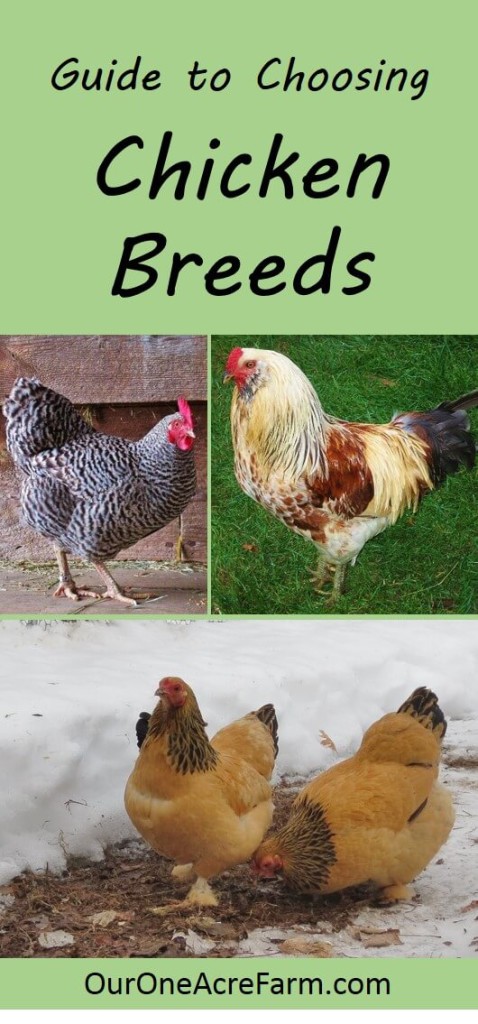
Guide to Choosing Chicken Breeds: Pick the Best Breeds for Your Flock
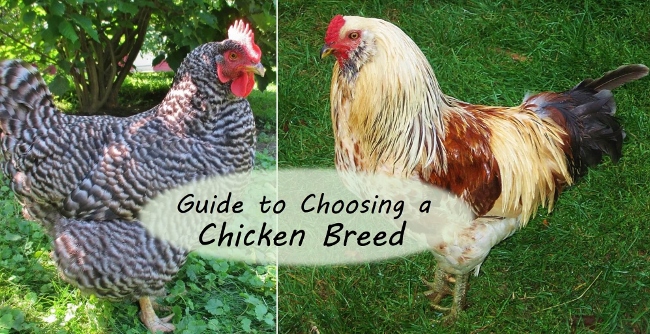
Thinking of starting a flock or adding to an existing flock, and not sure which chicken breeds to get? The options are dazzling. Chicken breeds differ in many ways, such as productivity, appearance, temperament, etc. There is no “best” chicken breed, but after reading this, I’m sure you’ll find that certain ones will be better for your particular needs. This guide to choosing chicken breeds will help you sort through the options.
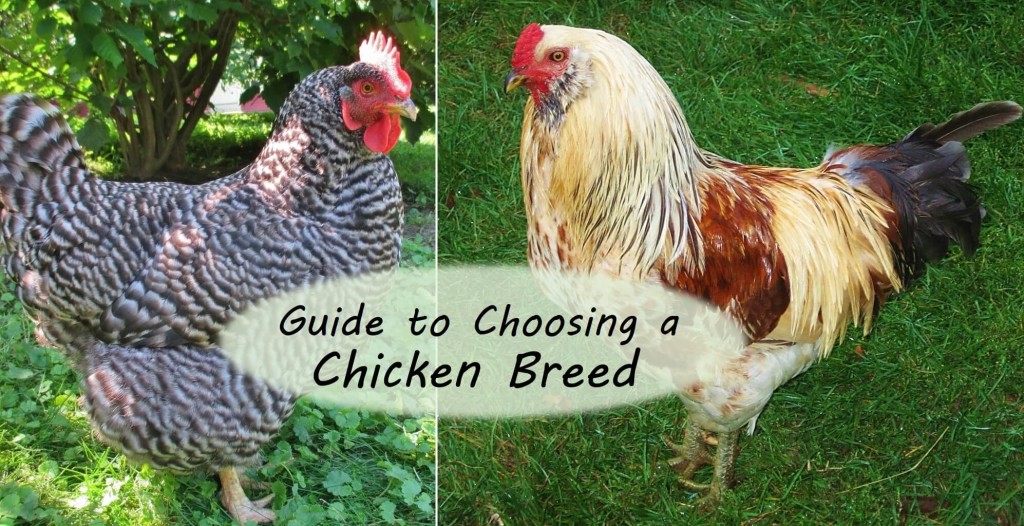
Two popular breeds for the backyard flock: Barred Plymouth Rock hen on the left, and Easter Egger rooster on the right.
Guide to Choosing Chicken Breeds
Notice I said “breeds” and not “breed”. That’s because many people, even those with small backyard flocks, keep multiple breeds. If you aren’t going to breed them, you’ll probably be happier with a mixed flock, as explained in 4 Benefits of a Mixed Flock of Backyard Chickens. However, if you are going to breed them, consider the first item carefully.
“Show Quality”
While showing chickens is not a priority for most backyard flock masters, you should think about whether you might want to breed and/or show your chickens, somewhere down the road, before you start your flock. If you do want to get serious about showing and breeding, you will want to buy your birds from a breeder who strives for the American Poultry Association Standards of Perfection. Hatchery breeders are more concerned with quantity than quality, but keep in mind that “quality” here refers to the APA standards. Hatchery chickens might not match the standards very well for plumage pattern or body type, but many are healthy, vigorous, productive, and even tempered birds, well suited to the backyard flock. Hatchery birds are also less expensive. I’ve purchased most of my chicks from hatcheries, and generally I’ve been pleased.
Utility
To choose the right chicken breeds for your flock, you need to know what you want from them. Most people want eggs, some people want meat, and some people want both meat and eggs.
Dual purpose breeds
Before the days of factory farming, many families kept chickens for two purposes: eggs and meat. They wanted chickens that could produce a lot of eggs, and could also flesh out to produce a nice roaster for the dinner table. Because these birds roamed the barnyard, a calm temperament and an inclination to forage were desirable. A tendency for some of the hens to go broody (set on eggs to hatch them) was also desirable, to ensure future generations. These breeds are excellent for today’s backyard flocks, even though many backyard flock masters don’t butcher any of their chickens. The other traits make them well suited to the home flock. Most of my chickens have been dual purpose breeds. Here are some examples:
- Plymouth Rock
- Wyandotte
- Orpington
- Sussex
- Rhode Island Red
- New Hampshire Red
- Australorp
Egg production
When egg production is the primary goal, breeders develop chickens which are extremely efficient at converting feed into eggs, without “wasting” it on flesh. Some (but not all) of these breeds were developed for factory farms. Laying breeds tend to be slender. They can be suitable for the backyard flock, but they do tend to be nervous, and because they are light weight, many can fly well. If your birds are to be contained by a fence rather than a complete enclosure, you might want to avoid these breeds. I’ve had two laying breeds (a Hamburg and a Leghorn), and they were too nervous and flighty for my taste. The Hamburg could fly onto the roof of the house even in her old age. Layers are also less likely than dual purpose breeds to go broody, which can be a good thing or a bad thing, depending on your goals. Some examples of laying breeds and hybrids:
- Leghorn
- Hamburg
- Campine
- Fayoumi
- Dominique (historically a dual purpose breed, but a very small body for meat, by today’s standards)
- Golden commet
- Red star
- Black star
Meat production
When meat production is the primary goal, breeders aim for birds that grow large thighs and breasts, without “wasting” calories on a lot of eggs. They are larger and plumper than dual purpose breeds. Cornish and Brahma are some of the old fashioned “meat breeds”. But the modern hybrid, Cornish-Rock cross, trumps them all. The big 7 pound roasters you can buy at the supermarket are Cornish-Rock crosses. Chickens raised for meat include:
- Cornish-Rock Cross
- Freedom Ranger
- Red Ranger
- Cornish
- Brahma
- Jersey Giant
Size
When selecting chicken breeds, think about the space you have available for them, and whether or not young children will be involved.
Standard sized chickens
Also called large or full sized, standard sized chickens lay the familiar sizes of eggs available in stores. Most standard sized chickens weigh 4-8 pounds, depending on breed.
Bantam chickens
Bantam chickens are miniatures, weighing about 1/4 of the size of standards. There is a bantam version of many standard sized breeds (e.g., a bantam Wyandotte, a bantam Brahma, etc.), but some bantams have no large counterpart. The Dutch and Serama bantams, for example, exist only as bantams. Bantam egg size depends on the size of the particular breed. The bantam versions of dual purpose breeds lay eggs about 1/2 the size of a standard large egg, even though the hens themselves are only about 1/4 of the size of their standard counterparts. This sounds like a great deal…except for the fact that most bantams lay far fewer eggs than their standard cousins. This is because they are bred more for appearance than utility.
Given the smaller quantity and size of the eggs, why would anyone want bantams? There are actually several good reasons:
- They require less space than standard sized birds, and can be the perfect choice for people on small lots, or for people who need to keep their chickens locked up at all times.
- Their small size and typically calm temperament make them an excellent choice when children will be involved in their care.
- They can make wonderful show birds.
- Certain bantam breeds are quite broody prone. Some people keep a few of them just to raise the chicks of their standard hens who don’t go broody. Bantam breeds particularly prone to broodiness are Cochins and Silkies. And while I’ve never seen this written anywhere, bantam Easter Eggers are, in my experience, inclined to broodiness. My bantam Brahmas, on the other hand, rarely go broody.
If you’re really short on space, consider the smallest bantam breeds:
- Serama – 1 lb or less
- Nankin – about 1.5 lbs
- Dutch – about 1.25 lbs
- Bearded D’uccle – about 1.5 lbs
- Bearded D’Anver – about 1.5 lbs
- Booted Bantam – about 1.5 lbs
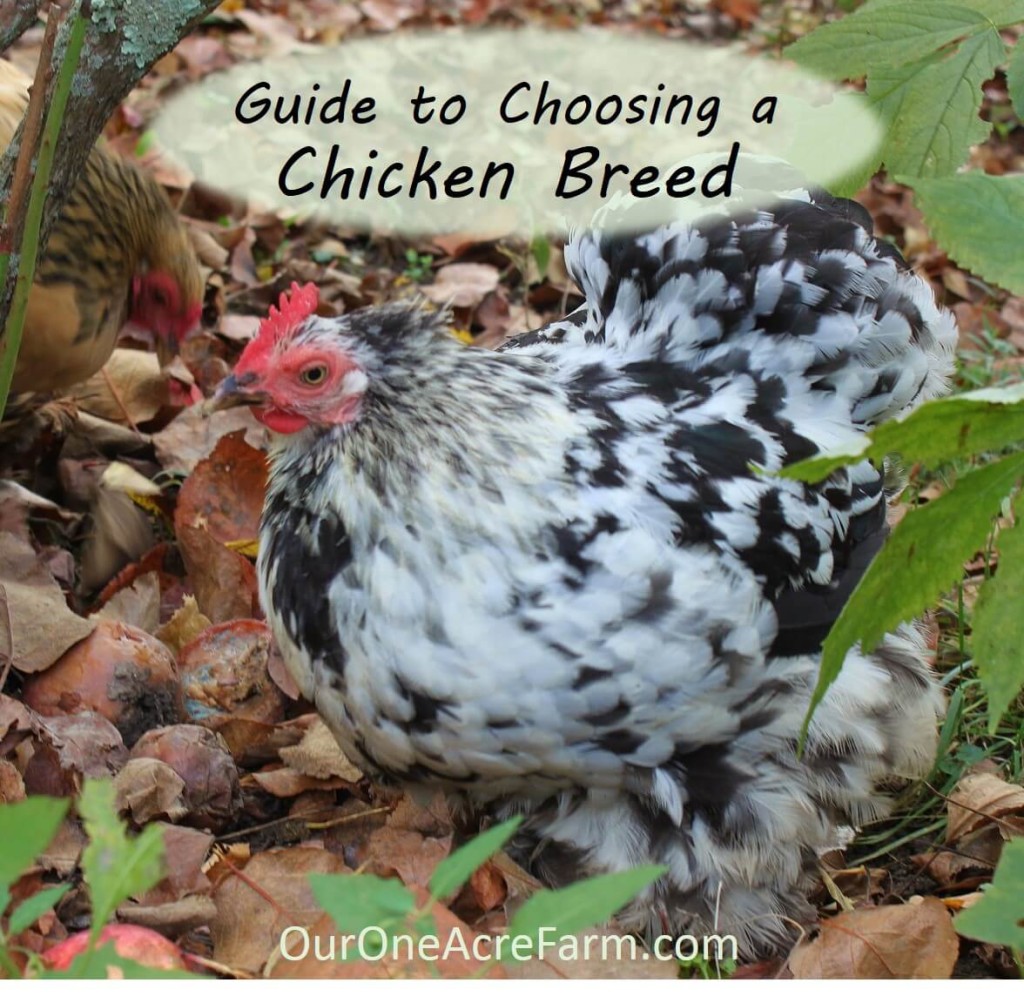
Cochin hens (here, a bantam mottled cochin) frequently go broody. Mine goes broody every summer.
Egg Shell Color
As you’ve seen in stores, chicken eggs come in white and medium to light brown. Egg shell color is breed dependent, and some breeds which are not used in commercial egg production lay eggs of other colors: dark brown, pinkish, cream, shades of blue, and shades of olive. Egg shell color does not influence flavor or nutritional value, so feel free to go wild and keep a mixed flock of backyard chickens if you want a variety of egg colors. Here are examples of breeds and the color egg they lay:
- Brown – many dual purpose breeds, such as Plymouth Rock, Rhode Island Red, New Hampshire Red, Wyandotte, Brahma, Sussex.
- Dark brown – Marans, Welsummer, Penedesenca
- White – many slender egg laying breeds, such as Leghorns, Campines, and Hamburgs.
- Cream to light brownish-pink – Easter Eggers (occasionally), Salmon Faverolles, Dorking, Cochins, Old English Game Bantams
- Blue – Easter Eggers, Ameraucanas, Araucanas, Cream Legbar
- Olive – Olive Eggers
Plumage Choices and Considerations
Flip through a book on chicken breeds, or click around some of the hatchery websites, and you’ll notice a dazzling array of plumage colors and patterns. Black, white, buff, red, “blue” (really more of a blue-gray), and all shades of brown find their way into poultry plumage. Get whatever varieties delight your eyes, but consider more utilitarian factors, as well. If your birds will spend some or all of their time free ranging, think about camouflage:
- Colors and patterns which mimic the appearance of the surroundings offer some protection from the searching eyes of predators.
- Disrupted patterns, such as stripes, speckles, lacing, etc. tend to blend better and evade predators better than solid colors.
- Neutral tones are better than white or yellow.
- Except in snow, white plumage is most easily seen by predators.
White, however, has its advantages. If you will be raising chickens for meat, white plumage is desirable because it leaves no dark spots when plucked.
There are plumage options beyond color and pattern:
- Silkies have modified feathers that look like fur. Some sources say these modified feathers afford less insulation and make the bird more vulnerable to cold weather, but other sources say Silkies are actually quite cold hardy.
- Both Silkies and Polish have exotic head feathering which can obscure vision. This makes them vulnerable to aerial predation. You can clip the head feathers to improve vision, but do you really want that extra task? If you plan to let your birds free range, you would do well to avoid these breeds.
- Some breeds have feathering on their legs. This could be an advantage in cold climates, but on the other hand, birds with feathered legs are more prone to scaly leg mites (or perhaps it’s just more difficult to treat for these mites, once a bird with feathered legs gets them).
Climate Suitability
Many chicken breeds are suitable for a range of climates, but if your winters are extremely cold or summers are extremely warm, you might want to opt for breeds which are best suited to that climate. I live in zone 5, which means are winters can be quite cold, but summer temperatures are rarely above 90 degrees, so I generally keep breeds which are best adapted to the cold.
This Wyandotte pullet has the flat rose comb typical of her breed. The rose comb is less vulnerable to frostbite than a single blade comb.
Cold Tolerance
Rounder bodies and body parts lose heat much more slowly than long, slender, or flat ones. On a practical level, you already know how quickly long, slender, or flat objects lose heat. You can touch a piece of aluminum foil right after it comes out of a hot oven, because that thin material loses heat so quickly. Similarly, fingers, toes, and earlobes lose heat quickly, and are more likely to suffer frostbite than other body parts.
Chickens with long, slender bodies will lose heat more quickly, and all else being equal, they will not tolerate extreme cold as well as chickens with roundish bodies. Large flat combs and large wattles are more vulnerable to frostbite than short thick combs and small wattles. The upshot? Chickens with rounder bodies, short thick combs, and small wattles are best suited to extreme cold. Note that some breeds traditionally labeled “cold hardy”, do have roundish bodies, but also have single blade combs susceptible to frostbite. I think this is a carry over from the days when people thought of livestock as objects with no capacity to suffer. Frostbite is painful, but livestock breeding is focused much more on production than on comfort of the animal. Read more about frostbite and chicken combs.
Chickens kept in cold climates should also have full feathering for excellent insulation. Leg feathering is also a nice feature. Some of the most cold hardy and frostbite resistant breeds:
- Chantecler
- Buckeye
- Brahma – (Has leg feathering. Males may have large wattles which are somewhat susceptible to frostbite.)
- Wyandotte – (Males may have large wattles which are somewhat susceptible to frostbite.)
Heat Tolerance
The most heat tolerant breeds have the opposite traits. If chickens will be subject to extremely warm temperatures, get slender breeds with large single blade combs. Those slender bodies and large blade combs will lose heat more quickly, helping to cool the bird. Some good choices for hot climates:
- Leghorns
- Andalusians
- Campines
- Lakenvelder
- Black Faced White Spanish
- Catalana
- Naked Neck
Temperament and Behavior
Each breed tends to be associated with certain behavioral traits. Dual purpose and “meat breeds” tend to be mellow, while slender layers are inclined to be anxious. Breeds originally developed for cock fighting tend to be feisty and aggressive. Some breeds, such as Cochins and Silkies, are more apt to go broody, while others (most dual purpose breeds) tend to be excellent foragers. While there are many exceptions, I have found these traits to be mostly true. Breeds known for calm temperament include:
- Orpingtons
- Australorp
- Cochin
- Faverolles
- Sussex
- Plymouth Rock
- Wyandotte
- Brahma
Would one ever want a more aggressive breed for a backyard flock? It’s not a bad idea to go feistier birds if you will be adding to an existing flock. The reason is that the incumbents always have the upper hand, at least temporarily, and if the newbies are very mellow, they may be subject to a lot of bullying. Birds that are able to hold their own might fare better during the integration period. The following are breeds originally developed for cock fighting. They are often used for showing now, but to some degree they still have the feisty attitude of their ancestors.
- American Game Bantam
- Cubalaya
- Modern Game
- Old English Game
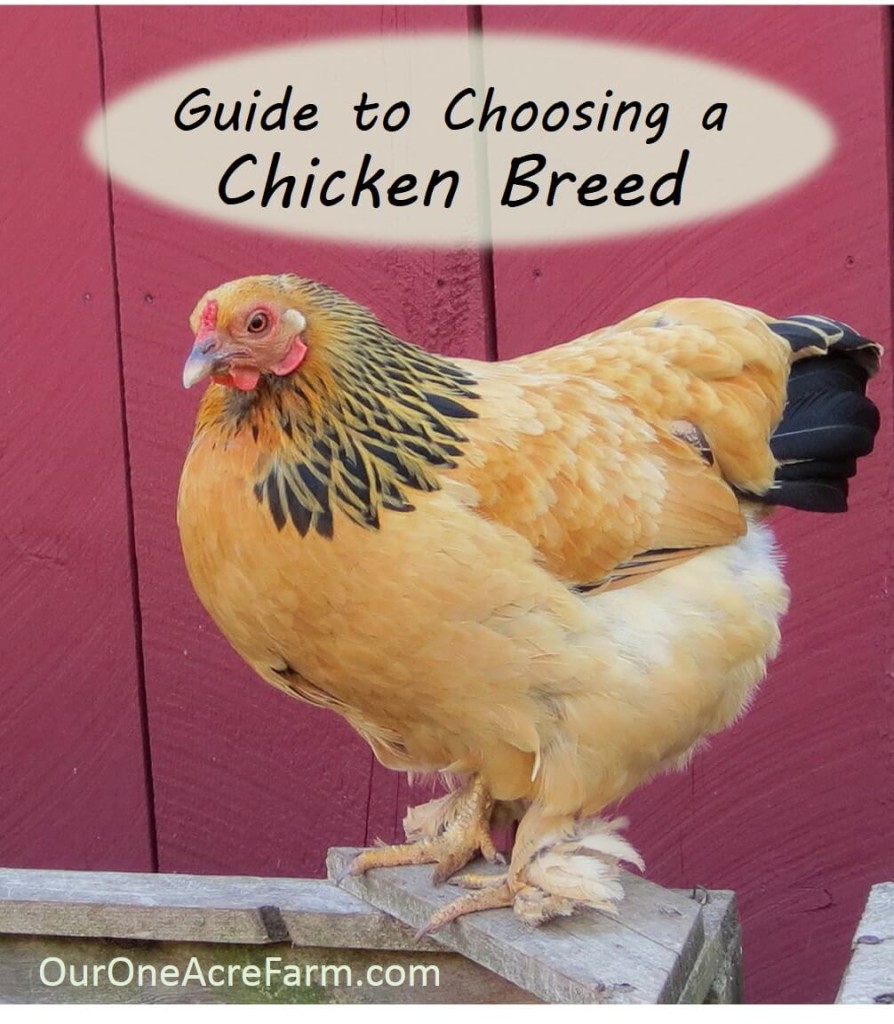
The Brahma (here, a bantam buff Brahma), is reputed to be calm and easily handled, but some of mine have been standoffish. Expect variability within a breed.
Confounding a Guide to Choosing Chicken Breeds: Variation within Breeds
While each breed is associated with certain physical and behavioral traits, there is a lot of variation within a breed. That can lead to disappointment, especially if you’re dealing with small numbers of each breed. Most Hamburgs do not go broody, but you might get one that does. Most Leghorns lay a lot of eggs, but the occasional individual doesn’t. Most Golden Laced Wyandottes have large, roundish bodies with deep gold within black lacing, but one of mine is small and slender with pale gold. Most Easter Eggers lay blue to green eggs, but a few lay brown eggs. Most Orpingtons are mellow by nature, but the occasional bird may be feisty. What to do? Use this guide to choosing chicken breeds to select what will likely work well for you, but do be prepared to accept the eventualities of Nature.
New to chickens? Ask your questions below. Are you an old hand? Tell us about your experience. What do you think are the best chicken breeds? What are the most important factors in a guide to choosing chicken breeds?
Sources
- Damerow, G. A Guide to Raising Chickens. 1995. Storey Communications, Inc. Pownal, VT.
- Ekarius, C. Storey’s Illustrated Guide to Poultry Breeds. 2007. Storey Publishing. Pownal, VT.
- Henderson’s Handy Dandy Chicken Chart