
15 Trees for a Wildlife-Friendly, Edible Landsape

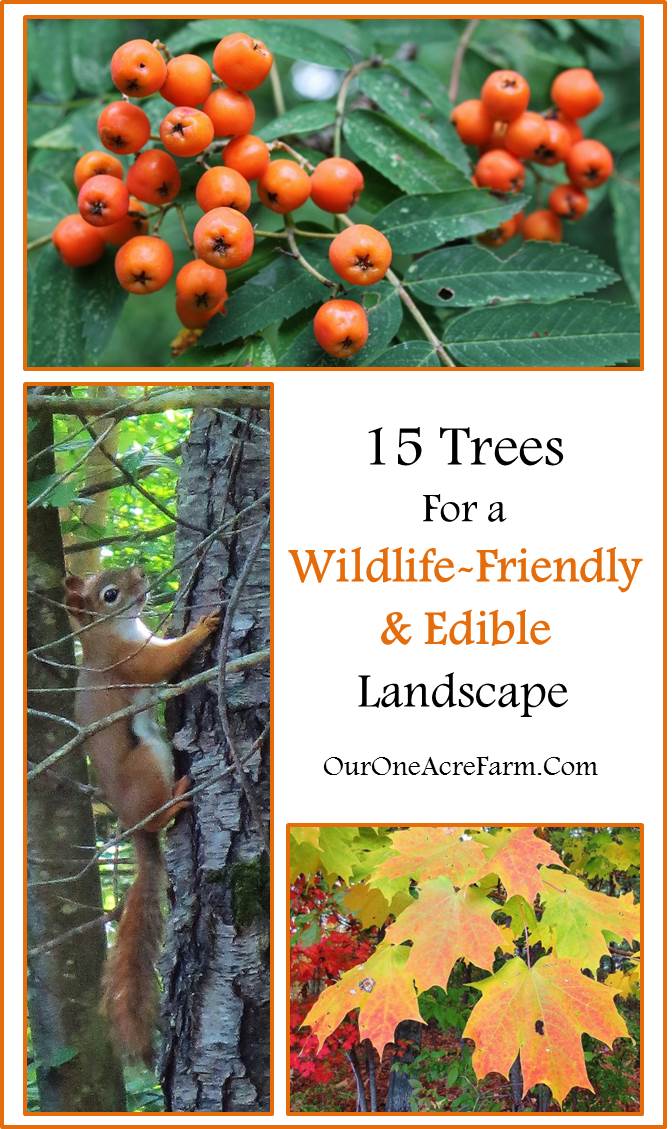 Creating a wildlife-friendly, edible backyard had been a dream of mine for years. When we saw this property 20 years ago, I knew immediately that this was the perfect place for it. The 1+ acre of land had the house within it, and trees and shrubs growing wild around the property boundary. The rest was open, without so much as a shrub at the front door.
Over the first few years, we added some of the trees on this list to the oaks, maples, birches, hickories, pines, cherries, aspens, and crabapples already on the periphery. We also added plenty of shrubs, a flower garden, and a vegetable garden. Then the magic began to happen. The yard came alive with wildlife, and yielded fresh, organic food for us!
Basic considerations
- Choose trees native to your area, because they fulfill the needs of native animals better than non-native plants.
- Consider soil type, moisture, and climate preferred by each tree.
- Think beyond berries and birds, and consider nectar, leaves, buds, and twigs as food for insects and mammals, as well as for birds.
Books which I have found indispensable in developing my edible wildlife habitat
Please note that this blog is not meant to be THE definitive sources on edible wild plants. Always consult several authoritative sources before consuming any wild plant! Eat only when you are certain of the plant’s identity.
15 Trees for a Wildlife-Friendly, Edible Landscape
All of the trees here provide excellent food, cover, and/or nesting sites for wildlife, as well as food for people.
Small trees
These are trees which typically grow to less than 50 feet in height, and which tend to fruit at a younger age. They are good choices for planting if you want to harvest their fruits within your own lifetime!
1. American Mountain Ash, Sorbus americana
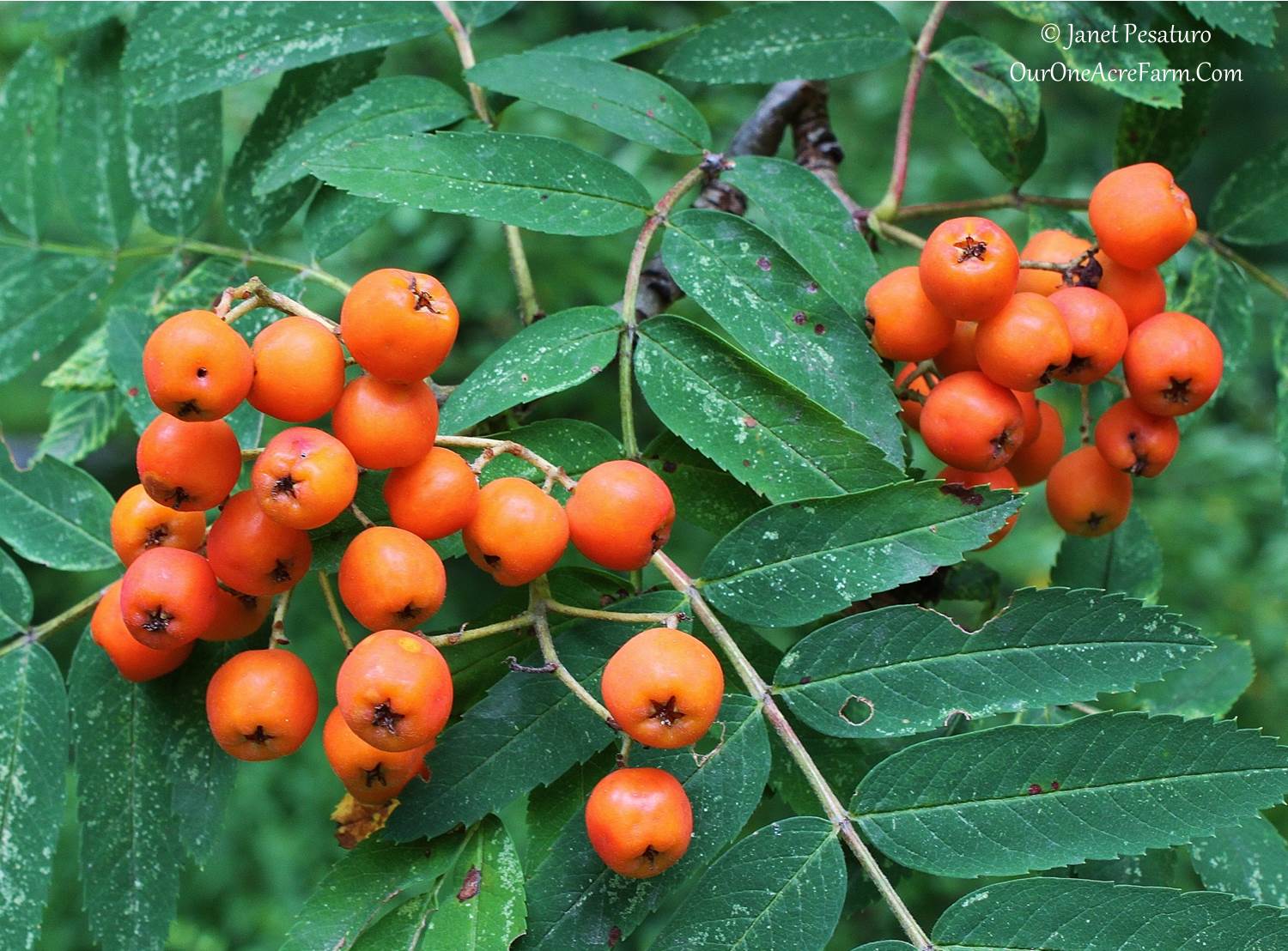
This is European mountain ash, but go with the American mountain ash. It looks very similar.
Almost 20 years ago, when we were planning an edible and wildlife friendly landscape for our yard, I had American Mountain Ash on the list. Unfortunately, I allowed myself to be talked out of it. I was told that the native tree tends to be short-lived. So instead, I chose the European mountain ash. If I had fully understood how important native plants are to our native animals, I never would have made that decision.
Wildlife value
- At least 25 bird species are known to eat them, and turkey, pileated woodpecker, eastern kingbird, gray catbird, eastern bluebird, and red-eyed vireo are quite partial to them. Bears, fishers, and martens also like the berries.
- The flowers are pollinated by a variety of native insects
- Host plant for the larvae of tiger swallowtail butterflies
Edible berries
- Used for jellies, jam, and wine, and often cooked with meat
- High in vitamin C, vitamin A, and iron
Other notes
- Often dies by the age of 30.
- Can live for 70 years in optimal conditions (cool, humid climate and rich soil).
2. American Persimmon, Diospyros virginiana
This is not a tree I have personal experience with, because it ranges further south. But it’s valuable for the edible and wildlife friendly garden, and seedlings fruit within 6 years after planting.
Wildlife value
- Fruit preferred by waxwings, mockingbirds, catbirds, robins, turkeys, woodpeckers, foxes, bears, raccoons, skunks, rodents, and others.
- Flowers are of special valuable to honeybees, and it is a host plant for larvae of the luna moth.
- Deer browse it.
Edible fruit
- For jams and jellies.
- Seedlings may bear fruit within 6-10 yrs after planting
3. Cherry, Prunus species
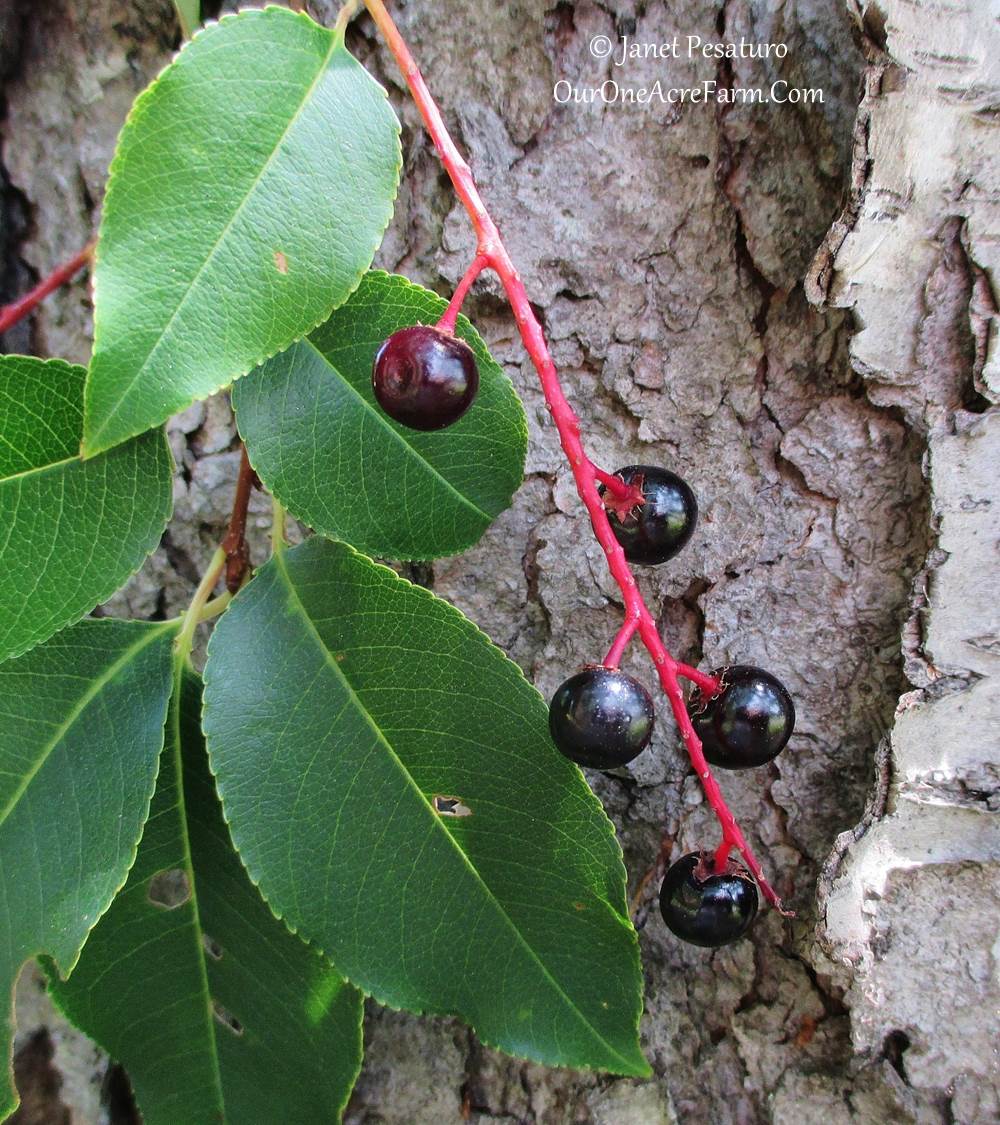
Fruits of black cherry are taken by many birds and mammals. You can use them for jams and jellies.
Native cherries are excellent choices for the edible and wildlife friendly garden. Black cherry, Prunus serotina, is very common along one of my walking routes, and every year I see Baltimore orioles nesting in it. It’s on the borderline between “small” and “large” since it sometimes reaches 60 feet. But its relatives, pin cherry and chokecherry are much smaller, and offer similar landscape value.
Wildlife value
- Host plant for over 200 species of butterflies and moths, including tiger swallowtails, coral hairstreak, striped hairstreak, red-spotted purple, cecropia, promethea moth, and hummingbird clearwing moth.
- The berries are a favorite of at least 50 species of birds, including various woodpeckers, tanagers, orioles, finches, sparrows, and grouse.
- Pollinating bees, flies, and beetles visit it for pollen and nectar.
- Mammals seem to like the berries as much as birds. Every summer, I find fox scat full of remains of black cherry. Bears, raccoons, squirrels, and mice also enjoy them.
Edible berries
- Make delicious jellies and jams.
Other notes
- The wood is valuable.
- Twigs are toxic to cattle and horses.
4. Common Hackberry, Celtis occidentalis
I am in search of the common hackberry. If you see on in Central or Eastern MA, please contact me! Seriously, it’s one of those trees I just haven’t encountered. Or maybe I’ve seen it but confused it with something else. Common hackberry usually maxes out at a height of 50 feet, but under ideal conditions, it can grow much taller.
Wildlife value
- Very sweet berries appeal to many birds, especially thrushes, cardinals, turkeys, and some woodpeckers.
- Mammals such as bears and raccoons also relish the berries.
- Deer, rabbits, and woodchucks love to browse the twigs.
Edible parts
- Berries are palatable and digestible in the raw, but there are many other ways to use them.
- Berries are unusually high in fat, carbohydrate, and protein, offering great nutrition for both humans and wildlife.
5. Hawthorns, Crataegus species
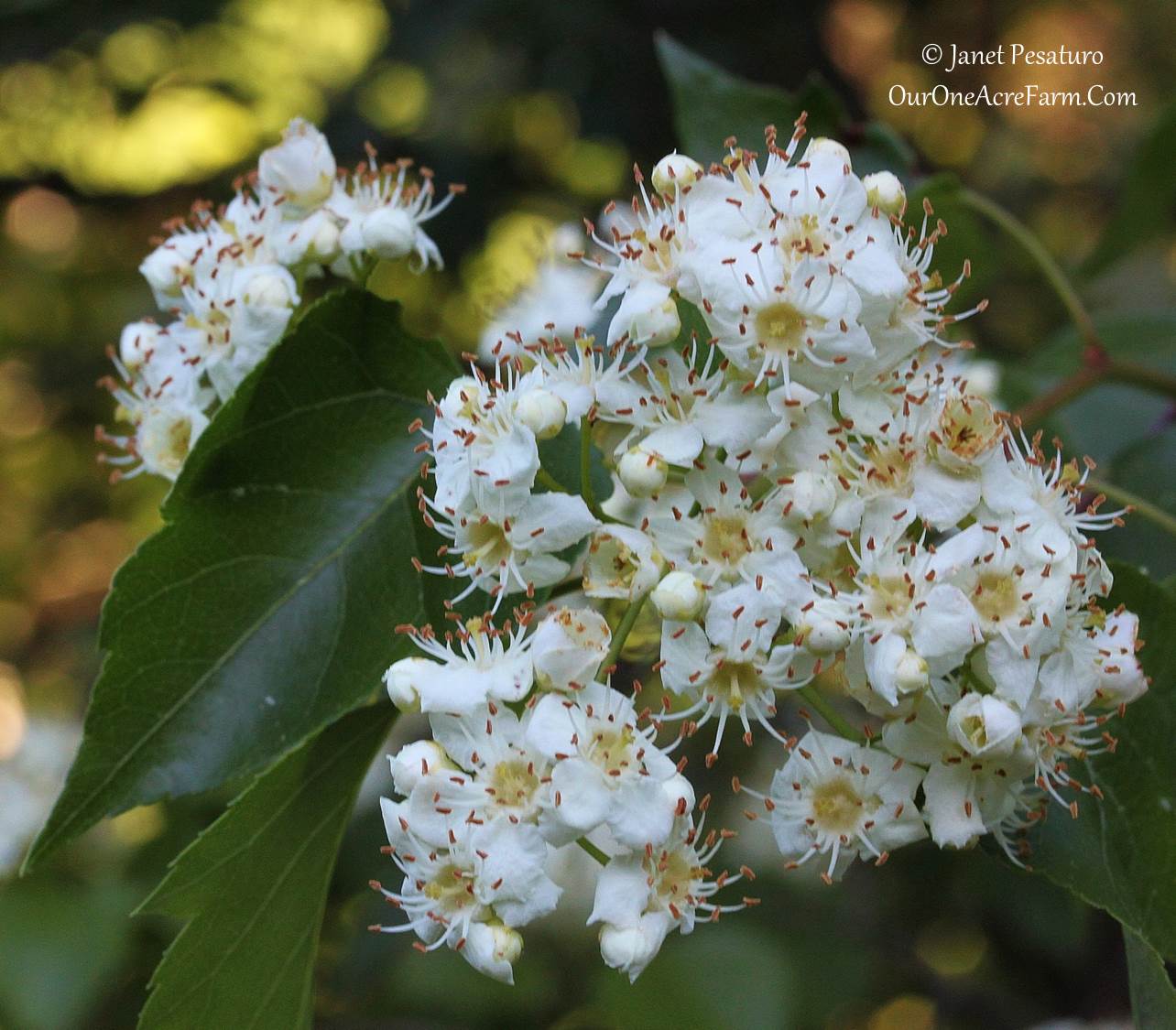
The flowers of Washington Hawthorn are visited by many pollinators. Birds love the berries, and you can cook with them.
There are many species of hawthorn native to North America, all with excellent wildlife value. So take your pick, but consider these 2 words of advice: 1. Grow one that is appropriate for your particular hardiness zone, and 2. Avoid planting non-native hawthorns, because some are invasive, and none support native wildlife as well as native hawthorns.We have a Washington Hawthorn that is alive with pollinators when in bloom, alive with birds when berries are ripe.
Wildlife value
- Many birds take berries in winter. Ruffed grouse, cedar waxwings, and fox sparrows are particularly fond of them.
- Thorns provide good protection for nesting birds.
- Flowers feed a multitude of pollinating insects.
Edible berries
- Mildly sweet and can used to make jellies and jams.
- Can also be used to make hawthorn berry extract.
Other notes
- Susceptible to rusts and blights, eastern red cedar is host to one of the destructive rusts and should not be planted near it. (We planted a Washington hawthorn over 15 yrs ago and have had no problems with pests.)
- Can be used to create an impenetrable, thorny hedgerow.
6. Red Mulberry, Morus rubra
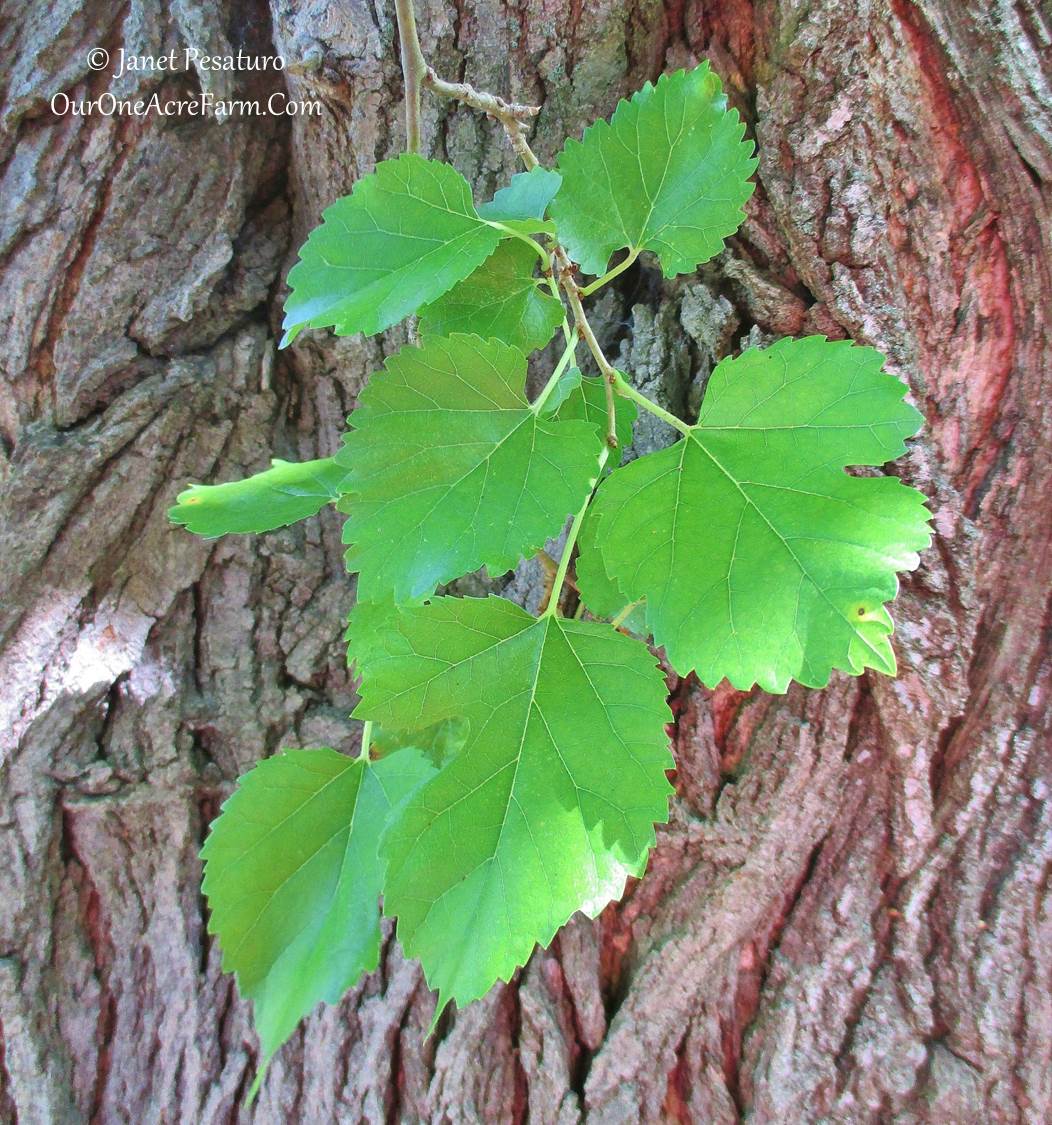
Leaves and bark of red mulberry, an excellent tree for a wildlife-friendly, edible backyard.
Oh, how I would love to have a red mulberry in our yard. It’s native, and the sweet berries are prized by countless birds and mammals, and by my own palate. They are truly delicious.
Wildlife value
- Larval host plant for mourning cloak butterfly.
- Berries are taken by over 40 species of bird, and preferred by many of them. Various woodpeckers, thrushes, waxwings, tanagers, sparrows, orioles, jays, and more, all love these berries.
Edible berries
- Sweet and delicious
- Can be eaten raw, by the handful!
Other notes
- The tree might fruit heavily by the time it’s 10 years old
- Prolific fruiting can leave a mess on the ground if you don’t harvest any berries. Don’t plant it where that will bother you.
7. Serviceberry, Amelanchier species
There are many serviceberries native to North America, and they are way under utilized in the wildlife and edible garden. Some grow as shrubs and some grow as small trees. We have 3 serviceberry trees in our yard, and they are my favorites. In spring, serviceberry is a lacy veil on the landscape, with its whispy branching habit and delicate white or pale pink flowers. And in fall, the leaves turn bright yellow, orange, or red.
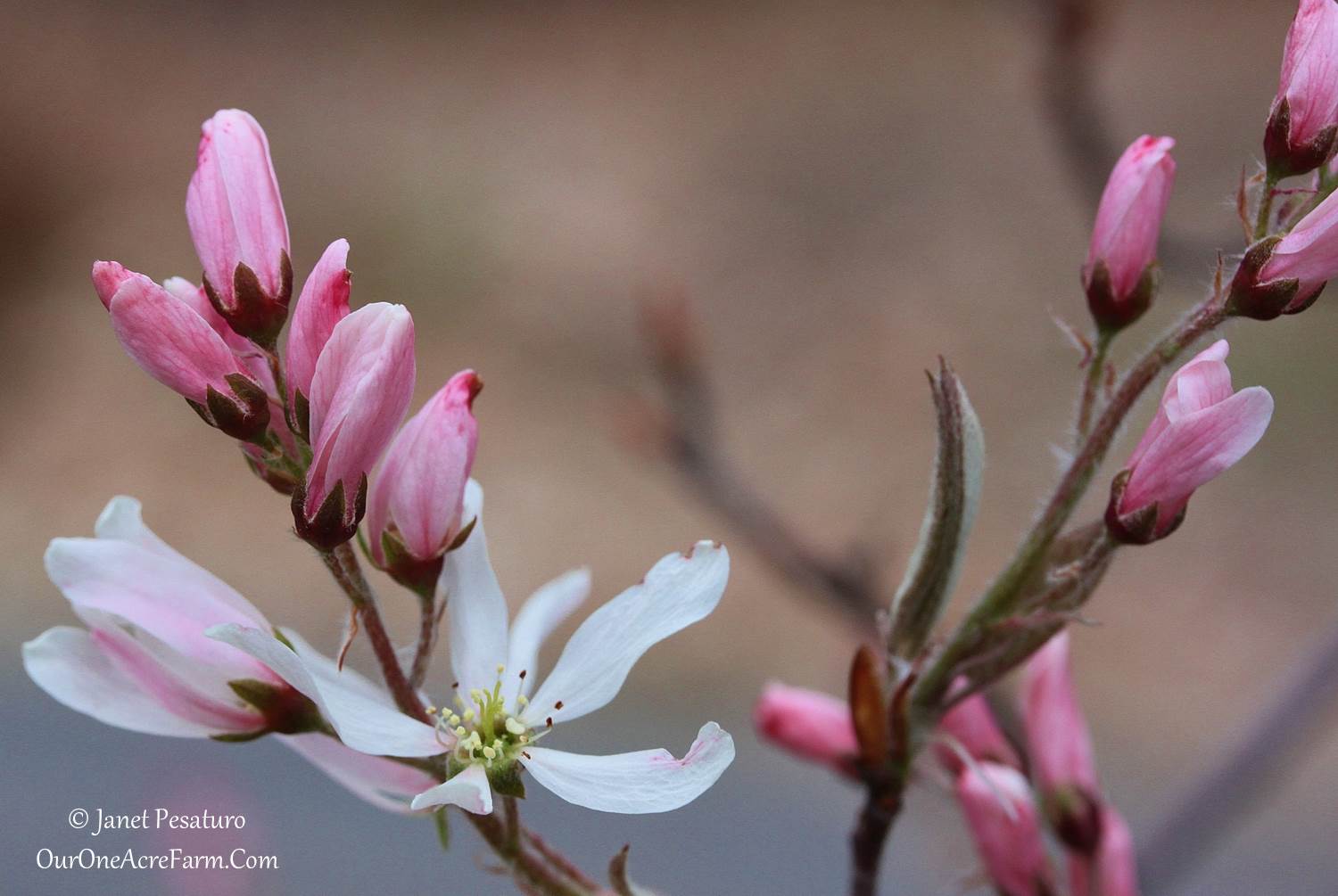
Serviceberry has beautiful pink or white flowers in early spring.
Wildlife value
- Because it blooms early, it is especially useful for pollinators when there is little else available. Mine are always buzzing with pollinating insects, when blooming.
- Larval host plant for red-spotted purple butterfly.
- Thrushes, orioles, tanagers, woodpeckers, grouse, American redstart, and cardinals, are among the approximately 30 bird species known to enjoy serviceberries.
Edible berries
- Sweet enough to be eaten raw.
- May be too sweet for jellies and jams, but are said to be excellent when dried.
Other notes
- In some areas (such as my area of Massachusetts), serviceberry fruits are damaged by rust, leaving few good berries.
- In other areas (perhaps the midwest) it does extremely well, providing abundant fruit for many wildlife species, and for people.
Large trees
These trees all grow taller than 50 feet, and take longer to fruit. Plant them for their wildlife value, or to benefit the next generation. If you already have mature trees and need to remove some, use this as a guide for which trees to retain.
8. American Basswood, Tilia americana
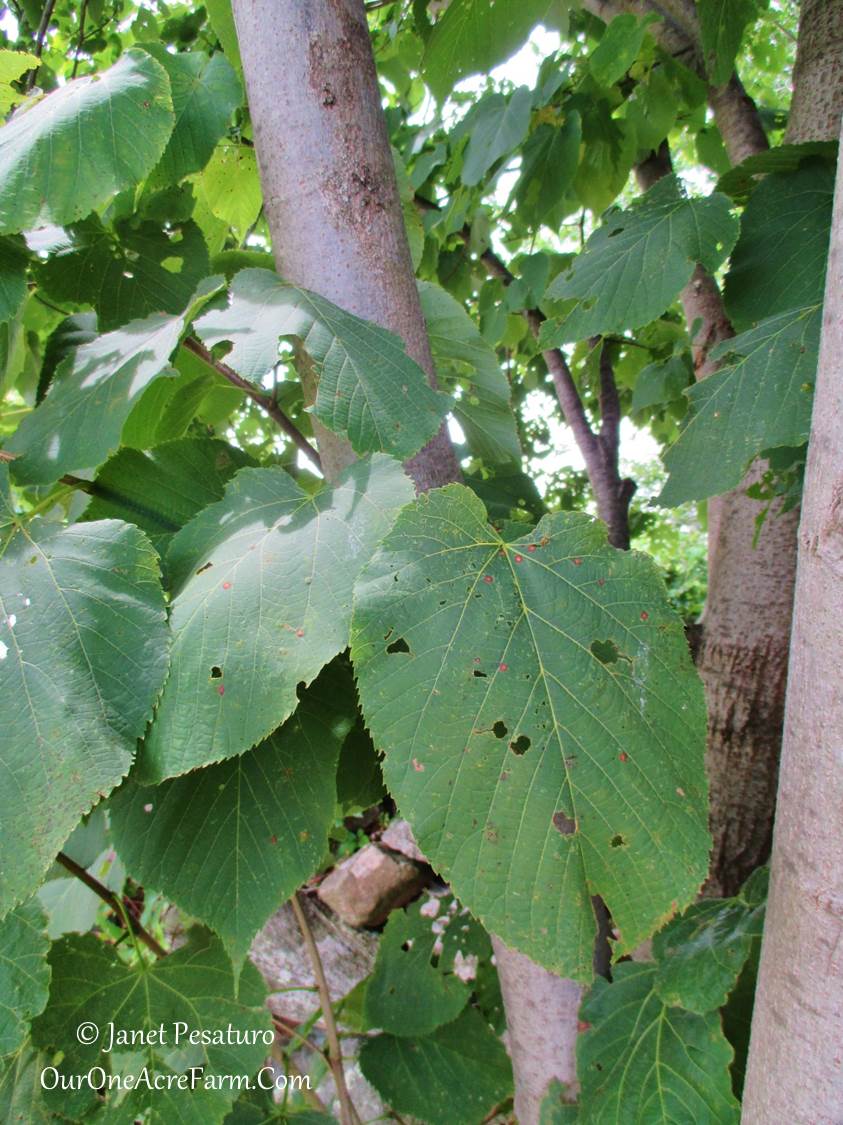
The heart-shaped leaves of basswood are edible in early spring, just after they unfurl.
The basswood, also called Linden, is not often considered for its wildlife value, possibly because it does not have conspicuous fruits favored by birds. But my own philosophy is that it’s best to provide for a diversity of wildlife, and this tree appeals to a different group than the berry eating birds.
Wildlife value
- Favored by sapsuckers for drilling sap wells. These wells provide food (sap) not only for the sapsuckers, but for ruby-throated hummingbirds, which drink from these wells in early spring, when flowers are scarce.
- Flowers are highly attractive to bees due to prolific nectar production.
- Larval plant for red-spotted purple, mourning cloak and eastern tiger swallowtail butterflies.
- Seeds are eaten by many small mammals, such as squirrels, chipmunks, mice, and voles.
- As the tree declines, cavities form that attract many cavity nesting wildlife species, such as wood ducks.
Edible parts
- Young leaves can be eaten as a salad green. They are best in spring, just after the leaves unfurl.
- Sap can be boiled to make syrup
9. American Beech, Fagus grandifolia
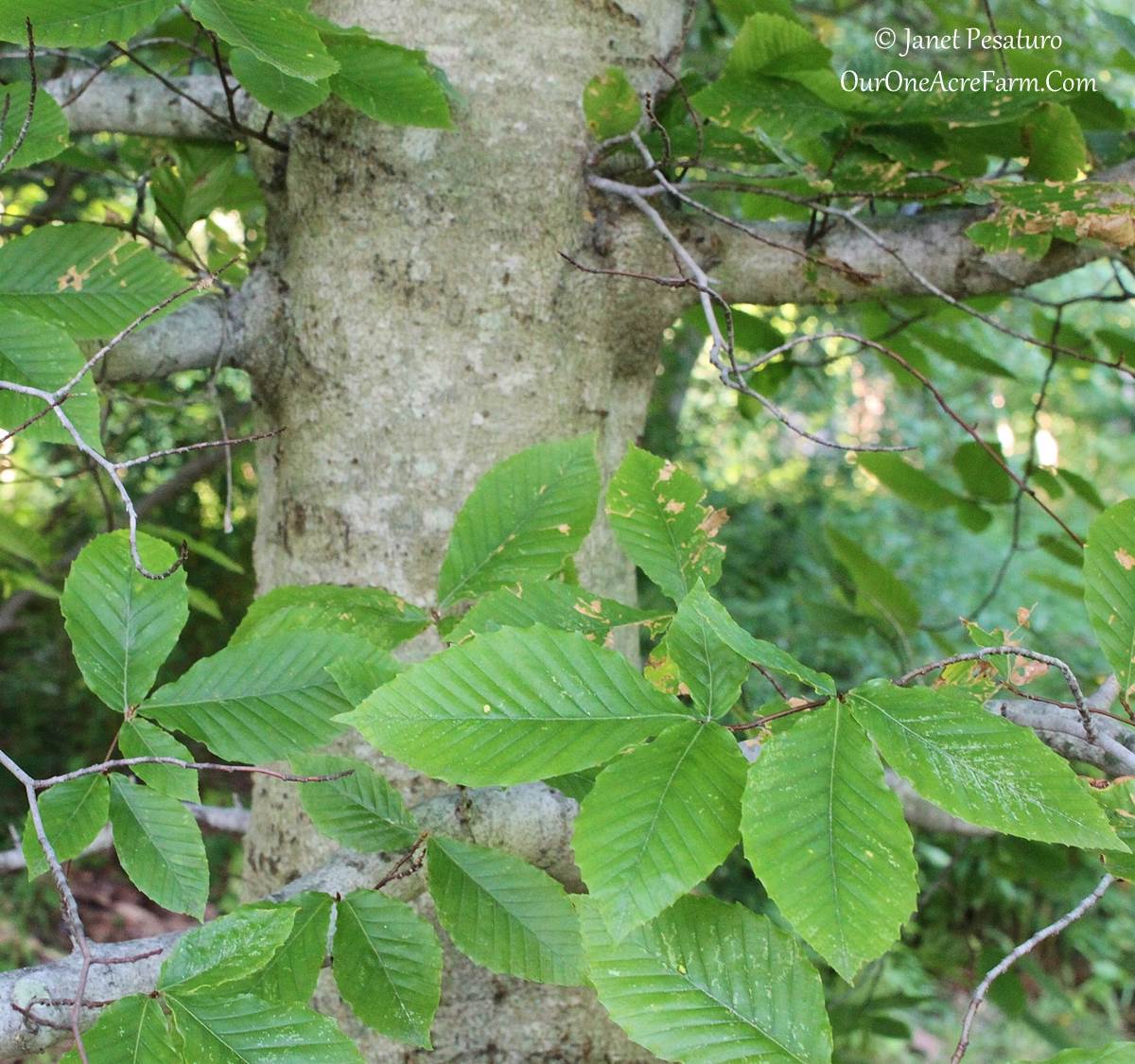
American beech has smooth bark even when mature. When fruiting, this tree is alive with hungry mammals and birds.
This is an excellent tree for both humans and wildlife. Its unusually smooth bark is beautiful and provides a nice contrast to the rough bark of many other trees.
Wildlife value
- Many kinds of animals, from birds to mammals, relish the small nuts.
- Turkeys, wood ducks, ruffed grouse, woodpeckers, nuthatches, jays, and crows all love them.
Edible parts
- Some people love the nuts, but preparing them requires a lot of work. They must be hulled, husked, and (at least) slightly cooked. I don’t feel it’s worth the time.
- Young leaves in spring, just after they unfurl, are sweet and edible, though not quite as tender as lettuces.
Other notes
- Beech is susceptible to beech bark disease, which has a fungal and insect component. Some trees may be resistant, but others die within 5 years.
- If the tree is not stressed, it can live for many years with a sub-lethal infection.
10. Birches, Betula species
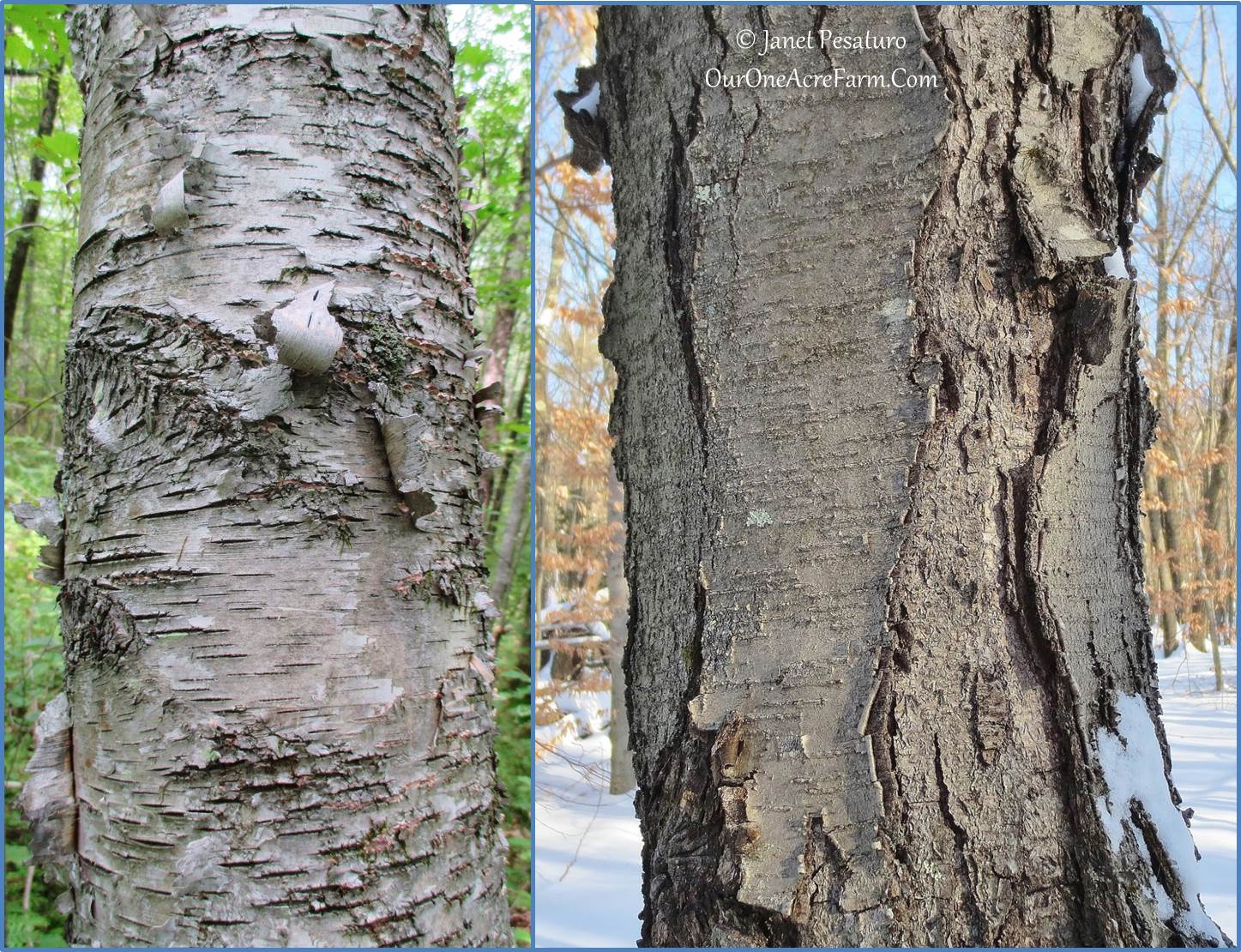
Bark of paper birch on the left, and black (sweet) birch on the right.
There are many birches native to North America, but paper birch (Betula papyrifera) or black birch (Betula lenta) are best for birch syrup production (see below). Paper birch is stunning in the landscape, but does best in cold climates. So if paper birch isn’t a good choice for your yard, consider black birch. It lacks the striking white bark of its cousin, but it’s longer lived and more tolerant of warmer climes.
Wildlife value
- Seeds favored by many small birds, such as goldfinches and siskins.
- Grouse feed on the buds.
- Host to over 400 species of butterfly and moth, including eastern tiger swallowtail, and some of our giant silk moths, such as the luna, cecropia, and polyphemus moths.
Edible parts
- Sap of paper birch and black birch can be tapped to make a delicious syrup with many uses. See my recipe for Birch Syrup Ice Cream.
- Birch syrup is popular in Canada and Russia, and becoming more popular in the US.
- You can make wintergreen extract from twigs of yellow birch or black birch
11. Black Walnut, Juglans nigra

Black walnut in early fall, with ripening nuts.
If you are interested in edible wild nuts, you should taste the black walnut before planting a tree or retaining it in your forestry plan. Most people either love ’em or hate ’em.
Wildlife value
- Squirrels of all kinds love black walnuts, and are well able to open their shells with their large incisors
- Many birds species appreciate the nuts, but cannot open the thick shells. They can, however, pick out left over fragments of nutmeat which have been opened by squirrels.
- Popular roosting tree for eastern screech owl
- Deer browse the buds, and rabbits and mice nibble at the twigs.
Edible parts
- The nuts are edible, but but some people find them very bitter.
- Variation in perception of bitterness in the black walnut may be due to genetic differences. See explanation on my black walnut ice cream recipe.
- It is said that the longer a fully ripened nut stays in the husk, the more intense the bitterness, though I have not put this to the test.
- Some people really love black walnuts!
Other notes
- Black walnut produces a compound called juglone, which inhibits the growth of some other plants, so plant it away from your vegetable garden, and don’t plant a lot of them.
- A number of plants are resistant to juglone, such as beech, birch, and maple.
- Juglone shouldn’t necessarily scare you away from black walnut. Certain other plants also produce compounds that inhibit the growth of other plants; this is not unique to black walnut.
12. Hickory, Carya species
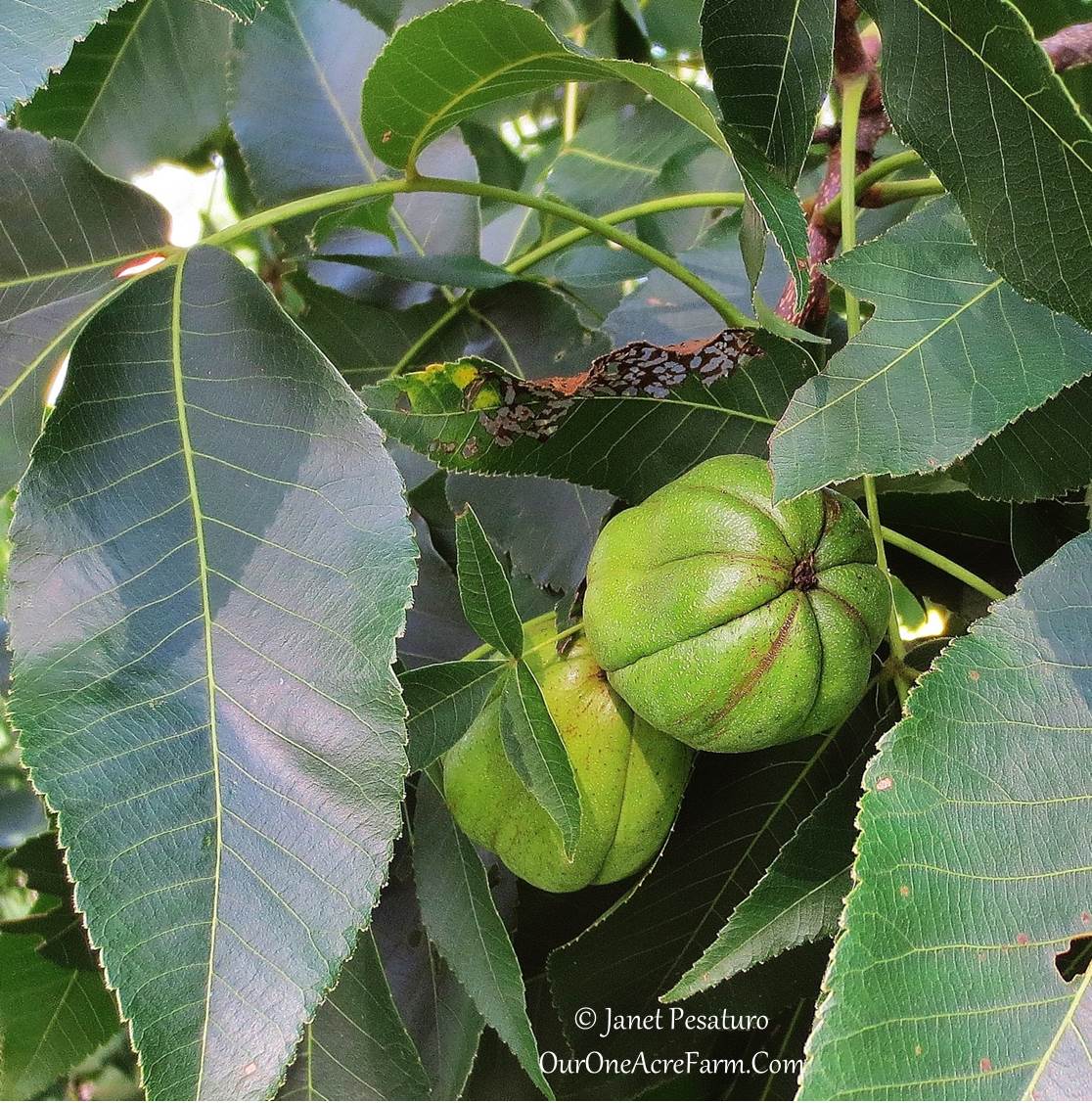
Shagbark hickory in late summer, with ripening nuts.
There are many hickories along the roads and within the woods where I walk, and for some reason they’ve always fascinated me. I love the big thick winter buds, the interesting bark, and all the wildlife activity around them when the nuts are ripe in fall. Wildlife seem to like the nuts of all species, but only some species bear nuts that people can eat.
Wildlife value
- Small mammals of all kinds love the nuts.
- Many bird species and other animals that cannot open the shells, gobble up the fragments left behind by squirrels.
- Hickories are host to over 200 butterfly and moth species, including the pale tussock moth, American dagger moth, and several of our giant silk moths (Io, Polyphemus, and luna moths)
Edible parts
- Nuts of some species are sweet and edible.
- If you live within its range (southern US), your best bet is probably the pecan (Carya pecan), due to its large, sweet nut and thin, easy to crack shell. Other edible hickory nuts have thicker, hard to crack shells.
- Here in the northeast, the best for eating is probably the shagbark hickory (Carya ovata), though the pignut (Carya glabra) and mockernut (Carya tomentosa) are also edible.
- In the midwest, the large nuts of shellbark hickory (Carya laciniosa) provide excellent eating.
- You can also make hickory syrup from the bark and hulls.
13. Maple, Acer species
Many of the maples are beautiful trees with stunning fall foliage. Choose any native maple that grows well in your region. But if you want to make maple syrup and live within the range of the sugar maple, Acer saccharum, grow that one (see below). Do not plant the Norway maple, because it is already invasive in some areas, and may prove to be invasive elsewhere.
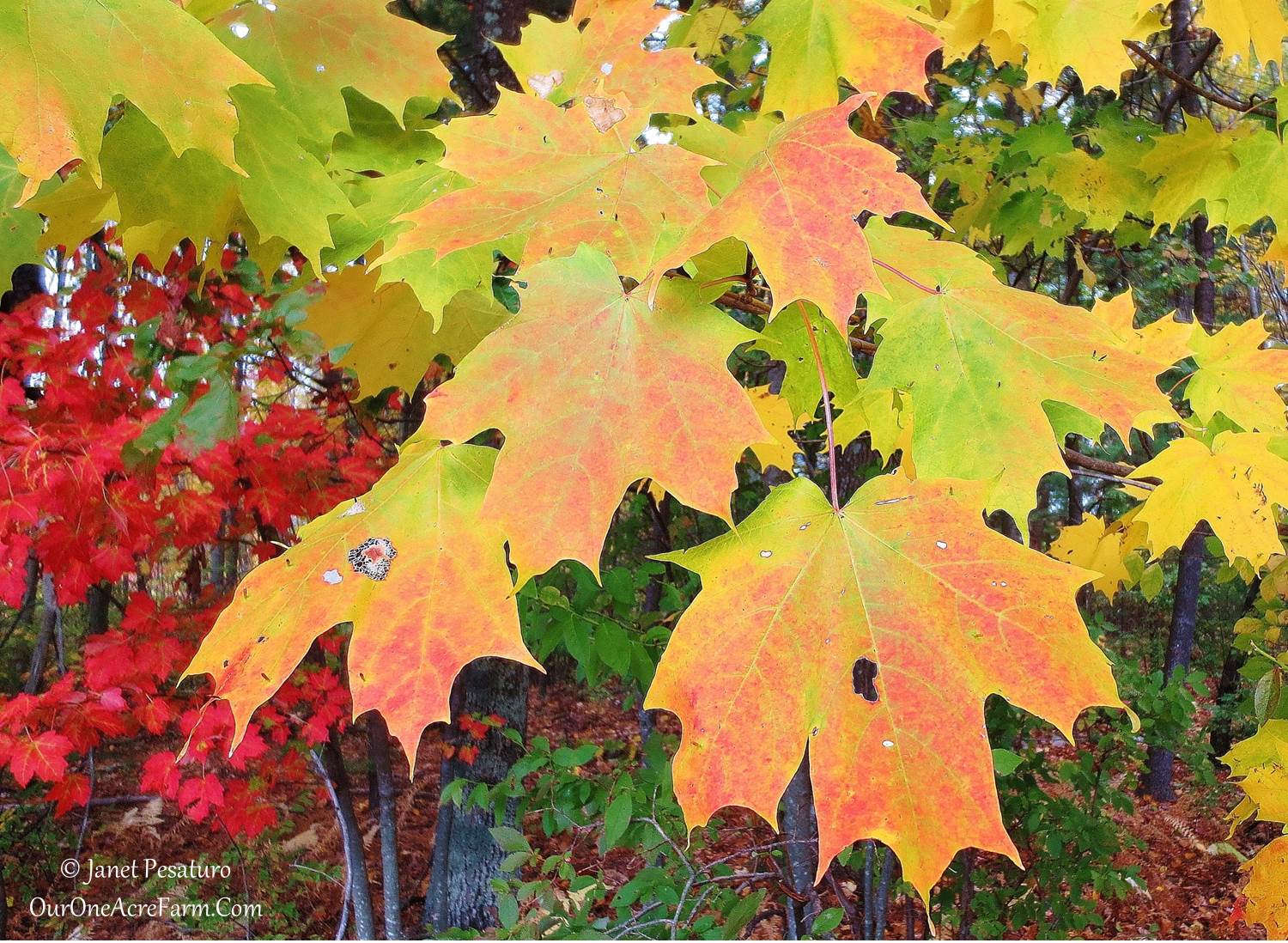
In addition to it’s wildlife value and its use in maple syrup production, sugar maple is spectacular in the autumn landscape.
Wildlife value
- Many birds and mammals enjoy the familiar winged seeds of maples.
- Maples are used by almost 300 species of butterflies and moths, including several of our giant silk moths, such as the Io, Imperial, and Cecropia moths.
Edible parts
- Sap can be boiled to make maple syrup, a beloved confection of the north. Sap of sugar maple contains a higher sugar concentration than any other maple. This means it takes less time and fuel to make maple syrup form the sugar maple. Other maples can be used, however.
- It can take 40-50 years for a sugar maple to achieve a size suitable for tapping using the traditional method.
- A new process of maple syrup production involves tapping saplings.
- Seeds removed from their winged cases, are edible. Those which are sweet are said to be edible in the raw. If they are bitter, they should be leached of their bitter compounds, just as acorns are leached.
- The young, early spring leaves of all maples are said to be edible, but I have tried only small amounts of red and sugar maples. They are mild, but not as tender as lettuces.
14. Oak Quercus species
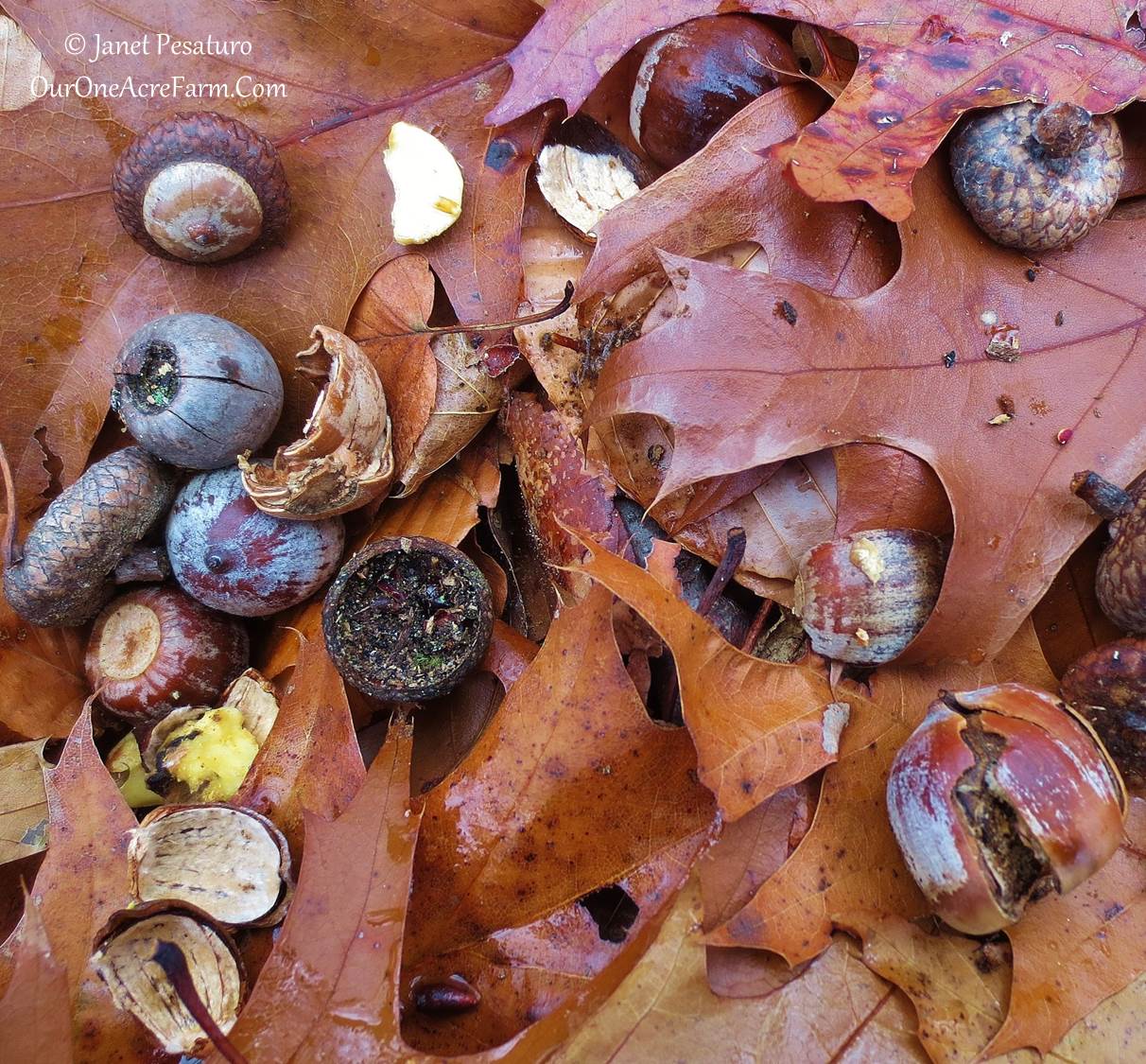
When acorns are produced in abundance, you can see evidence of animals feeding on them all over the forest floor.
There are over 50 species of oak native to North America. All are of excellent wildlife value, so choose one that does well in your area.
Wildlife value
- I needn’t mention the fact that squirrels love acorns, but it might surprise you that many other mammals do, too. Mice, porcupines, deer, and bear enjoy them.
- Acorns are a preferred food for jays, turkeys, grouse, and bobwhite. Many other birds eat them to some extent, including woodpeckers, thrashers, thrushes, titmice, and nuthatches.
- Oak is one of the top choices for native insects, supporting the larvae of over 500 species of butterfly and moth.
- Acorns are high in protein, carbohydrate, and fat, providing excellent nutrition for wildlife.
Edible parts
- People can eat acorns after the tannins have been leached out. The nut meats can be ground into a meal or flour, and used for breads and muffins.
- Acorns from species within the red oak family are higher in tannins and require more leaching than acorns of the white oak group.
Other notes
- In large amounts, leaves and acorns are toxic to cattle horse, sheep, and goats, due to high tannic acid. Once they develop a taste for oak, they may seek it out.
- Acorns are great food for pigs.
15. Spruce Picea species
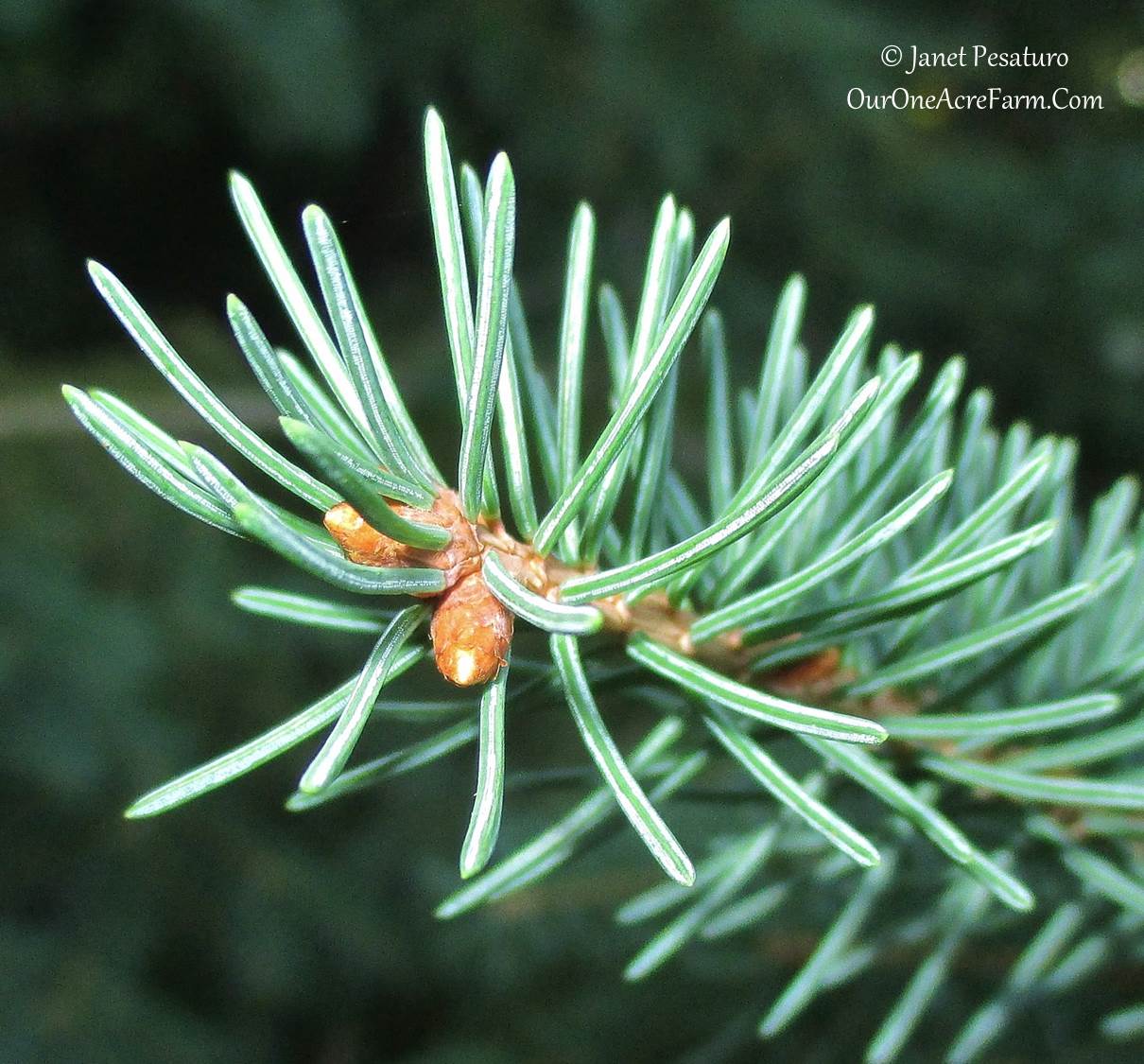
White spruce in late summer. Next spring, those brown buds will open into fresh, young leaves which are edible.
Any native spruce, fir, or pine is a great habitat element in the backyard, and the young leaves of all are edible. I chose to feature spruces here, because spruce needles are said to taste better, with a citrusy flavor.
Wildlife value
- Finches, grosbeaks, and crossbills are well equipped to harvest the seeds hidden within the spruce cones, and depend on them for food.
- Excellent winter cover for a great many mammals and birds, when deciduous trees are bare.
- Excellent cover for nesting birds in spring. We have two white spruces, are both have been used frequently by nesting birds in spring.
Edible parts
- Young spruce needles are edible when they emerge in spring, before they darken (look for the lighter green growing tips).
- Use spruce tips in recipes such as this one with pasta and wild mushrooms.
- Can be used to make spruce tip syrup or tea.
Sources
- Beech Bark Disease
- Top 10 Woody Plants in Conservation Gardening
- Mountain Ash
- American Basswood
- Maples
- Maple Syrup from Saplings
- Ladybird Johnson Native Plant Database
- All of the books in the Amazon ads above
What are your favorite trees for a wildlife friendly and edible backyard?
Shared on: Homestead Barn Hop, Natural Living Monday, Thank Goodness it’s Monday, Mostly Homemade Monday, Tuesdays with a Twist, Backyard Farming Connection, Wildcrafting Wednesday, Down Home Blog Hop, Green Thumb Thursday, HomeAcre Hop, From the Farm Blog Hop, Simply Natural Saturdays, Green Thumb Thursday