
Creating a Chicken Habitat with Tips from Jungle Fowl
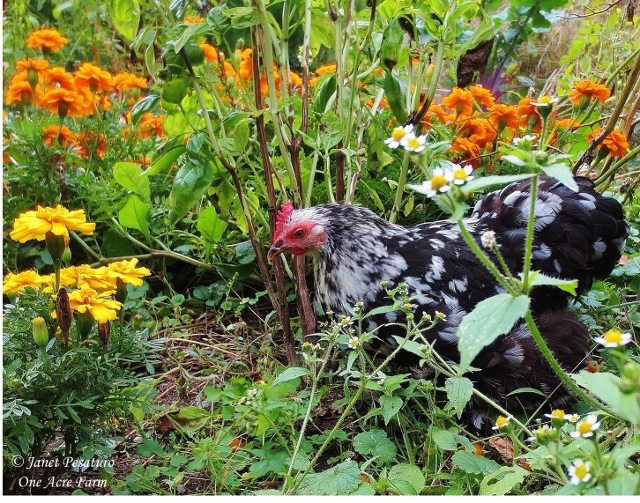
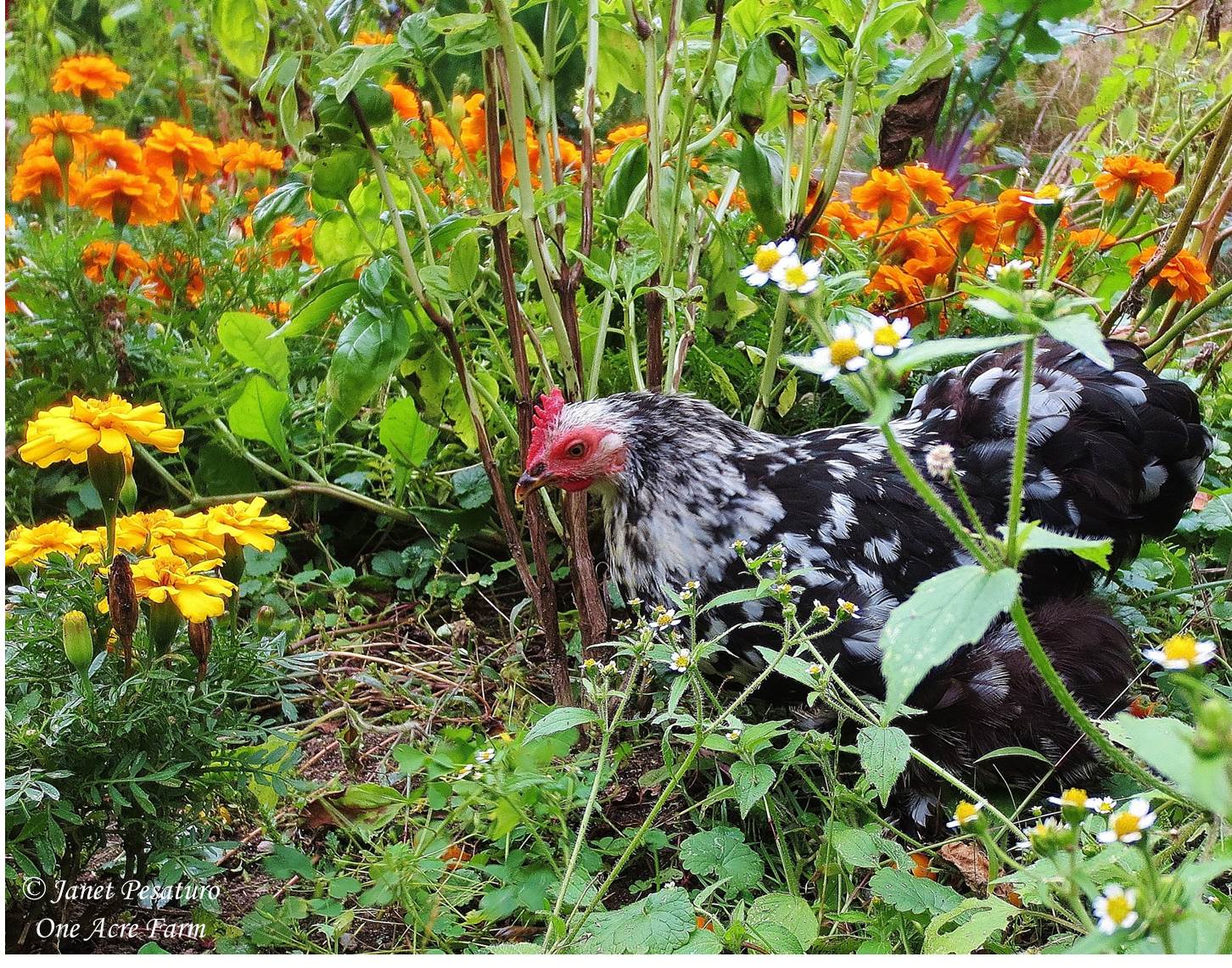
In early fall, I give my chickens the run of the our vegetable and herb garden. This bantam mottled cochin enjoys the diversity of plants and insect foods.
Chickens can be tightly confined and still produce a lot of eggs, but productivity is not necessarily a measure of contentment. Have you ever wondered how chickens would live if they could choose? I think the best place to look for an answer is in Asia, where their wild relatives evolved. Genetic studies suggest that chickens were domesticated largely from red jungle fowl, so we can use information about red jungle fowl habitats and habits as guidance in creating an environment that will best allow chickens to express their natural behaviors. I will address some common questions about chickens, using what is known about red jungle fowl.
What is a “normal” flock size?
Aside from the smallest of backyard flocks, most domestic chickens are kept in large groups. But according to a study in India, flocks of red jungle fowl are actually quite small.
- When not breeding, this bird lives in small groups, typically consisting of 1 rooster with 1-4 hens, and sometimes with 1 or 2 subordinate roosters trailing in close proximity.
- Most younger males live in single sex groups of 2-4.
- In spring, breeding hens go off to nest singly. Once a hen is done laying her clutch of 3-7 eggs, she incubates the eggs, then raises her chicks on her own. Hens are not usually associated with a flock while raising chicks.
Frankly, I was surprised to learn that their flocks are so small. When I was planning for my flock, I was told I needed at least 6 birds to satisfy their social needs. But that idea is apparently unfounded.
How much space do chickens need?
A study in India showed that a flock of about 5 red jungle fowl occupies, on average, an area of 12.5 acres. That’s a population density of only 1 bird for every 2.5 acres! Compare that to the oft quoted standard of a minimum of 4-10 square feet per chicken in captivity!! Chickens spread themselves out quite thinly, given the opportunity.
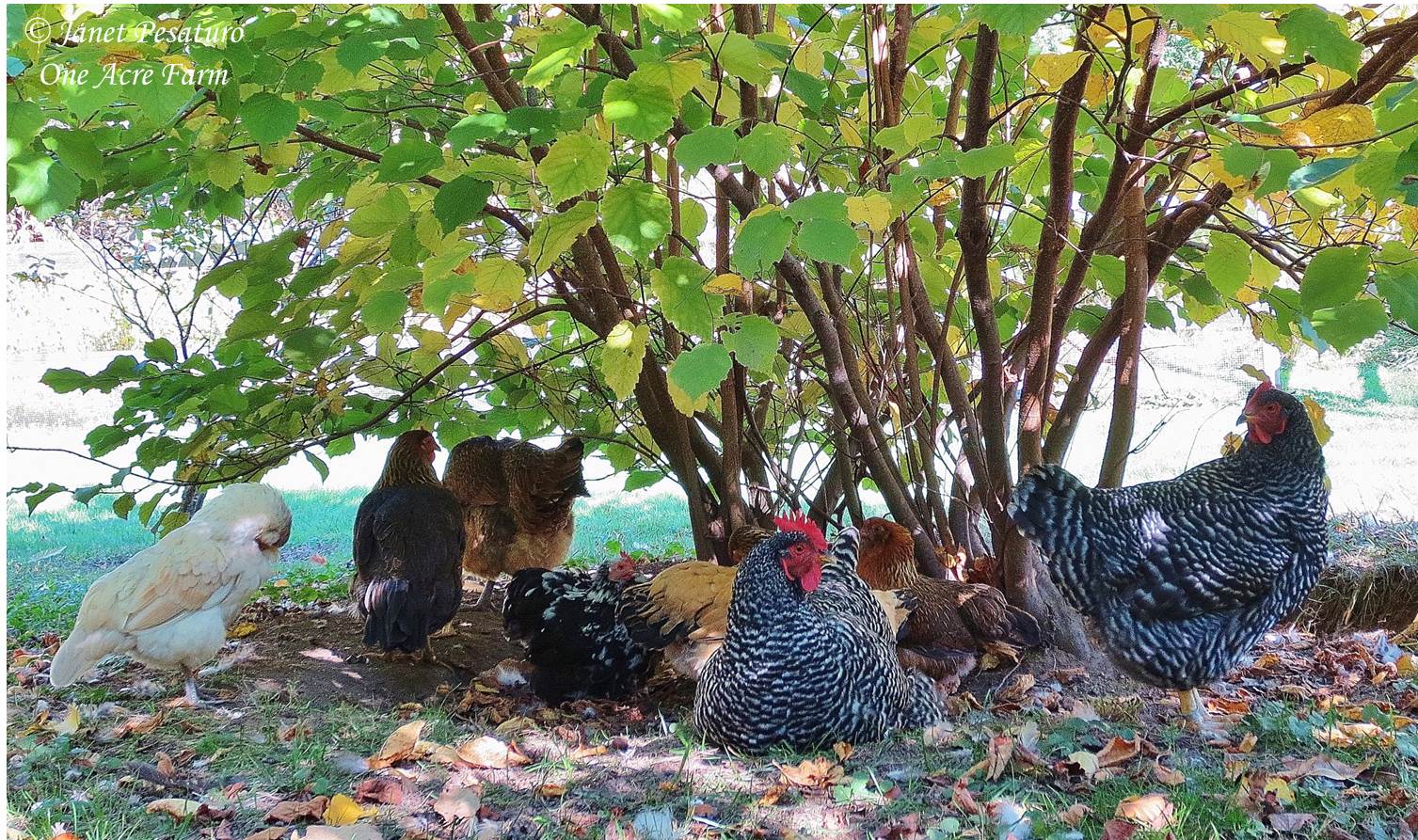
Our flock enjoys an afternoon siesta under a hazelnut bush.
What’s a normal activity level for a chicken?
I’ve often read that captive animals don’t need or want to move about, as long as they are given all the food and water they need. They’re “fat and happy”, we are told. But my birds have unlimited food and water available at all times, and still explode out the door as soon as I open it. And that is no surprise, considering the normal daily routine of wild red jungle fowl:
- About 5 hours of active foraging in the morning, beginning with a drink at the water hole.
- Resting and dust bathing in the shade and safety of dense vegetation during the afternoon heat.
- An additional 2-3 hours of active foraging in early evening as they make their way towards the water hole for another drink, before returning to their roost for the night.
That’s a total of 7-8 hours of active foraging per day!
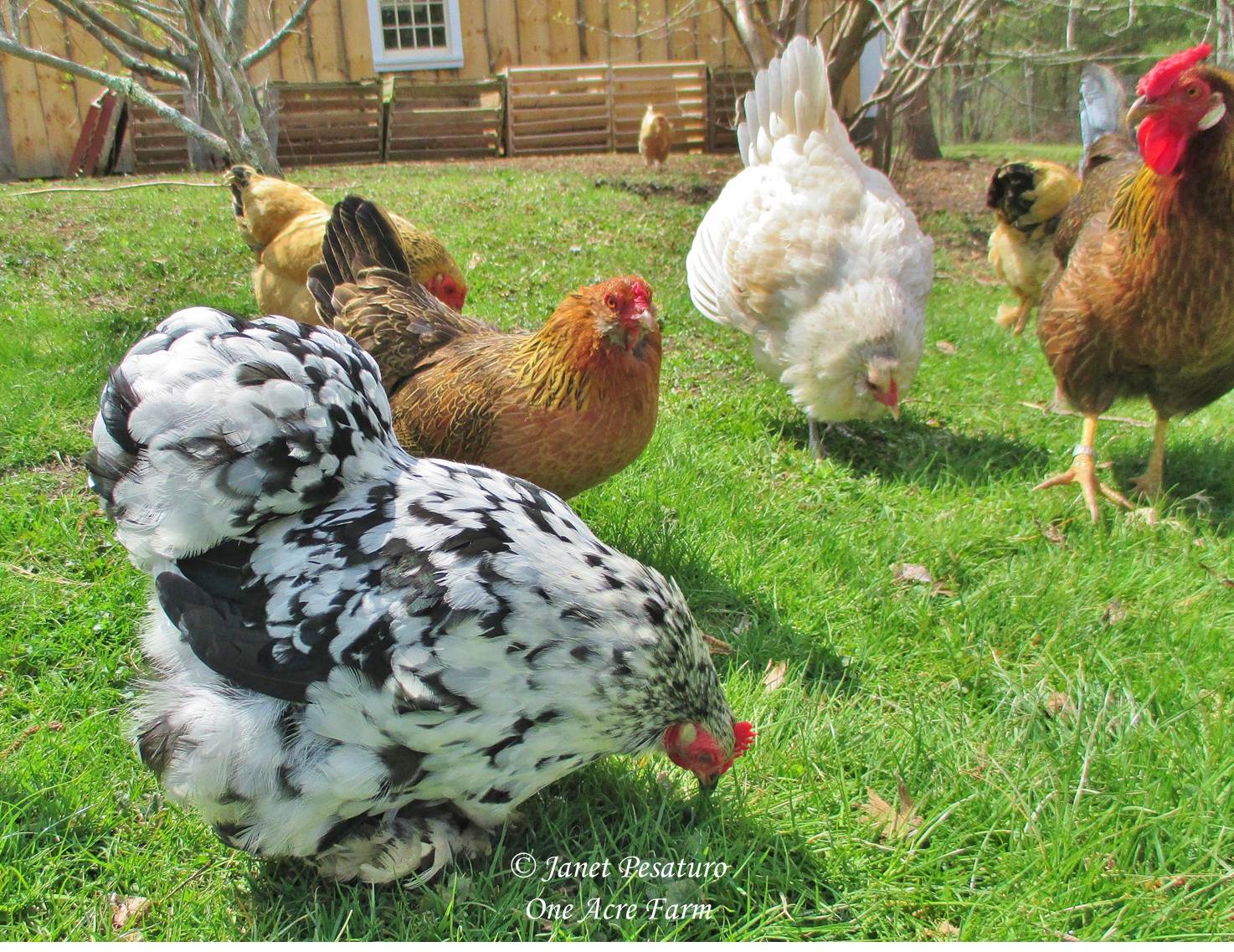
This flock of chickens ranging over lawn is a pretty site, but chickens prefer taller and more diverse vegetation.
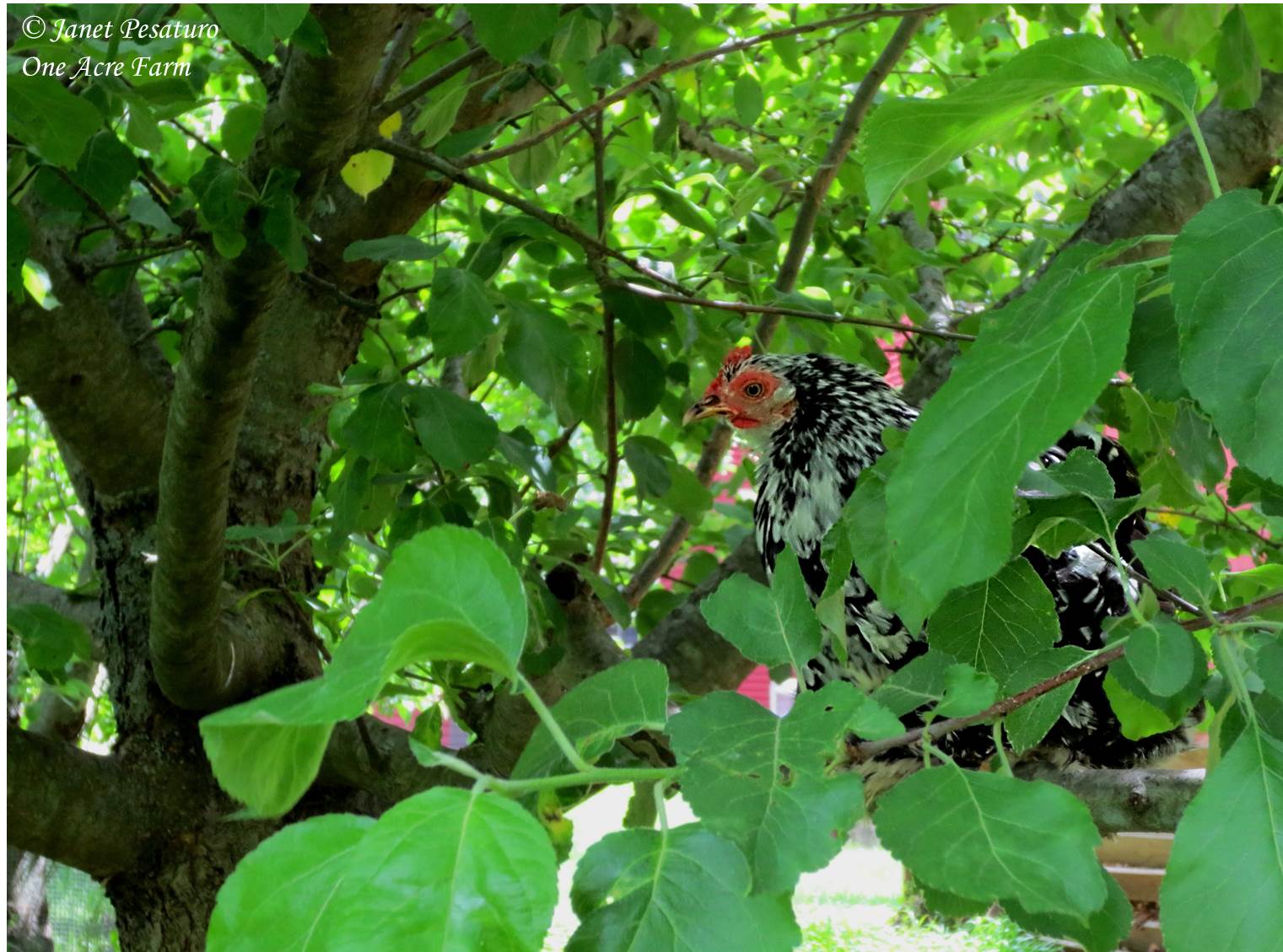
Chickens love the cover provided by trees and shrubs. Mine like to rest on the ground beneath, and to perch in the lower branches of our apple trees.
What kind of habitat do chickens prefer?
Who doesn’t associate chickens with open lawns and bucolic pastures? But their free and wild relatives frequent a variety of habitats, all with better cover and plant diversity, than lawn or pasture. Red jungle fowl in India prefer:
- “Second growth” (young) forest
- Forest edges (where forest and field meet)
- Scrubby/shrubby areas
- Bamboo forests
- Patches of tall bunchgrass for nesting, because the tall, spreading leaves provide good cover for chicks, and open areas in between clumps which allow young chicks to move easily.
- Cultivated fields, where they partake of crops.
They move among these different habitats to harvest favorite foods as they become available. So, for example, when coveted berries are in season in scrub land, the birds will spend more time there.
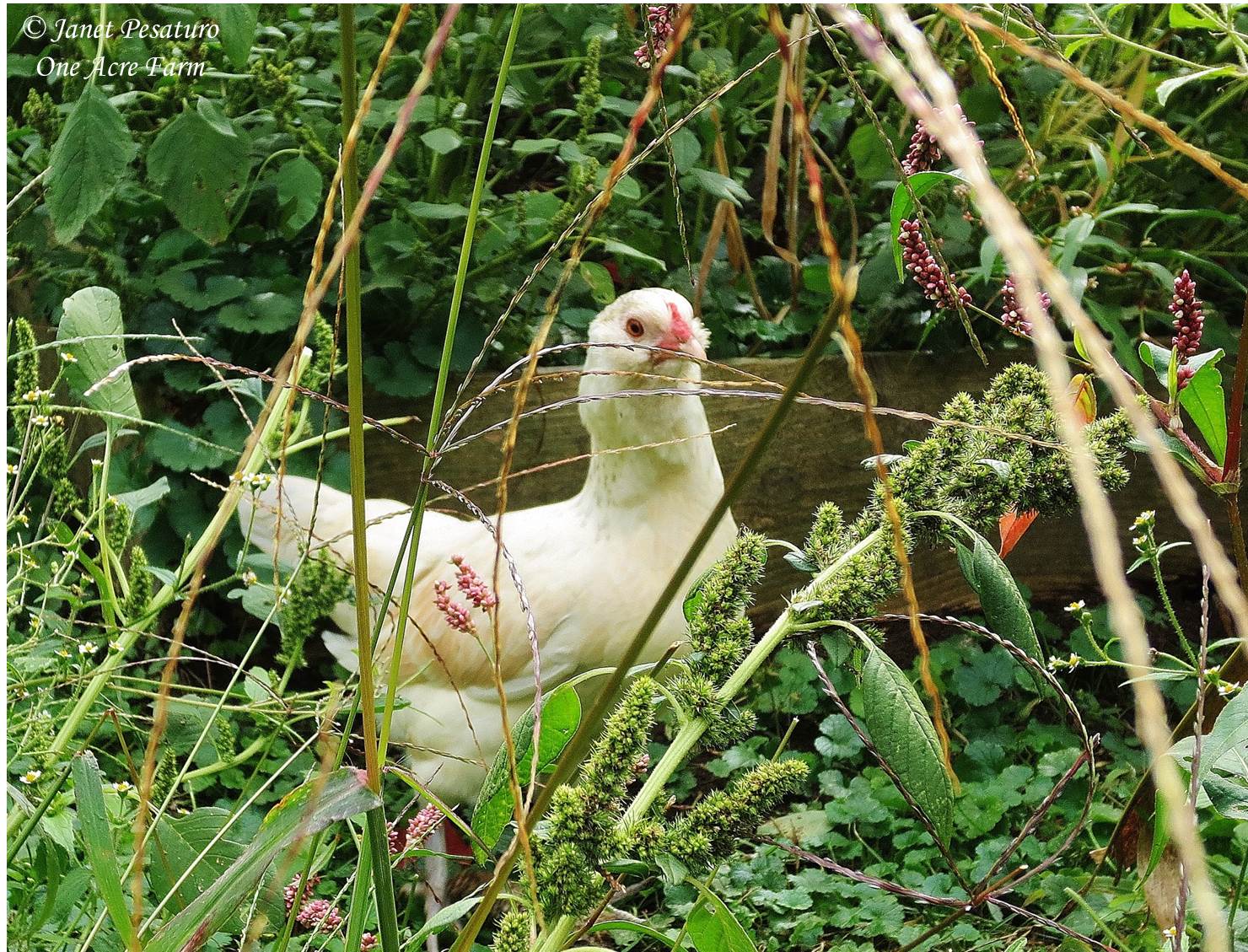
Chickens prefer overgrown weedy fields to manicured lawn, because the former offers a much greater diversity of plant and insect foods. Take this into consideration when creating a chicken habitat.
What do chickens like to eat?
Chickens use a variety of habitats precisely because they like to eat a wide variety of foods. Red jungle fowl crop studies reveal an enormously varied diet:
- Seeds from about 30 different species of plants (some seeds were probably ingested for the fruit)
- A wide variety of grasses, young bamboo shoots, leaves, and flower petals
- Many kinds of insects, spiders, snails, caterpillars, worms, and lizards
- Termites are thought to be particularly important protein source for young chicks.
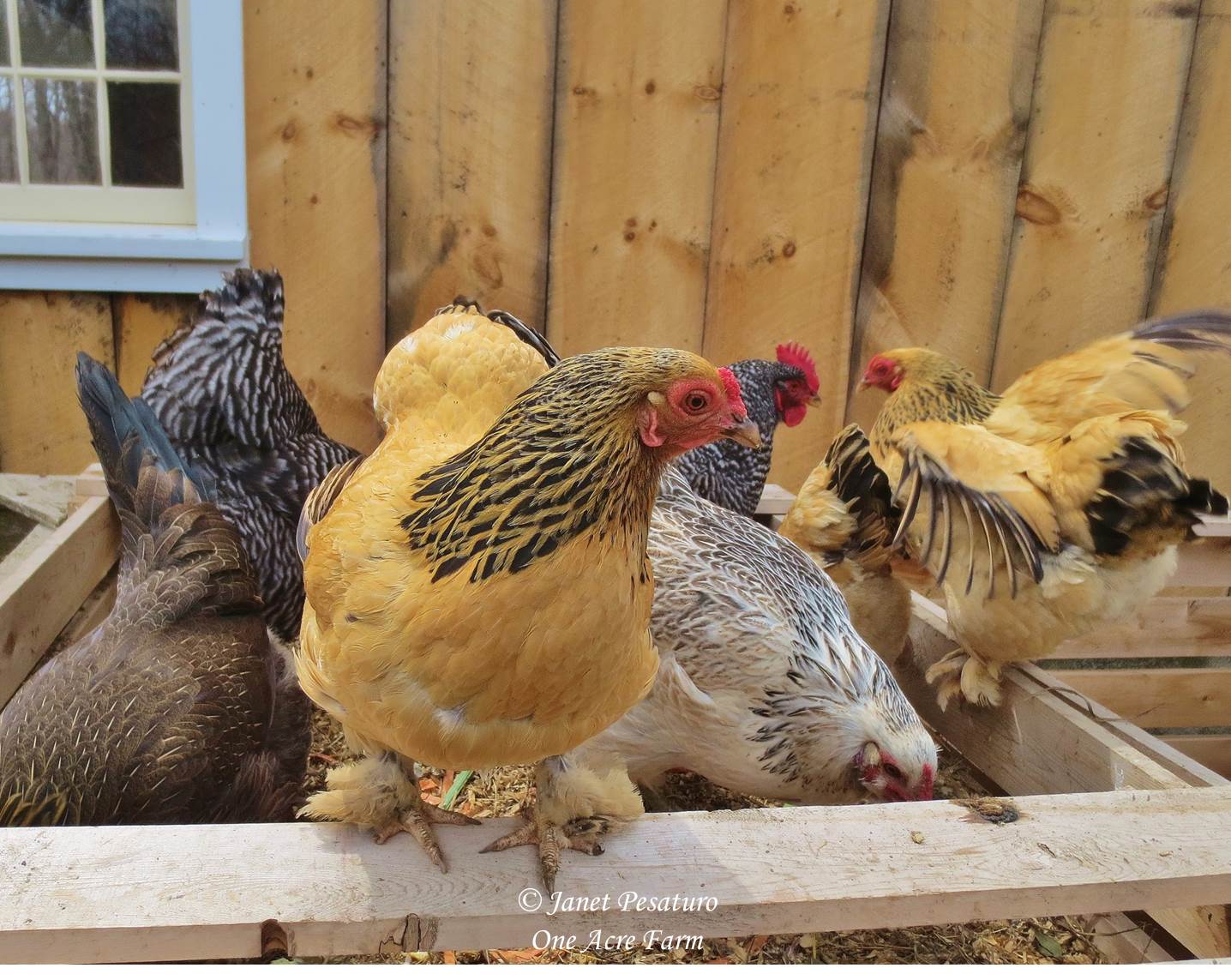
Our compost bins are in the chicken yard, and it’s always a popular foraging spot.
So what’s the take home message about creating a chicken habitat?
- Small flock size is better than large.
- More space is always better than less.
- Higher plant diversity – trees, shrubs, herbaceous plants, and grasses – is preferable, because chickens eat so many different plant food
- Higher plant diversity also attracts a wider variety of insect/invertebrate prey.
- Chickens enjoy eating the seeds of grasses and weeds, not just the green leaves, so a patch that can go to seed, is better than mowed lawn.
- Chickens enjoy the security under the cover of tall or dense vegetation.
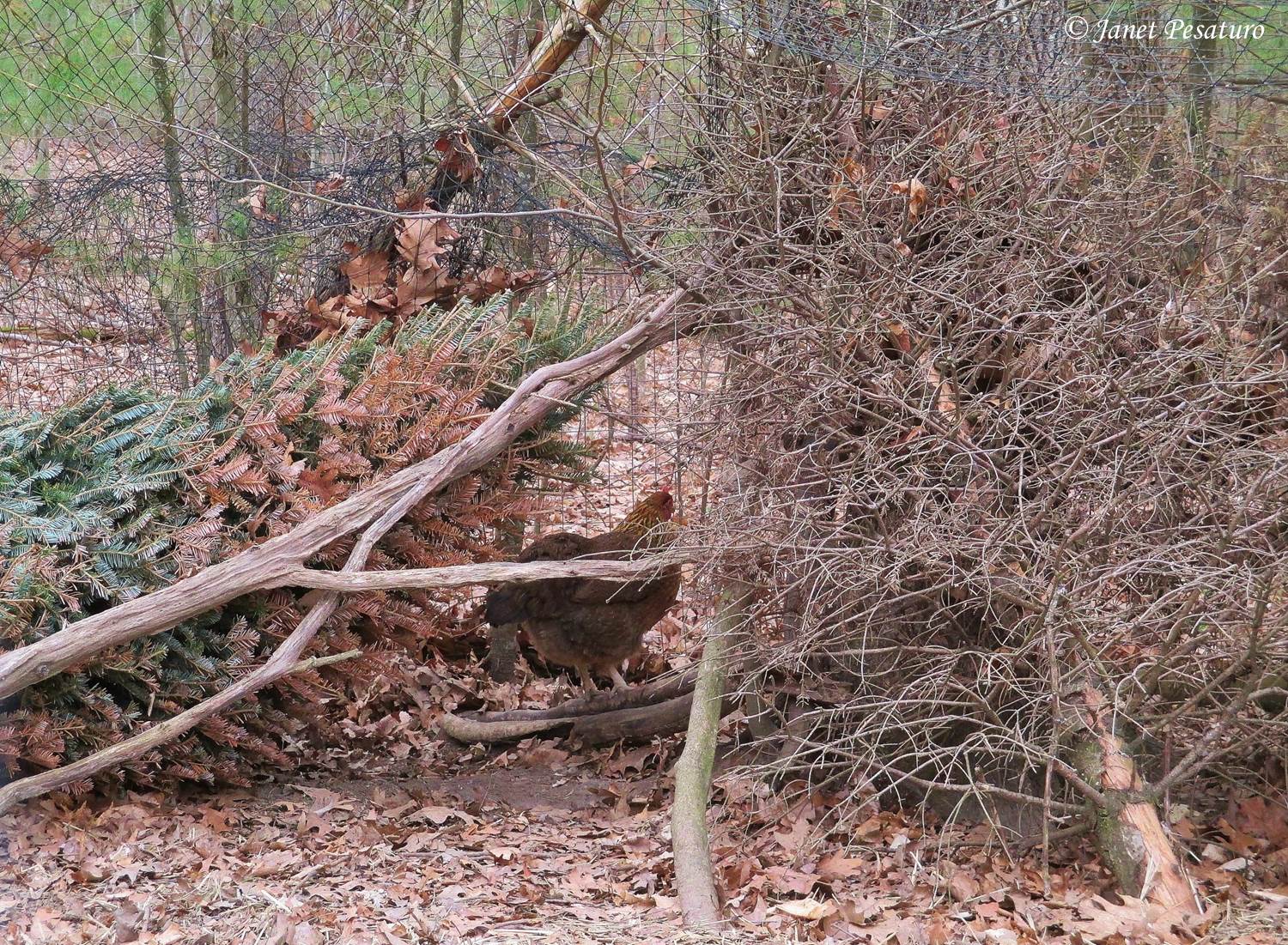
Chickens confined within a relatively small space will devastate most plantings. So, to provide cover, my good friend Reta made this hiding area with discarded Christmas trees and fallen branches. Her chickens also like to perch on the branches.
How to make the most of your available space
Chickens confined at high density will quickly destroy most plant life. So if you cannot provide plant diversity, try adding complexity and diversions. Here are some ideas.
- Bring them berry laden branches when in season (I bring branches of wild autumn olive and elderberry into the chicken yard in late summer, and chickens love plucking the berries)
- Keep your compost bin within the chicken yard or run. Turn it frequently to prevent rodents from making their homes in it.
- Feed them mealworms, especially if they have little access to insects. Dried mealworms are a convenient treat. Or, you can raise mealworms and treat your chickens to live ones.
- Provide a dust bathing area (sand/soil in a litter box will work).
- Discarded Christmas trees and fallen branches can provide additional shade, cover, and perches. They enjoy the hiding places even if their set-up is predator proof.
- Create an interesting playground of perches, using boards and/or fallen branches.
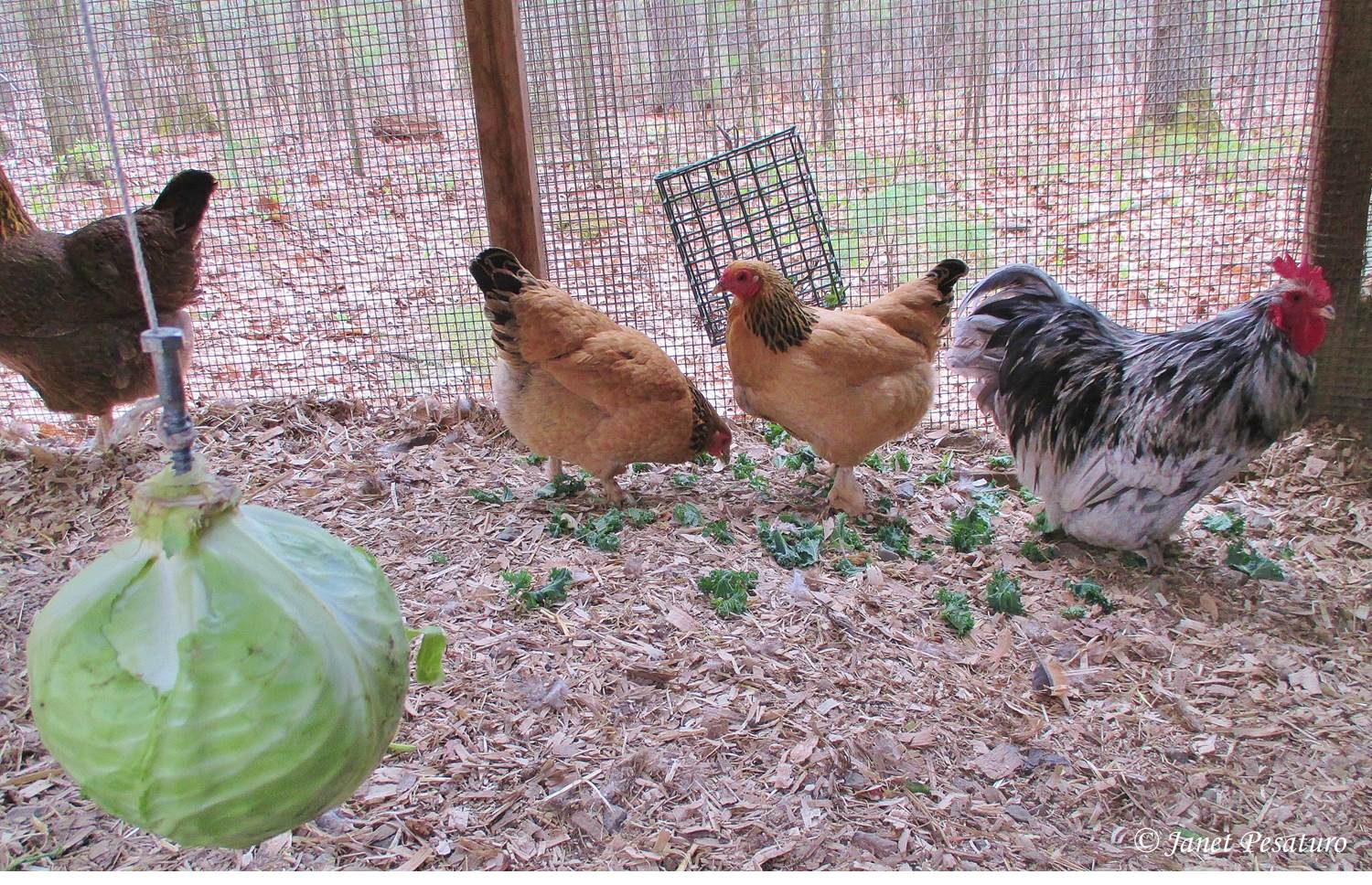
- Hang a head of cabbage and a basket of other leafy greens for them to peck at.
- In winter, a basket of birdseed-studded suet can be a great diversion and treat.
-
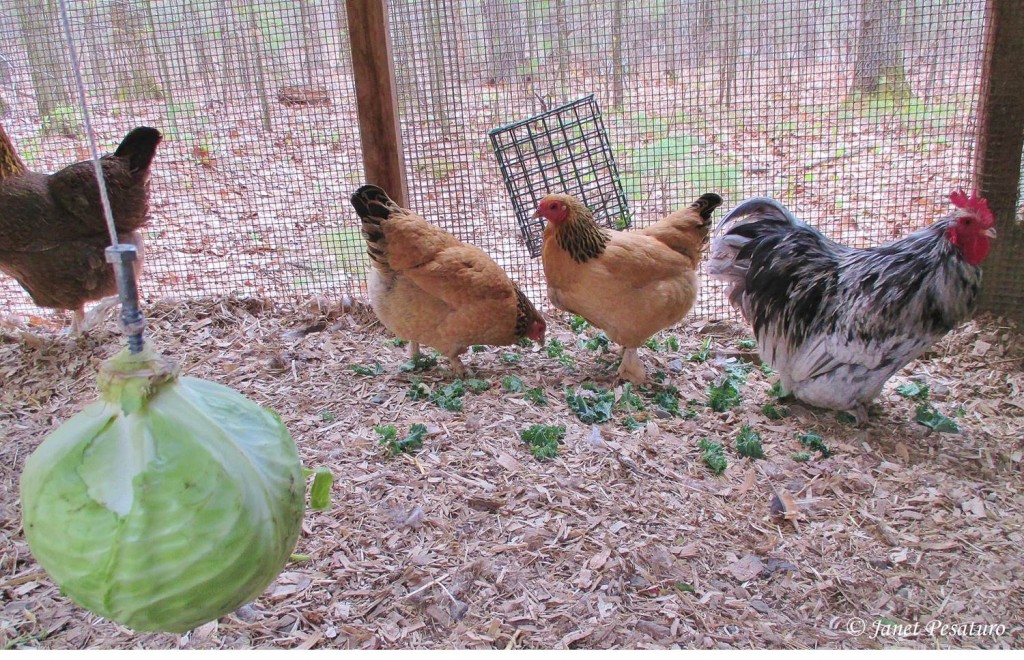
My friend Reta hangs a head of cabbage in the run to simulate green forage. It keeps them busy with something better than each other to peck. She also puts kale in the hanging basket, and, in winter, suet cakes.
Sources:
- Collias, N. E. and Collias, E. C. A Field Study of the Red Jungle Fowl in North-Central India. The Condor, 69: 360-368, 1967.
- Collias, N. E. and Saichuae, P. Ecology of the Red Jungle Fowl in Thailand and Malaya with Reference to the Origin of Domestication. Nat. Hist. Bull. Siam Soc. 189-200, 1967
- Johnson, R.A. Habitat Preference and Behavior of Breeding Jungle Fowl in Central Western Thailand. Wilson Bull, 270-272, 1963.
- Sawai, H. et al. The Origin and Genetic Variation of Domestic Chickens with Special Reference to Junglefowls Gallus g. gallus and G. varius. PloS one, 2010.
- Red Jungle Fowl Fact File
Shared on: Homestead Barn Hop #158, Heritage Homesteaders Hop #10, Thank Goodness it’s Monday #69, Backyard Farming Connection #79, Down Home Blog Hop #86, HomeAcre Hop #69, Wildcrafting Wednesday #136, From the Farm Blog Hop, Simply Natural Saturdays, Mountain Woman Rendezvous #45, Simple Life Sunday #17, Natural Living Monday, Wicked Awesome Wednesday #160, Farmgirl Blog Hop #158