
How to Grow Apples Without Pesticides
 Perfect apples usually come at the expense of pesticides. In fact, residues of 47 different pesticides have been found on apples by the USDA Pesticide Data Program, and many of them are hormone disruptors, neurotoxins, developmental or reproductive toxins, or honeybee toxins. Customers demand unblemished apples, and that’s hard to accomplish on a large scale without pesticides. But with careful planning, small scale farmers can grow slightly blemished fruit, and with some extra effort, they can even grow big, beautiful, perfect apples. Learn how to grow apples without pesticides, and you too can enjoy organically grown fruit from your own backyard.
How To Grow Apples Without Pesticides
Growing apples without spraying requires careful planning before you even begin planting. The varieties of apples, the surrounding plant community, and the care you provide all impact susceptibility to pests and diseases. I cover a number of considerations – you don’t have to heed them all if you can tolerate some blemishes, but if you want perfect apples, you’ll have to follow most of them. To save time, we choose to tolerate some spots. As we go along here, I’ll tell you what we do and don’t do, to grow a lot of slightly imperfect apples.
Selecting varieties for apples to be grown without spraying
Choose disease resistant varieties
It’s always important to select varieties that are adapted to your region, but to grow apples without spraying at all (not even with organically approved pesticides), be sure to choose disease resistant varieties. Be aware from the outset that disease resistance is rarely 100%. Some sign of disease might be visible on resistant fruit, but it will be less dramatic.
The most disease resistant varieties are not necessarily available in your local nursery. Where I live, (east-central Massachusetts), nurseries tend to sell popular names commonly seen in the grocery store. Red Delicious, Granny Smith, and McIntosh are often available, but these are not the most disease resistant. If you opt for mail order, you will have many more choices.
I ordered my 3 apple trees about 15 years ago from Miller Nursery, which has since been acquired by Stark Brothers. I purchases a collection of 3 highly disease resistant varieties, including Liberty, Jonafree (developed from Jonanthan) and Macfree (developed from McIntosh). All are good producers of tasty apples with minimal care other than pruning. Liberty is particularly productive, and its fruit are the cleanest. Nowadays, more disease resistant varieties are available, which a quick internet search will reveal.
On occasion I’ve been asked what’s in disease resistant apples that makes them disease resistant, or warned that whatever is “in them” to make them resist disease could be harmful if ingested. But disease resistant apple varieties are developed by selective breeding, the same way that desirable traits of so many other fruit and vegetable varieties are selected. The desirable trait, disease resistance in this case, is encoded by genes that occur naturally in the DNA of some of the fruit. These genes evolved in plants – that is, nature selected for them – to allow the plant to detect and mount a response against disease. Scientists select for those individuals in their breeding programs, just as they select for tomatoes of a certain size or color. An example of a trait which can impart disease resistance is production of phenolic compounds which play a role in limiting spread of, or future attack by, a bacterial or fungal pathogen.
Note that this selective breeding is distinct from genetic modification. As far as I’ve been able to determine, all currently available disease resistant apple varieties were developed by selective breeding. But genetically modified varieties might be available in the near future. Research is underway to develop GMO apples that resist codling moth, fire blight, apple scab, and powdery mildew (1). If it results in less pesticide use, then it seems like a good thing to me.
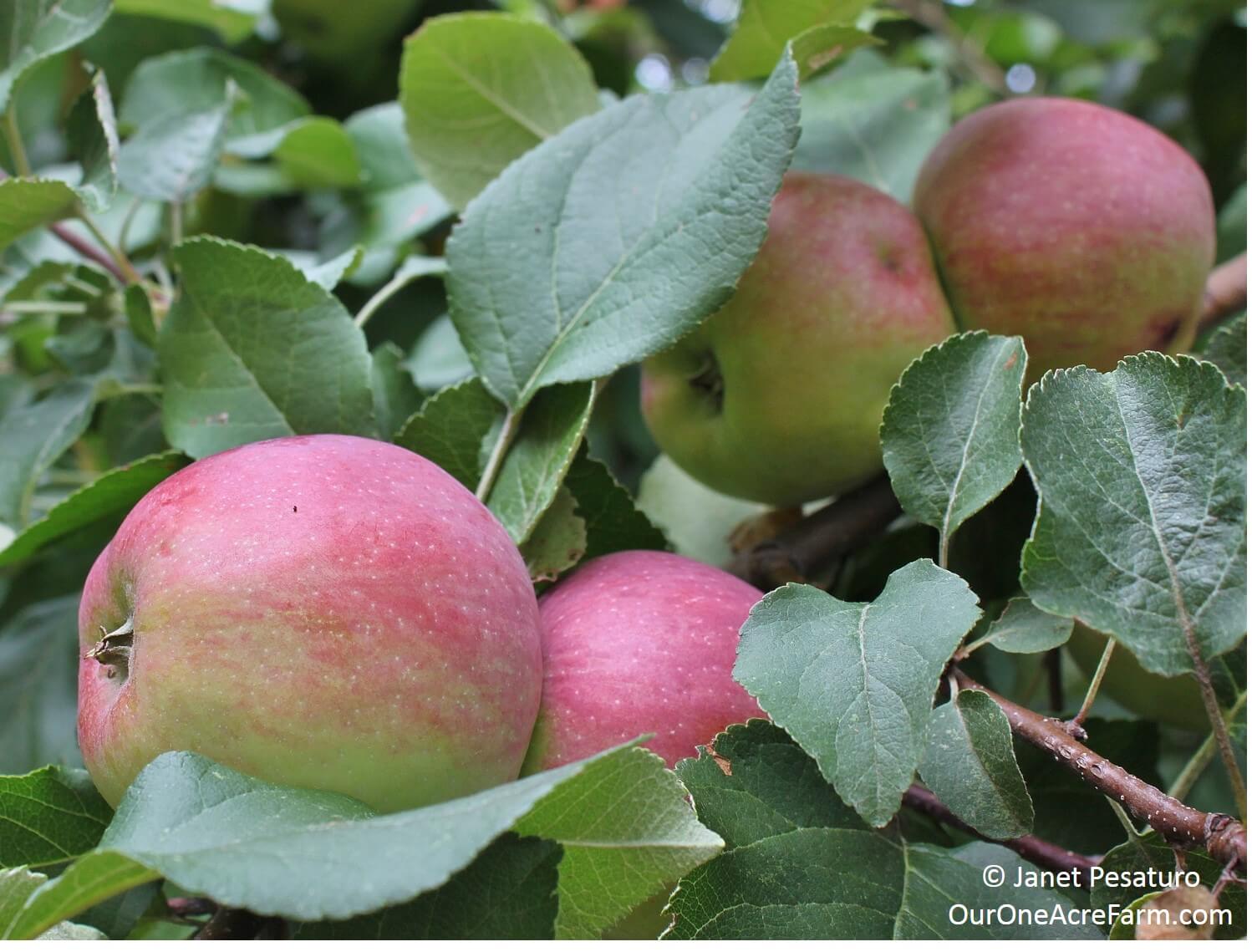
These are Liberty apples, my most productive, flavorful, and disease resistant apples. Semi-dwarf.
Choose dwarf or semi-dwarf trees
It’s easier to reach the fruit if trees are short, which is a great convenience for those who will be thinning flowers or fruit, and/or bagging young fruit. Be aware that tree size is determined by both apple variety and root stock. See if you can determine the root stock of any apple trees you are considering. This information is not always available – the description may simple indicate “dwarf”, “semi-dwarf”, or “standard”. But if you can determine root stock, look it up online, because there is considerable variation within each category. Some dwarf root stocks produce trees that reach only to 5 feet, while others produce a tree that can reach 10 feet. This might impact where, within your landscape, you will want to plant the trees for good sun exposure.
Choose varieties to ensure pollination
Knowing a bit about pollination is important whether or not you plan to spray your apple trees. Most apple varieties are not self pollinating, which means they need another variety that blooms simultaneously for pollination and fruit set. A few varieties which are self pollinating. These are the best bet for those with space enough for only one apple tree. Self pollinating varieties can also pollinate other apple varieties, including pollen sterile varieties, provided they overlap in bloom time. Crab apples can also pollinate apple trees.
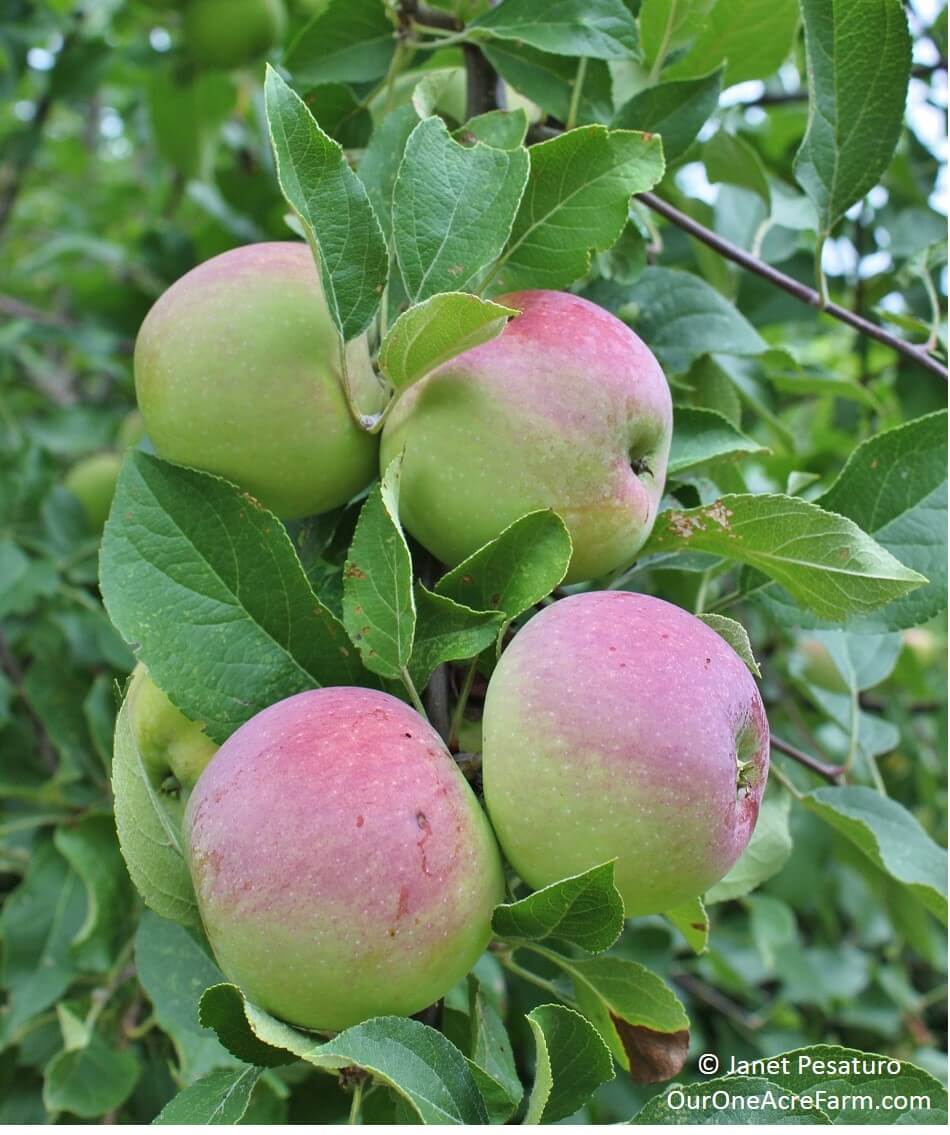
This is Macfree, semi-dwarf. In our backyard, Macfree hasn’t performed quite as well as Liberty, but is still well worth growing.
Planting considerations for growing apples without pesticides
Choose proper site conditions
Apple trees do best well drained, loamy soil with a pH of about 6.5. As for many fruit bearing trees, production will be greatest in full sun. Our soil is poor, so we filled a large hole with compost prior to planting. The trees are situated down slope from our compost bins, where they receive plenty of nutrients, and receive sun for about 2/3 of the day. The result has been an abundance of apples from our 3 trees.
Mimic natural ecosystems
Large grids of fruit trees are convenient and appeal to our sense of symmetry, but biodiversity is low in standard orchards. Species poor ecosystems lack checks and balances, and are therefore more susceptible to pest outbreaks. So think “off the grid” and get creative with your plantings. Create a complex ecosystem by inter-planting your apple trees with other trees, shrubs, vines, and herbaceous plants. Learn why complex ecosystems are more resilient and less susceptible to pests in Permaculture Principles for Practical Gardeners and Farmers.
Taking the permaculture philosophy further, think of your apple trees as part of your farm’s food web. Use the outputs of other crops as inputs to the apples. Compost plant and animal wastes, and use them to feed the fruit trees. And use outputs from your apple trees as inputs to other farm elements. Do you have animals which will eat fallen apples, or browse on apple tree prunings? Do you keep bees? They will feed at the blossoms, and pollinate them at the same time.
Our apple trees are situated in our chicken yard. The latter enjoy eating fallen apples, and benefit from shade and cover in our limited free range system. Check out a diagram of our layout and learn more about how it works in Limited Free Range Chickens. We no longer have rabbits, but when we did, the bunnies relished fallen apples in autumn, and enjoyed the apple twigs we pruned all winter long. All animal droppings go into the compost, which feeds the apple trees, thus completing the cycle.
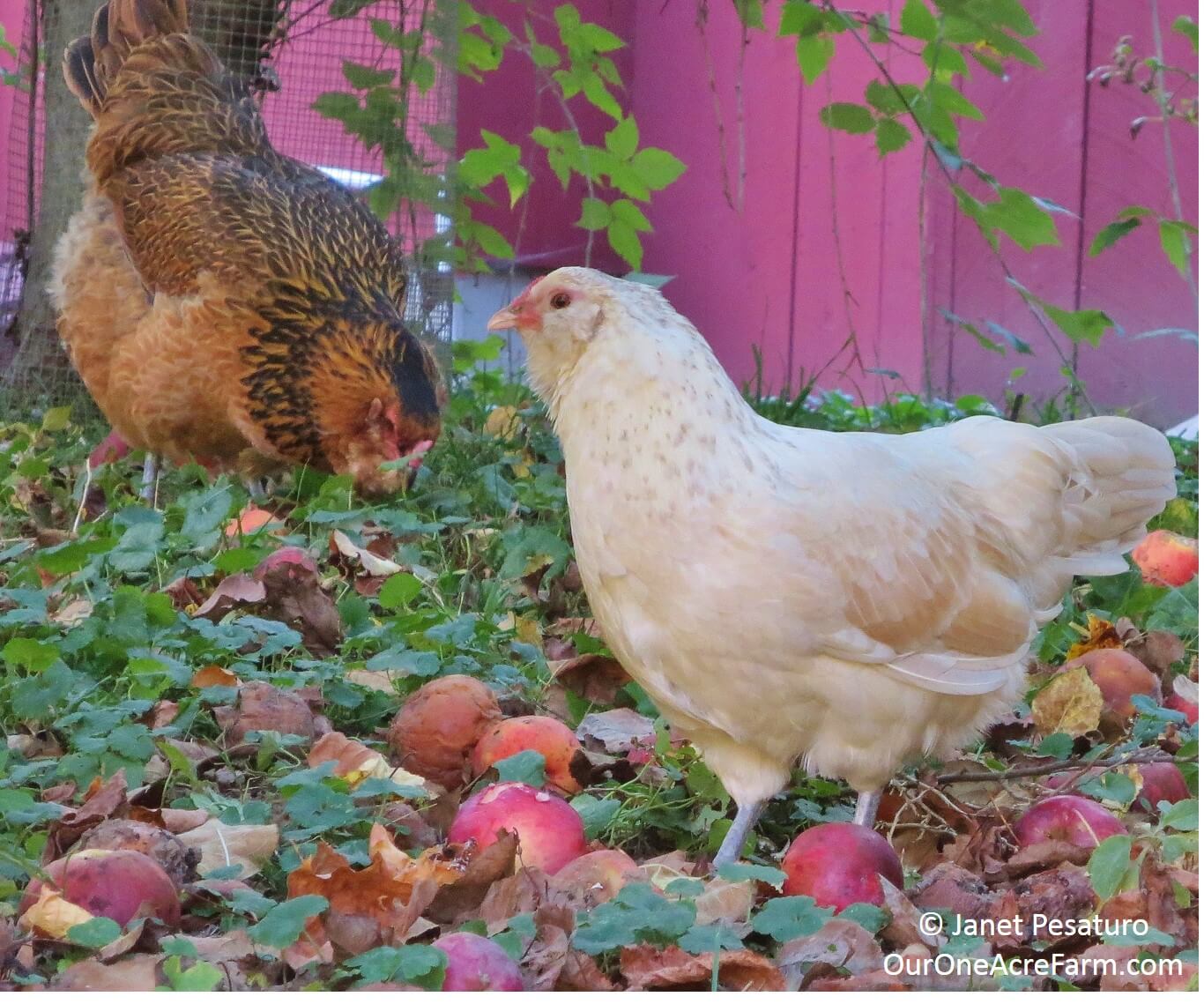
Our chickens enjoy eating fallen apples under the shade and cover of the apple trees. The chicken manure, in turn, fertilizes the trees.
Use companions and guilds
If you don’t want to be scientific or constrained by plant lists, just plant your apple trees among a diversity of other trees, shrubs, vines, and herbs that you want to grow. That’s what we did, and frankly, in many suburbs, the shade trees, foundation plantings, neighbors’ gardens, etc., are an ready-made diverse backdrop for your fruit trees. Most backyard farms are diverse by default, because there is insufficient space for a large monoculture. We live across the street from a standard grid-like apple orchard, but mature forest borders one of our yard, and young forest borders another side. But we also clustered our apple trees with hazelnut, blueberry, and chokeberry bushes, and the cluster sits by our vegetable garden.
If you enjoy learning about plant interactions and want to optimize productivity and minimize pest problems, read about companion planting and guilding. Companion planting (2) usually refers to the pairing of a crop plant with another plant that benefits the crop in some way, often by attracting pollinators or repelling pests. Fruit tree guilding (3), on the other hand, involves group plantings with many beneficial interactions among the different species, thus creating a productive, resistant, and resilient system.
In general, a guild might include:
- Fruit or nut trees (apple, pear, peach, pecan, etc.)
- Berry producing shrubs (blueberries, raspberries, etc.)
- A root crop (onions, garlic, carrots, etc.)
- Herbs (e.g., daylilies, comfrey, anise hyssop, coriander, dill, nasturtium, marigolds) which also attract pollinators and other beneficial insects. The herbs may be cut and used as mulch, thus conserving soil moisture.
- A nitrogen fixing legume
- A ground cover (e.g., strawberries)
Here’s an example of an apple tree guild:
- Apple trees
- Wild roses (host predatory insects)
- Anise hyssop (attracts beneficial insects)
- Chives (attract beneficial insects, helps protect young trees from borers, and prevent apple scab)
- Mullein (traps stink bugs which can damage young fruit)
- Fennel (attracts parasitic insects to control caterpillars)
- Strawberries (host to apple protecting insects)
- White clover (fixes nitrogen, attracts pollinating and predatory insects)
Note that most of these guild members also have culinary or medicinal uses.
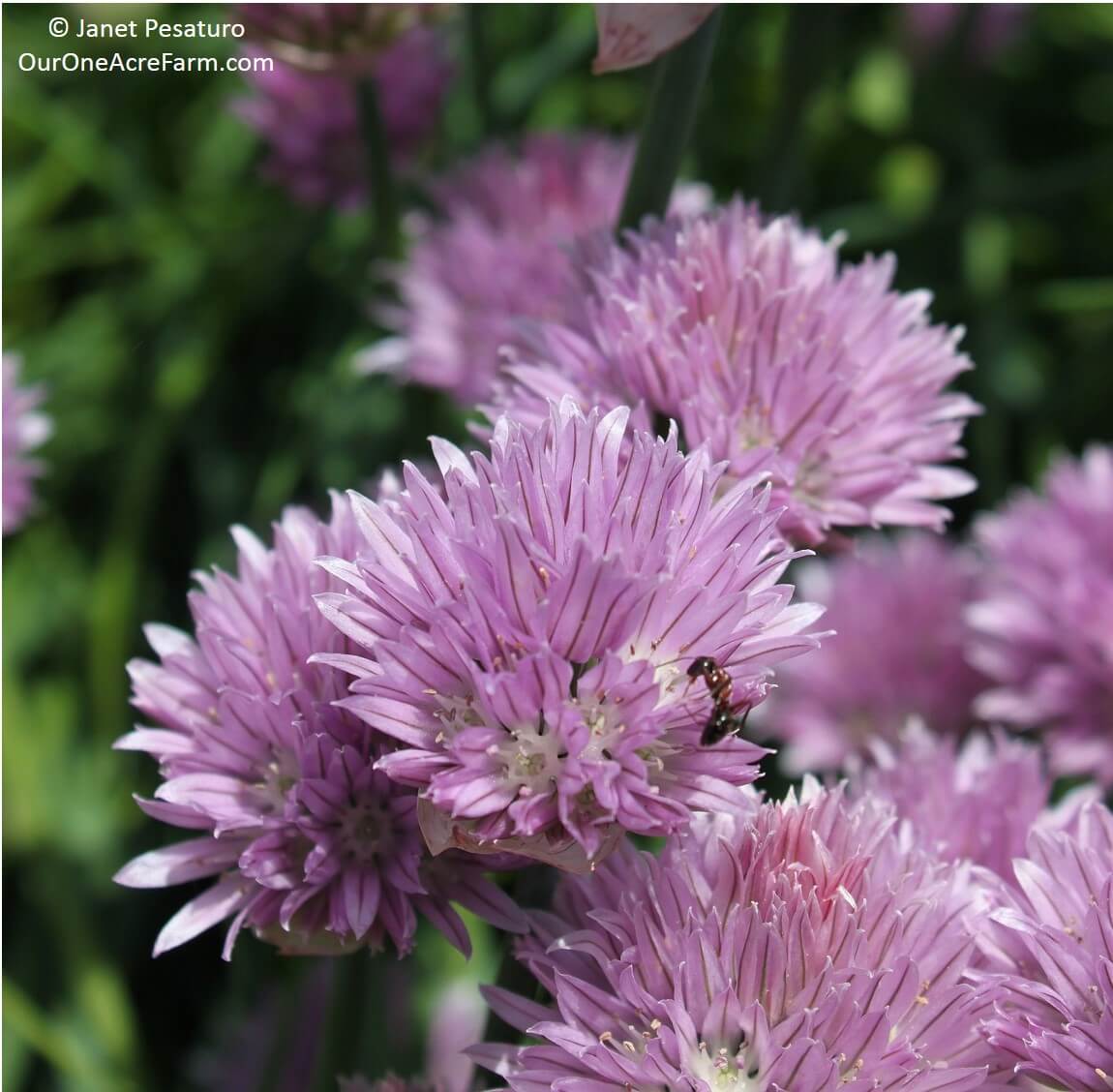
Chives are a good perennial companion for apple trees. They attract beneficial insects and also provide great flavor in cooking.
Caring for apple trees grown without pesticides
Fertilizing
Even disease resistant plants won’t produce well if you don’t keep them healthy. Companion planting and proper location can reduce or even eliminate the need for any fertilizing. Our apple trees get plenty of nutrients from the compost bins situated up slope. Our compost is enriched with chicken manure, a good source of what apple trees need: nitrogen, phosphorous, potassium, calcium, and boron. Consequently, we have not needed to fertilize our apple trees with anything. Excess nitrogen could become a problem, but we haven’t seen evidence of that. Perhaps the hazelnuts, blueberries, chokeberries, , grasses, and weeds near our apple trees take in enough to prevent it.
Keep an eye out for these common problems with apple trees (4):
- Potassium deficiency – older leaves turn brown and curl; small, pale fruit
- Calcium deficiency – soft depressions on surface of apple; quick spoiling during storage
- Boron deficiency – corky brown spots in apples, terminal bud death at end of new shoots
- Nitrogen excess – abundant leafy growth and few fruit. Excessive leafy growth might out-compete fruit for calcium, leading to signs of calcium deficiency.
- Nitrogen deficiency – new growth less than 8 inches per year.
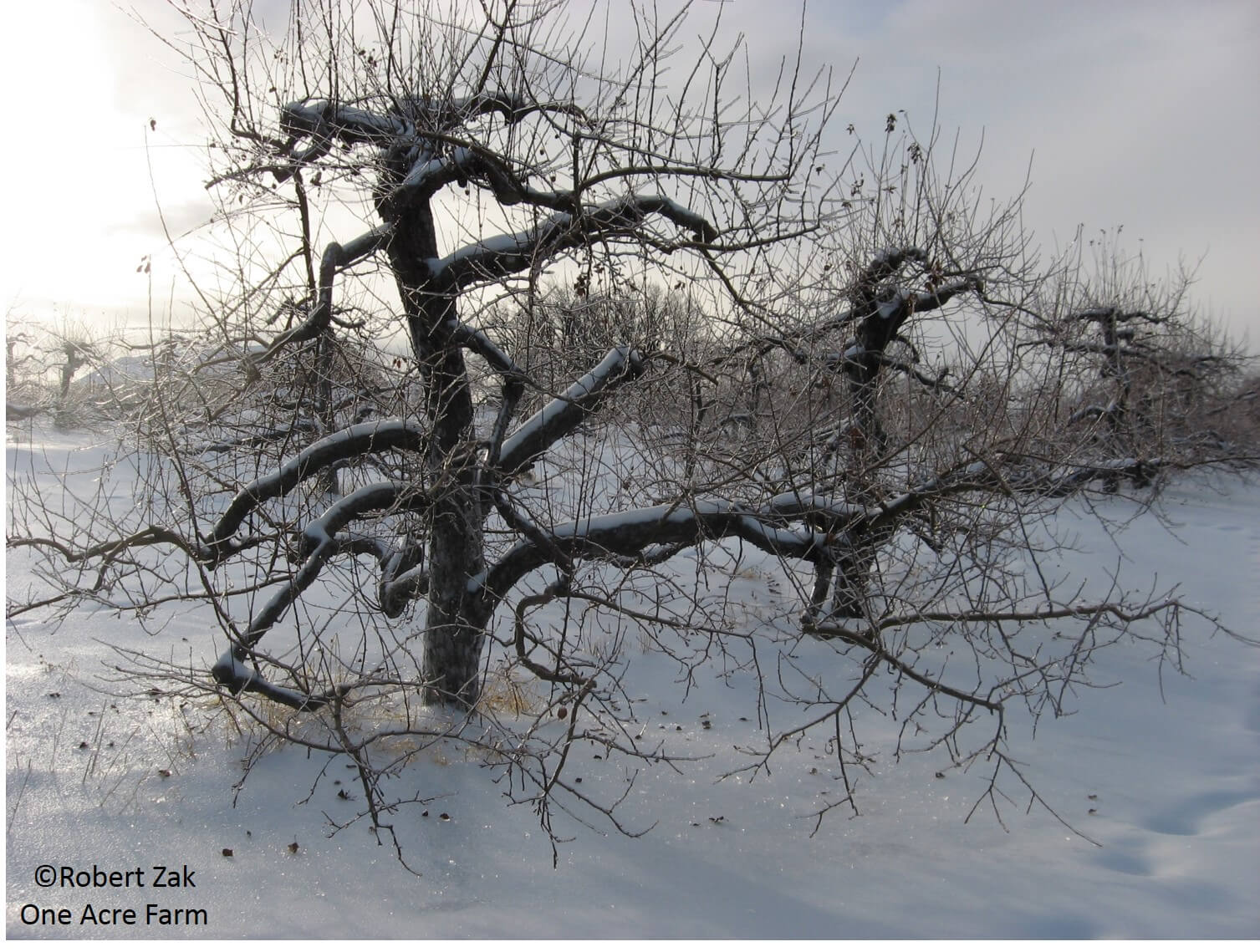
The apple trees in this orchard across the street from our little farm are pruned to have one leader and several stout branches. They’re also topped to limit height.
Pruning branches
Proper pruning of apple trees (5) removes dead and diseased wood, ensures good air circulation in the canopy, controls the height of the tree, and encourages development of strong, stout limbs which can bear the weight of apples. The photo of apple trees in winter shows the branch structure of trees pruned at a local orchard. Note the single leader, the small number of stout branches, and the topping off to limit height. Late winter is said to be the best time for pruning, for the coldest weather is past, and fresh cuts will not be exposed to severe icing.
It’s great to follow these rules, but you can vary the pruning schedule and style to fit your needs. If you’re short on space, you might choose to espalier them or even prune them to grow as a column. We prune our trees less vigorously because we want a slightly fuller canopy to provide shade and cover for our chickens. When we had rabbits, we used to prune gradually over fall and winter, as we fed the twigs to the rabbits. Now we just do all the pruning in late winter.
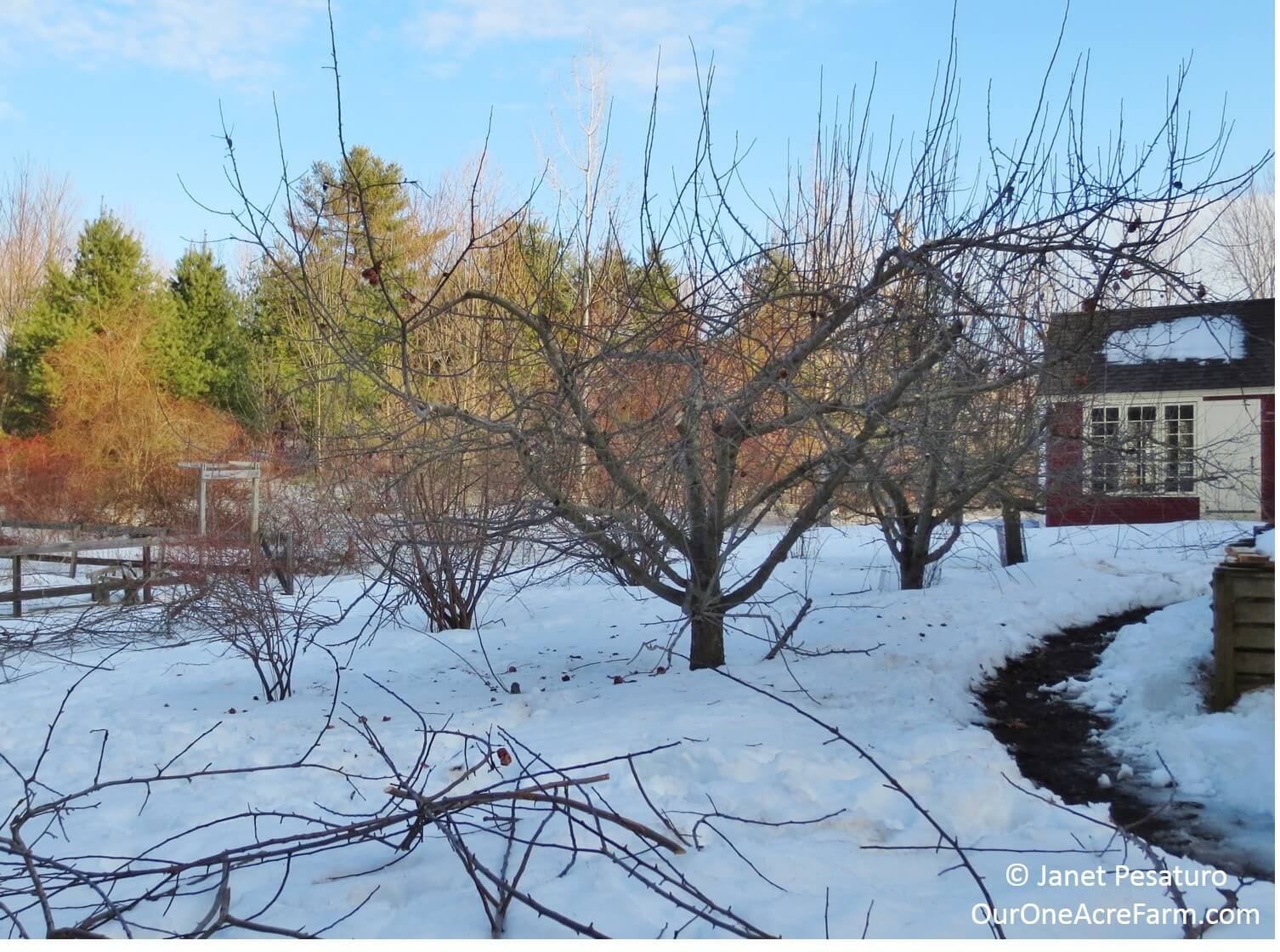
We aim for a slightly denser, spreading canopy when we prune our apple trees, because we need them to provide plenty of shade and protective cover for our chickens.
Thinning blossoms and fruit
Thinning the blossoms or young fruit improves the size of the fruit, improves air circulation, and encourages an even yield from year to year. If you thin young fruit rather than blossoms, you can select for undamaged fruit (6). Now, before I go into detail, I must say that I’ve thinned only once or twice in our 15+ years of growing apples. The reason is that it’s not really worth it for us, because the apples are for our own consumption. Most of them become dried apple rings or applesauce. I don’t care what they look like, as long as they are adequate for those purposes. And, with minimal to no thinning, most of them are. But if you hope to sell them, you may want to grow large, unblemished, well shaped fruit, for that is what customers demand. So pay attention to the following.
The vast majority of modern varieties bear fruit on spurs. A given spur produces fruit only on alternate years, and spurs tend to be synchronized, bearing fruit on the same year. This means that production will be very low on the “off” years. To encourage more even bearing from year to year, pinch off every other flower cluster, so half of them will produce this year, and half will produce next year.
Next, examine the remaining flower clusters. Notice that each consists of 5 flowers. The central one, called the “king blossom”, blooms earliest, and often produces the largest apple. Many people pinch off all but the king blossom, in these remaining clusters. Alternatively, you can wait till the flowers set fruit, and retain the best looking fruit in each cluster, whether it’s the central “king” or not.
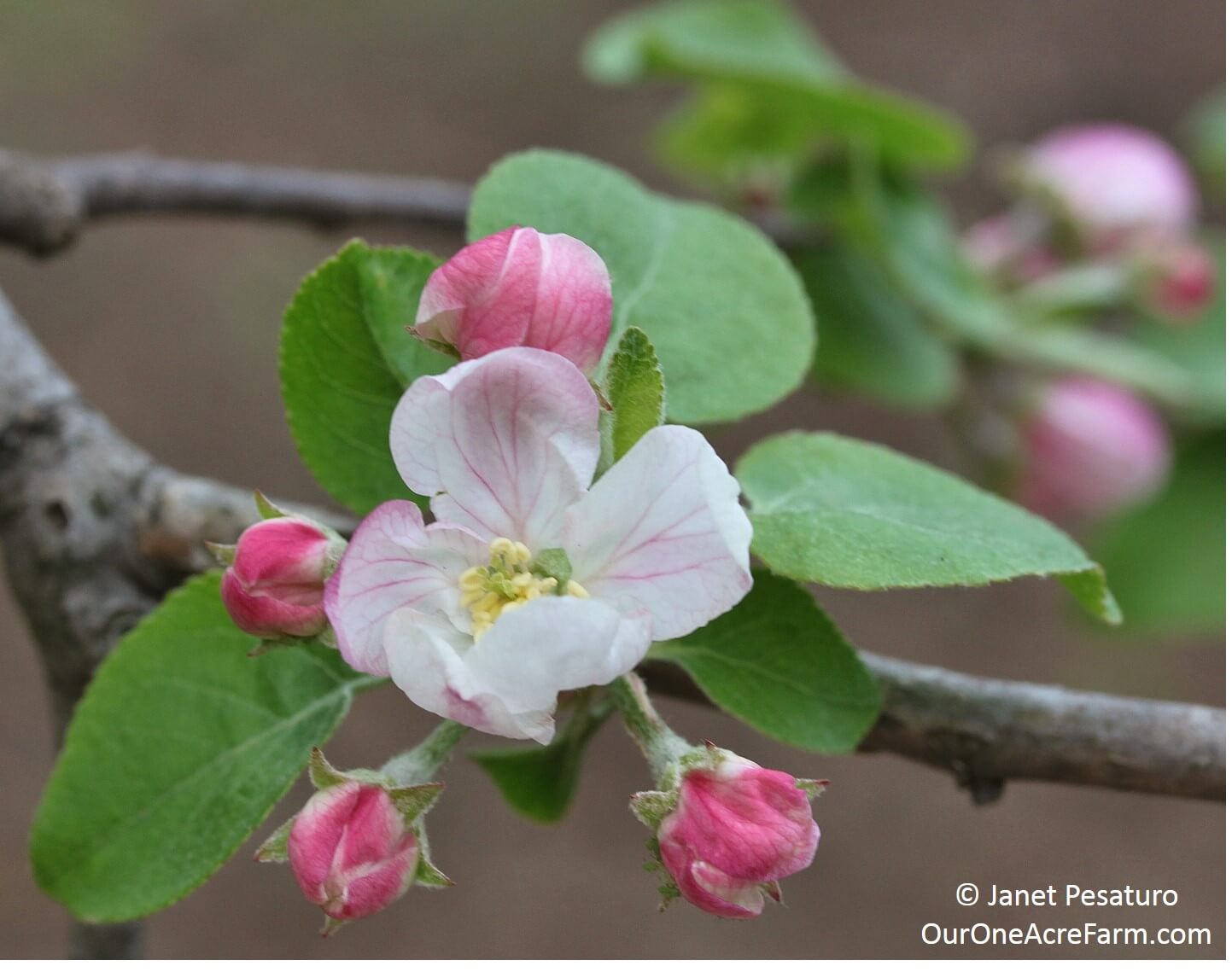
This is what the typical cluster of apple blossoms looks like. There are usually 5 flowers per cluster, and the center one, the “king blossom”, opens first, and often produces the largest, earliest ripening apple. For larger apples, prune off all but the king blossom.
Bagging fruit
This, too, is a labor intensive method which I don’t bother with, since we don’t sell our apples. But to get apples with a beautiful complexion, cover developing fruit early on, preferably by the time they reach 1 inch in diameter. Or, use sticky apple traps to time bagging – see below. Bagging protects the apples from insects and fungal pathogens which create unsightly spots (7). Plain paper lunch bags are not sufficient, unfortunately, because the paper disintegrates in the rain. Many people use plastic ziploc bags or plain plastic bags with twist ties. But that’s a lot of plastic per apple to put in a landfill. You can buy Japanese apple bags (the Japanese came up with the idea of apple bagging), but they are expensive. The best option I have seen is thin nylon socks, as demonstrated in this video on bagging apples:
Be sure to remove bags a few weeks before you expect to harvest so apples can color properly. If you don’t, even red varieties will remain yellow. However, if you use transparent plastic bags, apples may redden even if bags are left on.
Sticky apple traps
Sticky traps are red plastic balls which, like real apples, attract codling moths and Oriental fruit moths, whose larvae bore into apples. The use of a pheromone lure makes these traps more effective. These are more important if you are not going to bag your apples, but sometimes baggers use them just to see when codling moths are arriving. They bag their apples as soon as these moths arrive, to ensure minimal damage.
I’ve used sticky apple traps and pheromone lures several times, and was underwhelmed. They reduced damage only a little, but that may have been my own fault. I used 1 trap and 1 lure for each semi-dwarf trees. Perhaps next time I will use 2 or 3 traps per tree, and add a fresh lure every month.
Sources:
- GMO Compass
- Fruit Tree Friends (from State by State Gardening, Midwest Edition)
- 7 Parts of an Apple Tree Guild (from OpenPermaculture)
- What Kind of Fertilizer Do You Use on Apple Trees? (from HomeGuides)
- Apple Trees Benefit from Proper Pruning (from Oregon State University Extension Service)
- Thinning Fruit (from Arizona Cooperative Extension)
- Bagging Apples: Alternative Pest Management for Hobbyists (from U. of Kentucky College of Agriculture, Food, and Environment)
Please pin THIS image!